
UN Secretary-General, World Bank President and Ministers from Developing and Donor Countries welcome the Famine Action Mechanism
Add us as your preferred source on Google to see more of our content in Search.
 Add to Preferred Sources
On October 13, during the World Bank-IMF Annual Meetings in Bali, Indonesia, World Bank Group President Jim Yong Kim and United Nations Secretary-General António Guterres opened a high-level panel discussion highlighting the Famine Action Mechanism, a new global mechanism dedicated to preventing future famines.
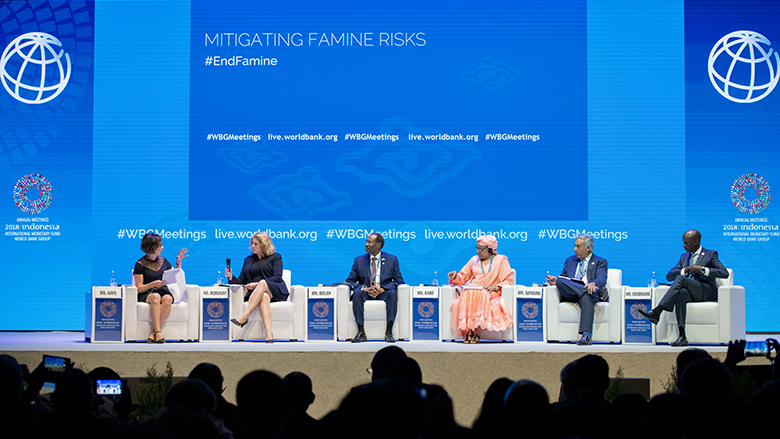
According to Guterres, while efforts to reduce overall poverty are working, the risk of famine continues to threaten more people.
“We are witnessing growth in the world. We are witnessing even a reduction in absolute poverty, but hunger has been on the rise in recent times,” Guterres said. “We need to have a systematic capacity to detect where famine can occur, to prevent it, and then to be able to create conditions of resilience in societies – to make sure that we are able not only to respond to the crisis but to make sure that those crises will not occur.”
“What’s interesting about FAM is that you bring together three things,” Guterres said. “You bring together data – analysis and capacity to detect situations, financing, and implementation. So, the three things, instead of being separated, are put together in a collective response that prevents, reacts, and creates resilience for the future.”
Launched by the UN, World Bank and International Committee of the Red Cross (ICRC) at the UN General Assembly meetings in New York in September, the FAM is a global partnership that seeks to address the risks of famine before they become crises.
The FAM includes support from Amazon Web Services, Google and Microsoft Corp, who are working to improve data and analytics aimed at better predicting famine.
Following the introduction from Guterres and Kim, representatives from countries directly impacted by severe food insecurity shared their experiences and ideas for successfully implementing the FAM. Panelists applauded the FAM’s proactive and collaborative approach and called on its partners to support the agenda of famine prevention, preparedness and early action.
The FAM will be rolled out initially in five countries that exhibit some of the most critical and ongoing food security needs and ultimately will be expanded to provide global coverage. It illustrates the World Bank’s efforts to promote a preventive and preparedness approach to crises and is a concrete application of the Global Crisis Risk Platform (GCRP).
Original source: World Bank
Published on 18 October 2018