

Add us as your preferred source on Google to see more of our content in Search.
 Add to Preferred Sources
Advocates for women’s rights stressed the challenges of obtaining justice for the survivors of violence, and called for an end to impunity for rapists in conflict, as they marked the International Day for the Elimination of Sexual Violence in Conflict.
Nang Pu, founder of the Kachin State Women’s Network and director of the Kachin-based Htoi Gender and Development Foundation, said justice remains out of reach for women survivors of violence in conflict areas, during a panel discussion organized by the Alliance for Gender Inclusion in the Peace Process (AGIPP) in Yangon on Monday.
“Not taking action against the perpetrators is the same allowing them to commit rape. And also there is no security for all women [in the state],”Nang Pu, founder of the Kachin State Women’s Network and director of the Kachin-based Htoi Gender and Development Foundation.
She said impunity still reigns when rapes are committed by Myanmar Army soldiers. The survivors and their families receive threats from the perpetrators not to report the cases.
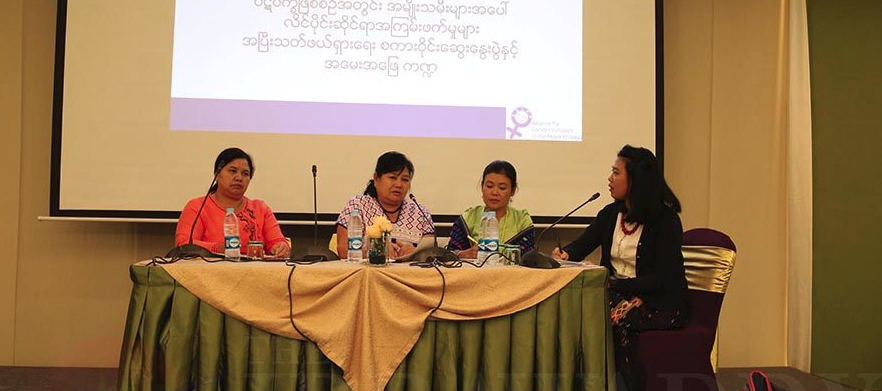
Rape is continually used as a weapon in conflict, said Nang Pu. Rape threatens all women, she said, leading to their insecurity, limiting their freedom of movement, and hindering their development, compared to others.
Traditional ways of resolving rape cases stand in the way of justice, she added, explaining that most rape survivors and their families refer to guidance from a religious leader or teacher. This may lead, she said, to compensation of just 200,000 kyats and some chickens. Or these individuals will try to comfort the survivor instead of reporting the case, she added, as the expenses of a legal process and the idea of dealing with male officers deter them.
Lower House lawmaker Nang Khin Htar Yee of the Shan Nationalities League for Democracy, who is also a member of the Shan State Women Affairs Committee, echoed her words. She said soldiers are responsible for most rapes in Shan State, but result in no arrests, and no transparency of whether action is taken against the perpetrator.
Nang Pu listed recommendations: a 30 percent minimum of women participation at all levels of the peace process; the implementation of the UN Security Council resolutions 1325 and 1820—which relate to women, peace and security issues—by the government and non-governmental organizations; and security for the media to report on sexual violence in conflict.
Source: The Irrawaddy. Read full article here.
27 June, 2017