
Add us as your preferred source on Google to see more of our content in Search.
 Add to Preferred Sources
Indigenous Food systems and indigenous traditional knowledge have survived hundreds and sometimes thousands of years, therefore they may have some of the answers we are looking for, FAO Director-General José Graziano da Silva said.
“FAO considers indigenous and tribal peoples as fundamental actors in the fight against poverty, hunger and all other forms of malnutrition, as well as in the promotion of sustainable agriculture practices,” Graziano da Silva said in a keynote speech wrapping up High-Level Expert Seminar on Indigenous Food Systems held to explore how to build on traditional knowledge to achieve Zero Hunger. Failing to grasp and support indigenous food systems risks losing ancestral knowledge and centuries of know-how.
“The loss of biodiversity, is also the loss of our identity of our foods and medicines, said Taita Ignacio Morales, a traditional healer from the Muiska-Piuret people of Colombia.
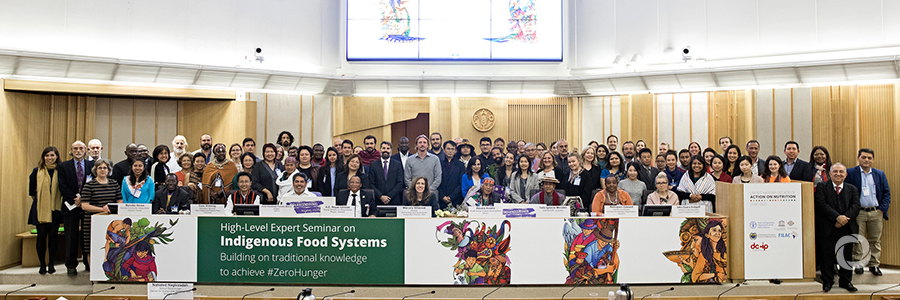
Seventy panelists coming from indigenous communities and organizations; universities; research centers and more than 180 attendees and 49 countries, exchanged their expertise and knowledge on indigenous food systems. By combining presentations on traditional knowledge and expertise from scientific knowledge, the seminar allowed to increase the understanding and contributions that indigenous food systems have been making to the world.
Participants reviewed some of the analytical and field studies done over the past year by a task force set up by FAO and Bioversity International, the Center for International Forestry Research, France’s Institut de recherche pour le développement (IRD) and the Indigenous Partnership for Food Security and Sovereignty, as well as several local indigenous organizations, on how indigenous communities around the world generate food while managing the territory and the environment in a sustainable way.
“In the path to achieve the Zero Hunger Goal we need more efficient food production methods. We need to cease environmentally unsound practices. We need to innovate on and open to all manner of food systems” highlighted Patrick Rata, New Zealand Ambassador.
Co-organized by FAO, UNESCO, UNPFII, FILAC and DOCIP, the expert seminar was an opportunity to exchange knowledge, understandings and concepts, which will be articulated in a future publication. The expert seminar and the publication are key contributions to the global debate on sustainability and climate resilience in the context of the 2030 Agenda and the United Nations Decade of Action on Nutrition.
Along with spurring greater and broader commitment to strengthen the understanding, promotion and preservation of indigenous food systems, the goal of the seminar is to upscale the current indigenous peoples task force into a FAO Technical Network with bolstered links to research institutions, universities, indigenous organizations and other United Nations agencies so as to coordinate activities, and to foster an informal action network to serve as a platform for countries to highlight and support the role that indigenous peoples and their food systems can play in ensuring food security and nutrition.
Original source: FAO
Image source: Flickr
Published on 9 November 2018