
World Antibiotic Awareness Week: Emphasis on preventing antimicrobial misuse across the entire Asia-Pacific biosphere
Add us as your preferred source on Google to see more of our content in Search.
 Add to Preferred Sources
The global tripartite partnership calling for more responsible use of antibiotics in humans, animals and agriculture has announced it is widening its coverage to include the environment sector.
The Food and Agriculture Organization of the United Nations (FAO), World Organisation for Animal Health (OIE), and World Health Organization (WHO) have expanded their partnership to counter antimicrobial resistance (AMR) through the addition of the United Nations Environment Programme (UN Environment). The move is intended to attack AMR in a more holistic way. The new partnership, which will be known as the Tripartite Plus, was announced at the opening of the World Antibiotic Awareness Week (WAAW) observance in Asia and the Pacific.
FAO Assistant Director-General and Regional Representative for Asia and the Pacific, Kundhavi Kadiresan, welcomed the establishment of the Tripartite Plus emphasizing the important role that the environment plays in addressing AMR, pointing out that all antibiotics, whether from manufacturing processes, or passing through humans and animals, can end up in soil and water and the environment, giving microbes further opportunity to build up resistance.
AMR – a major health threat, particularly in the Asia-Pacific region
Antibiotics, while very useful medicines invented to fight off infections, are becoming less effective due to over-prescribing physicians, veterinarians, dentists and their misuse by farmers and agronomists. The resulting resistance that has built up over time has become a global health emergency leading the UN General Assembly to include AMR as a priority health issue to be tackled alongside responses to Ebola and HIV.
World Antibiotic Awareness Week – “handle with care”
The main message of this year’s WAAW is ‘handle antibiotics with care.’ WHO is focusing on food safety while OIE will be promoting the prudent and responsible use of antimicrobials in animals. For FAO, the emphasis is on promoting good farming and biosecurity practices aimed at preventing infection in livestock, aquaculture, and crop production. The overall objective is to strengthen efforts to achieve many of the global sustainable development goals, particularly the goal of zero hunger, by 2030.
This year, in conjunction with WAAW, the Tripartite Plus revisits the global action plan (GAP) on AMR, which sets out responsibilities for national governments, WHO, FAO and OIE as well as for other national and international partners in responding to AMR. Promoting positive behavioural change remains one of the priorities in mitigating the spread of AMR. Strengthening policies and surveillance is crucial as well.
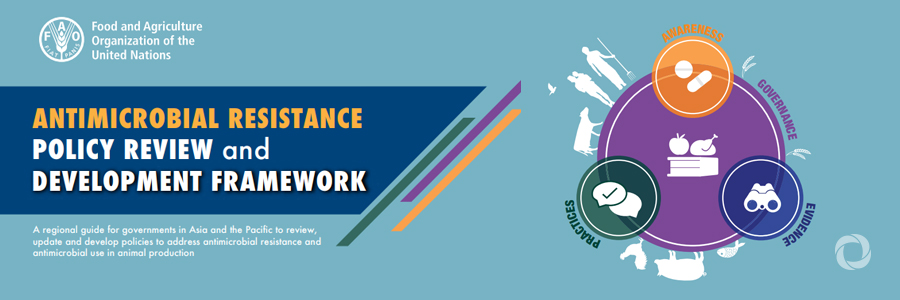
Read and download AMR Policy Review and Development Framework.
Original source: FAO
Published on 12 November 2018