
Add us as your preferred source on Google to see more of our content in Search.
 Add to Preferred Sources
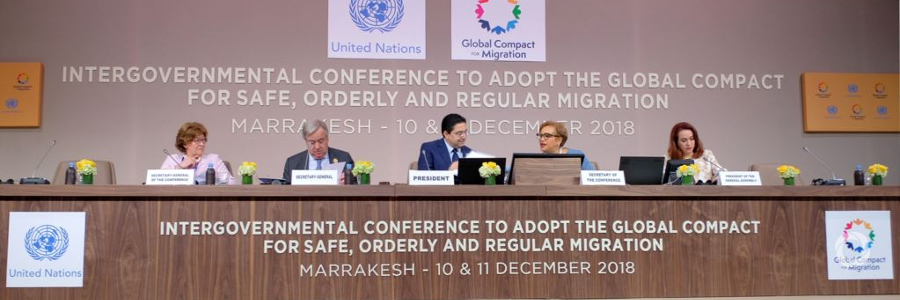
More than 150 governments represented by their Heads of States, Heads of Government or senior officials are meeting in Marrakech on 10 and 11 December at the high-level Intergovernmental Conference to Adopt the Global Compact for Safe, Orderly and Regular Migration.
The Conference is being held under the auspices of the United Nations General Assembly and hosted by the Kingdom of Morocco. In addition to government officials, nearly 400 partners, including high-level representation from civil society and the private and public sectors, and migrants as well, will engage in discussions about innovative partnership opportunities, collaboration and cross-sectoral initiatives with governments.
Louise Arbour, the United Nations Special Representative for International Migration and Secretary General of the intergovernmental conference, emphasized that “the adoption of the Migration Compact is a re-affirmation of the values and principles embodied in the UN Charter and in international law.”
“But it is the implementation of the Global Compact for Migration,” she added, “that will forever change the way the International Community manages human mobility.”
United Nations Secretary-General António Guterres will open the Conference. Other speakers at the opening ceremony include the President of the General Assembly, María Fernanda Espinosa Garcés; President of the International Organization of Employers, Erol Kiresepi; and the co-founder of OneChild organization Cheryl Perera.
The Conference will focus on encouraging creative, cooperative thinking around the full range of the Compact’s objectives with specific discussions on implementation, innovation and partnerships. A plenary debate will provide the Member States with the opportunity to formally announce initiatives and confirm their political commitments to the Compact.
About the Global Compact for Safe, Orderly and Regular Migration:
The Global Compact for Safe, Orderly and Regular Migration (GCM) is the first-ever, intergovernmentally negotiated agreement to cover all dimensions of international migration in a holistic and comprehensive manner. It was born out of the New York Declaration for Refugees and Migrants adopted unanimously by the United Nations General Assembly in 2016 and is the culmination of 18 months of discussions and consultations among the Member States, and other actors, including national and local officials, civil society, private and public sectors and migrants themselves. It provides a platform for cooperation on migration.
- The GCM defines 23 objectives covering all aspects of migration. Each objective comprises a general goal and a catalogue of possible actions, drawn from best practices, that States may choose to utilise to implement their national migration priorities.
- Examples of issues include the call for better data to support evidence-based policies; the need to promote ethical recruitment and decent labor standards; more effective efforts to combat trafficking, clamp down on smuggling and save lives; how to better harness migrants’contributions to development and promote skills exchanges; and the need to strengthen cooperation on facilitating safe and dignified returns and reintegration.
- There are two core elements running throughout the text. First, that national sovereignty must be respected: the migration policies best suited for one country are not necessarily the same for others; subject to existing international law and norms, states remain entirely free to determine their migration policies. And second, that the most effective means of implementing a national migration policy is through international cooperation.
- The GCM is not legally binding. Therefore, no new legal obligations arise under domestic or international law for participating States. The text is an agreed outcome from the intergovernmental negotiations and it is for each State to determine its next steps.
Original source: United Nations
Published on 9 December 2018