
Add us as your preferred source on Google to see more of our content in Search.
 Add to Preferred Sources
Environmental risks continue to dominate the World Economic Forum’s annual Global Risks Perception Survey, accounting for three of the top five risks by likelihood and four by the impact.
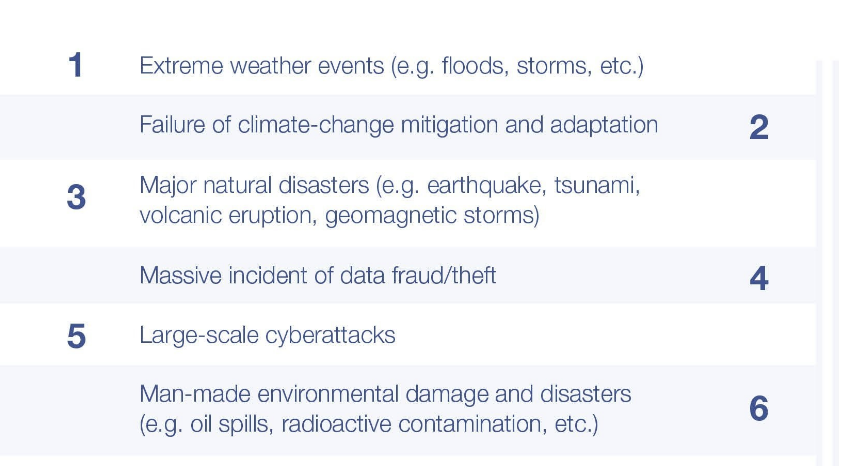
Extreme weather topped the list, but there is mounting concern about environmental policy failure, with the failure of climate-change mitigation and adaptation being the second major risk in terms of impact this year. The results of climate inaction are becoming increasingly clear. The accelerating pace of biodiversity loss is a particular concern. Species abundance is down by 60% since 1970. In the human food chain, biodiversity loss is affecting health and socioeconomic development, with implications for well-being, productivity, and even regional security.
Over a ten-year horizon, extreme weather and climate-change policy failures are seen as the gravest threats.
“Of all risks, it is in relation to the environment that the world is most clearly sleepwalking into catastrophe,” the report warns.
Rapidly growing cities and ongoing effects of climate change are making more people vulnerable to rising sea levels. Two-thirds of the global population is expected to live in cities by 2050 and already an estimated 800 million people live in more than 570 coastal cities vulnerable to a sea-level rise of 0.5 metres by 2050, according to the report.
There are three main strategies for adapting to rising sea-levels: (1) engineering projects to keep water out, (2) nature-based solutions, and (3) people-based strategies, such as moving households and businesses to safer ground or investing in social capital to make flood-risk communities more resilient, says the report.
Sea level rise is just one of the many risks of human-induced climate change which is causing more extreme weather and water stress. The cascading and interconnected challenges demand a holistic approach to tackle multiple hazards and build the resilience of basic infrastructure.
As one of many initiatives to support sustainable development and disaster risk reduction, WMO is developing a Multi-Hazard Early Warning System. Its Global Framework for Climate Services seeks to build resilience and promote climate change adaptation in climate-sensitive sectors including agriculture, health, water management and energy.
Original source: WMO
Published on 21 January 2019