
International Day of Education: UNESCO GEM Report shows insufficient progress on including migrants and refugees in national education systems
Add us as your preferred source on Google to see more of our content in Search.
 Add to Preferred Sources
On 3 December 2018, the United Nations General Assembly adopted with consensus a resolution proclaiming 24 January as International Day of Education, in celebration of the role of education for peace and development. As the world education community gathered in Brussels for the Global Education Meeting, the UN General Assembly voiced a strong message recognizing the foundational role of education for peace and development.
The adoption of the resolution 73/25 “International Day of Education”, co-authored by Nigeria and 58 other Member States, demonstrated the unwavering political will to support transformative actions for inclusive, equitable and quality education for all. By doing so, the international community reiterated that education plays a key role in building sustainable and resilient societies, and contributes to the achievement of all other Sustainable Development Goals as it dedicated a special day to celebrate education worldwide.
Furthermore, SDG 4 (quality education) is one of the Goals up for in-depth review at the July 2019 session of the UN High-level Political Forum on Sustainable Development. The 2019 Global Education Monitoring (GEM) Report, published recently by UNESCO, reveals some alarming data on global progress on education, focusing on countries’ achievements and shortcomings in fulfilling refugee and migrant children’s right to benefit from quality education. The report analyses the linkage between population movements and access to quality education and provides information on how can education make a difference in the lives of people who move and in the communities receiving them.
The report titled, “Migration, displacement and education: Building brides, not walls” shows that the number of migrant and refugee school-age children around the world today has grown by 26% since 2000 and could fill half a million classrooms.
The right of these children to quality education, even if increasingly recognized on paper, is challenged daily in classrooms and schoolyards and denied outright by a few governments. In the two years since the landmark New York Declaration for Refugees and Migrants in 2016, refugees have missed 1.5 billion
days of school.
Nevertheless, there has been progress in the inclusion of refugees in national education systems, as seen in eight of the top ten refugee hosting countries. Champions include low income countries such as Chad, Ethiopia and Uganda. Canada and Ireland are among the global leaders in implementing inclusive education policies for immigrants.
As the Director-General of UNESCO, Audrey Azoulay argues,
“Everyone loses when the education of migrants and refugees is ignored. Education is the key to inclusion and cohesion. Increased classroom diversity, while challenging for teachers, can also enhance respect for diversity and an opportunity to learn from others. It is the best way to make communities stronger and more resilient.”
Refugees: Half of the world’s forcibly displaced people are under the age of 18. Yet, many countries exclude them from their national education systems. Asylum-seeking children in detention in countries such as Australia, Hungary, Indonesia, Malaysia and Mexico, are given limited access to education, if
any. Rohingya refugees in Bangladesh, Burundian refugees in the United Republic of Tanzania, Karen refugees in Thailand and many Afghan refugees in Pakistan can only get an education in separate, nonformal, community-based or private schools, some of which are not certified. Some of these host countries, do not provide refugee learners with the language tuition they will need to achieve social integration and acquire good employment prospects.
Kenya, for example, allows refugees to benefit from its national educational curriculum but does not achieve full inclusion because its refugee learners are living in camps where they are unable to interact with their Kenyan peers. Lebanon and Jordan, who host the largest number of refugees per capita, do
not have the resources necessary to build more schools. They have therefore established separate morning and afternoon school shifts for citizen and refugee children, which limits interaction between the two groups.
The Report recognizes the considerable investments made by countries such as Rwanda and the Islamic Republic of Iran to ensure that refugees attend school side by side with nationals. Turkey has committed to include all refugees in its national education system by 2020, as have seven countries in East Africa.
Uganda has already fulfilled this promise.
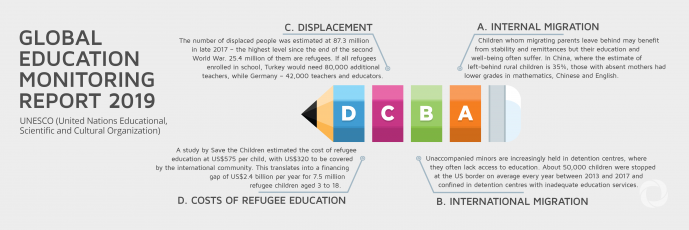
Efforts for inclusion may come to nothing in the absence of enough trained teachers. In Lebanon, only 55% of teachers and staff received specialized training to meet the needs of displaced learners in the past two years. To provide quality education to all refugees, Germany would need 42,000 new teachers, Turkey 80,000 and Uganda 7,000.
Low and middle-income countries host 89% of refugees but lack funds to cope. Donors need to multiply their expenditure on refugee education by three and ensure long term support.
Immigrants: The share of students with immigrant backgrounds in high-income countries has increased from 15% to 18% between 2005 and 2017. They now number 36 million, equivalent to the entire school-aged population in Europe. At current rates, it could rise to 22% by 2030. But immigrant children are not given a fair chance to succeed. In 2017, in the European Union, twice as many young people born abroad left school early compared to natives. First-generation immigrant students in the countries of the Organization for Economic Cooperation and Development (OECD) were 32% less likely than natives to achieve basic skills in reading, mathematics and science in 2015.
Manos Antoninis, Director of the GEM Report, said: “Countries cannot think the job is done once immigrants are in school. They are being excluded in so many other ways. They end up in slower school tracks or in under-resourced establishments in troubled neighbourhoods. Nevertheless,” Antoninis continued, “almost all countries are now signing two global compacts on refugees and migrants, which contain several key education commitments. This could be the much-awaited turning point.”
Canada, with the largest percentage of immigrants among the seven richest industrialized countries, makes sure children learn about migration starting in second grade and has enshrined multi-culturalism in its constitution. Ireland, with the highest percentage of first generation immigrants in the European Union, succeeded in funding an intercultural education strategy while in the midst of a deep financial crisis.
Report recommendations:
1. Protect the right to education of migrants and displaced people
2. Include migrants and displaced people in the national education system
3. Understand and plan to meet the education needs of migrants and displaced people
4. Represent migration and displacement histories in education accurately to challenge prejudices
5. Prepare teachers of migrants and refugees to address diversity and hardship
6. Harness the potential of migrants and displaced people
7. Support education needs of migrants and displaced people in humanitarian and development aid.
Original source: UNESCO