
Add us as your preferred source on Google to see more of our content in Search.
 Add to Preferred Sources
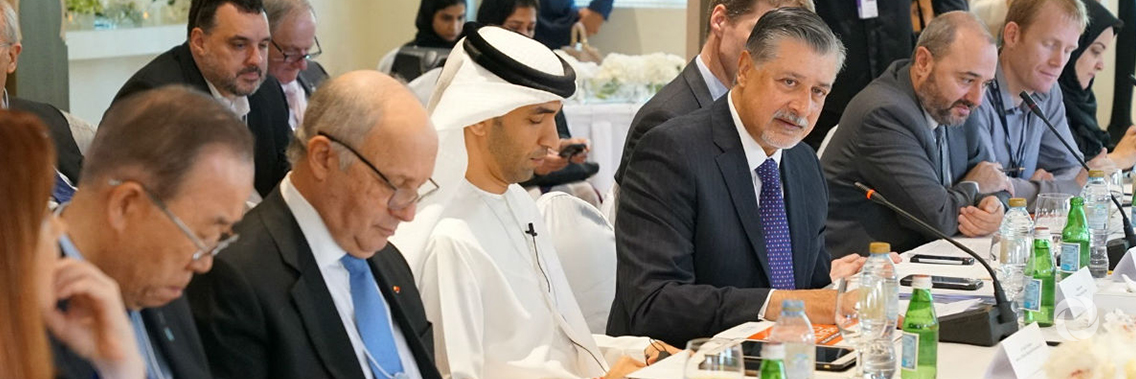
World leaders currently meeting at the World Government Summit in Dubai called for greater ambition and action to fight climate change. The call was sent from the Climate Change Forum which brings together decision-makers, international organisations, senior government officials and businesses from across the world to assess the human and environmental impacts of climate change, identify creative solutions to combat it, and discuss ways of ensuring compliance with the Paris Agreement and the 2030 Agenda for Sustainable Development.
IRENA Director-General Adnan Z. Amin played an integral role in the Climate Change Forum strongly emphasising the crucial role of renewable energy as a cost-effective and economically attractive climate solution.
During a roundtable convened by UAE’s Ministry of Climate Change and Environment and hosted by Minister Dr. Thani Al Zeyoudi, Director-General Amin joined the call for a dramatic scaling-up of action to address the urgent challenges that the world is facing. He stressed that the impacts of climate change compound existing risks and pressures such as population growth, urbanization, environmental degradation, and rising socio-economic inequalities. Climate change also adversely impacts the livelihoods of people by increasing food insecurity, water and land scarcity and unemployment. These consequences, in turn, lead to increased vulnerability amongst the affected population.
IRENA’s analysis shows that accelerating the energy transition in line with the Paris Agreement would significantly outweigh the increase in energy system costs. One of the most important social welfare benefit of the energy transition is the reduction in harm to health from air pollution.
Gains in human health and lower CO2 emissions from fossil fuels would generate savings of USD six trillion annually by 2050, an amount that is over three times larger than the additional cost of decarbonisation. If the higher end estimate is used, then cost savings would be as much as five times larger than the additional cost of decarbonization
An estimated one billion people globally are served by health care facilities without a reliable electricity supply today. Surveys carried out in 14 countries have revealed that only 28% of all healthcare facilities in those countries have fully reliable access to electricity. Off-grid renewable energy solutions are a key opportunity to dramatically improve the quality of health services in energy-poor areas.
Original source: IRENA
Published on 11 February 2019