
Add us as your preferred source on Google to see more of our content in Search.
 Add to Preferred Sources
New home-grown barley varieties developed using irradiation with the support of the IAEA and the Food and Agriculture Organization of the United Nations (FAO) are in the final stages of development and will be ready to be released to farmers for production in coming years.
“Modern plant breeding technologies ensuring sustainability and conservation of scarce natural resources are of paramount importance in achieving national food security and the enhancement of biodiversity,” said Habibah S. Al-Menaie, a senior research scientist in the Desert Agriculture and Ecosystems Program of the Kuwait Institute of Scientific Research (KISR). “Joining the FAO/IAEA coordinated research projects in the area of mutation breeding has led to the development of several barley mutant lines with improved yield and quality under Kuwait’s environmental conditions.”
As arable land is limited to small areas, 95% of the country’s food and animal fodder is imported. Barley is a preferred crop for cultivation because it is relatively drought tolerant and therefore one of the most suitable crops for an arid country like Kuwait. Having high yielding homegrown crops is among the key objectives of the country’s agricultural programme to enhance food security.
The FAO/IAEA support has been key to the success in developing the new barley variety. Through technical cooperation and coordinated research projects, the training in integrated crop mutation techniques as well equipment provided to the KISR plant and soil laboratories have helped scientists to gain a better understanding of how nuclear techniques such a gamma ray induction for crop mutation can help to have better crops, Al-Menaie said.
For barley to grow and produce seeds, soil moisture is critical, for which the FAO/IAEA Programme’s support to KISR’s soil and water section, through training and equipment, has been an added value, she said.
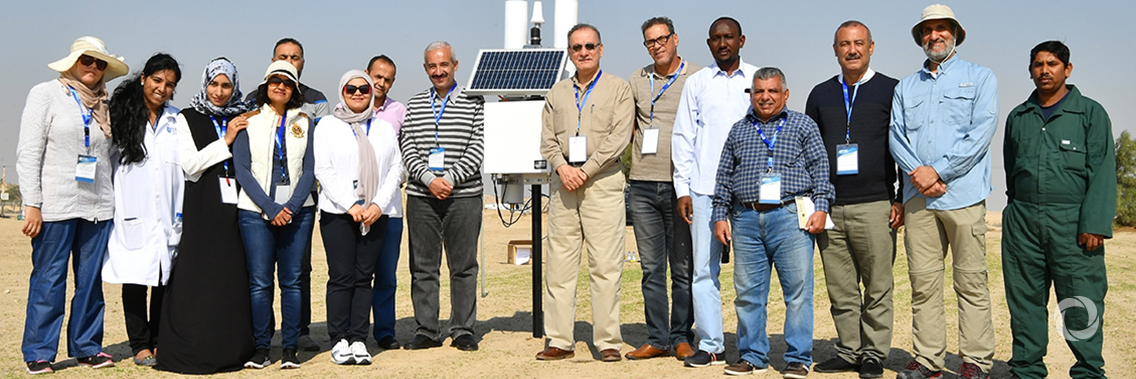
To assess the moisture levels in soil, and to ensure every drop of water is used, the FAO/IAEA experts provided training on soil water management and soil moisture equipment, including the use of the cosmic ray neutron sensor to assess water availability to the crop.
The moisture in the soil is tracked in real time and the data acquired helps develop effective strategies to optimise supplemental irrigation to have soil moist to a level that benefits crop production.
Original source: IAEA
Published on 18 February 2019