
FAO chief calls for innovative approaches and investments to ensure enough water for everyone in the Near East and North Africa
Add us as your preferred source on Google to see more of our content in Search.
 Add to Preferred Sources
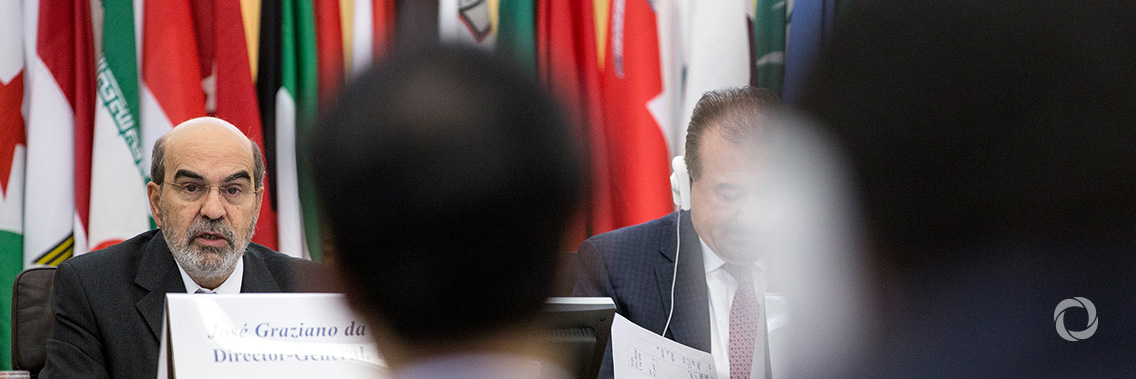
Scaling up innovation, policies and investments in the water sector in the Near East and North Africa (NENA) region is fundamental “to prevent water scarcity from setting us back in our ambitious vision of eradicating all forms of malnutrition, sustaining peace and leaving no one behind”, FAO Director-General José Graziano da Silva said.
He spoke at the Near East and North Africa Land and Water Days Conference, hosted by the League of Arab States and co-organised by FAO, in Cairo, Egypt (31 March-4 April), which aims to review the progress made in addressing water scarcity in the region and foster knowledge-exchange among countries and partners.
Addressing the conference, Graziano da Silva said that while conflicts and extreme climatic events were contributing to the rising of hunger in the region, water scarcity was straining rural livelihoods, forcing people to migrate from rural to urban areas. He noted that “one out of three in the country side are considered poor as a result of water scarcity” in the region.
In order to efficiently tackle water deficits in the region, Graziano da Silva emphasized the need for a “new generation of policies and investments,” pointing to the importance of establishing inter-ministerial coordination between water, food and trade policies as well as putting in place mechanisms that reward farmers for more efficient use of water and soil.
“It is also important to remember that water scarcity does not always emanate from the physical lack of water. Many areas suffer from water scarcity due to the lack of investments,” he stressed.
Graziano da Silva praised countries in the NENA region for their “great achievements in their long and continuous fight against water scarcity.”
“The Gulf countries, for instance, are pioneers in the area of water desalination. Algeria, Morocco, Jordan and Tunisia have undertaken great efforts on water harvesting. Egypt and Lebanon are advancing rapidly in relation to drip irrigation. There is also substantial progress being made on treated wastewater,” he said.
However, the FAO chief noted that despite all this progress, NENA countries should continue to look for innovative practices to face the challenges ahead, which are becoming increasingly complex.
Projections show that the frequency of drought could increase up to 60 percent by the end of the century compared to current levels in the region.
Original source: FAO
Published on 04 April 2019