
Add us as your preferred source on Google to see more of our content in Search.
 Add to Preferred Sources
As a mainstream source of global power generation, the progress of renewable energy over the last decade has been rapid. In 2018, renewables accounted for around a quarter of global electricity and around 16 percent of total final energy use. Its growth has outpaced all forms of traditional power generation over the last five years and has attracted global investment of around USD 1.5 trillion over the last six years. Our power system is evolving faster than many expected.
Less advanced, however, is the degree to which renewable technologies are being utilised to unlock barriers that inhibit the realisation of the sustainable development agenda. Ending poverty, improving human health, achieving sustainable economic growth, and addressing food and water security issues are just some of the Sustainable Development Goals (SDGs) that renewables can support. In fact, a brief launched by the multi-stakeholder SDG 7 Technical Advisory Group in July 2018 outlined the strength of the interlinkages between SDG 7 and other SDGs. “Modern energy offers many benefits,” the report highlighted, saying, “energy is not useful in itself: it is only useful to the extent that it provides desired services and drives actions.”
Ending hunger and all forms of malnutrition, and creating sustainable food production systems, are goals that renewable energy can help achieve. Food production is energy-intensive and around 30 percent of global energy consumption is used to produce, process, and distribute food. Decarbonising the industry’s energy system can save money, boost local development and contribute to climate change mitigation. It can also bolster food security — a growing challenge. Today, one in nine people on the planet is hungry, and the evidence suggests this figure has risen in recent years largely due to unpredictable weather patterns caused by climate change.
A recent IRENA publication, Accelerating geothermal heat adoption in the agri-food sector: Key lessons and recommendations, highlights that while geothermal energy is predominantly known for power generation and district heating, it can serve as a sustainable and effective energy source for food production by heating greenhouses and aquaculture ponds. Furthermore, geothermal energy can be used to minimise post-harvest losses by drying and refrigerating food.
In addition to boosting food security, geothermal energy in the agri-food sector can reduce fossil fuel dependencies, exposure to volatile prices, and harmful emissions.
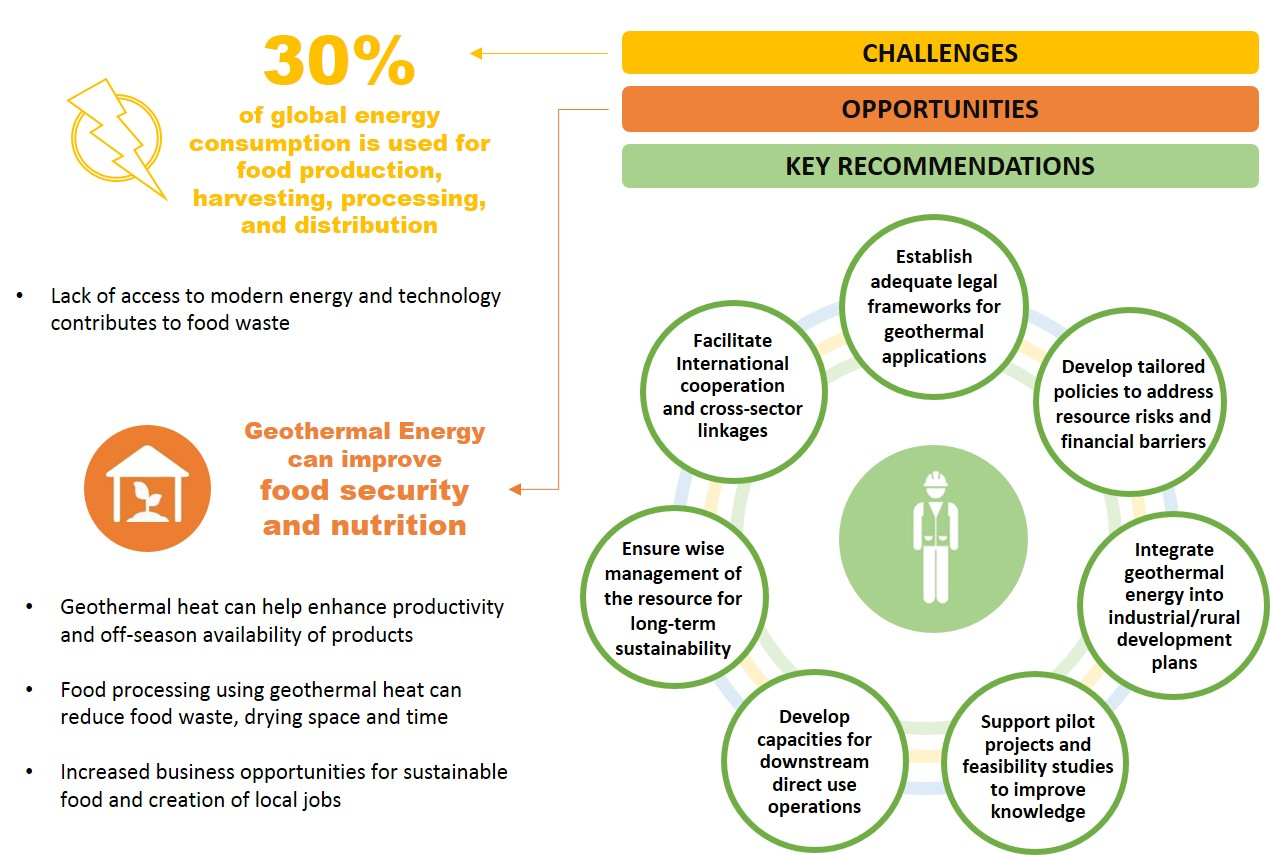
Global geothermal potential remains untapped, however. Today, its total installed capacity in power generation stands at around 14 gigawatts (GW) of electricity — a figure that rises to 70 GW when including geothermal heat use. Yet the potential worldwide remains largely untapped.
IRENA’s report draws on global lessons and best practice to recommend key factors to expand geothermal use in the agri-food sector.
Countries looking to develop geothermal energy applications for food and agriculture can benefit from international platforms such as the Global Geothermal Alliance, which share experiences and insights on technical, policy, regulatory and financial solutions and to explore opportunities for co-operation.
Original source: IRENA
Published on 11 April 2019