
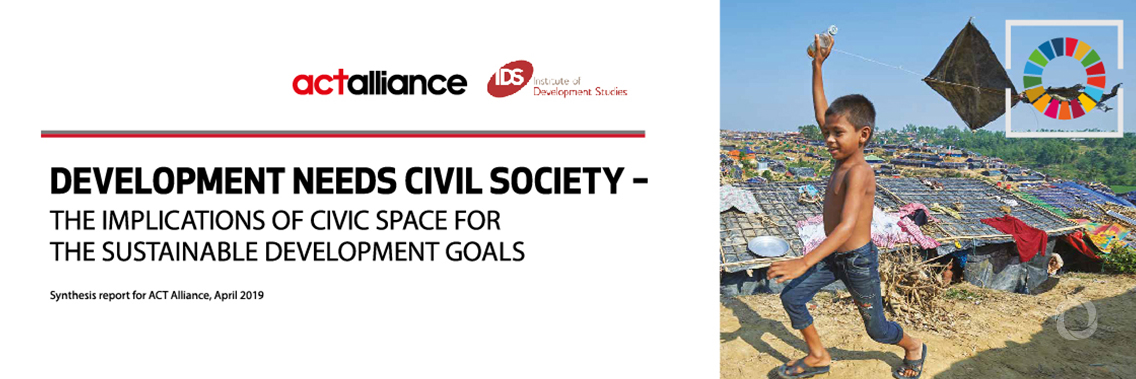
Development needs civil society– The implications of civic space for the sustainable development goals
Add us as your preferred source on Google to see more of our content in Search.
 Add to Preferred Sources
Without a fully engaged civil society, the SDGs are bound to fail. This is the main conclusion of the research and case studies done by Institute of Development Studies (IDS) and published in conjunction with ACT Alliance in the report Development Needs Civil Society– The Implications of Civic Space for the Sustainable Development Goals.
Shrinking civic space is likely to halt or reverse progress towards reducing inequality, ensuring inclusion, and improving sustainability because it is often precisely those who are marginalized who are at the greatest risk of being ‘left behind by development’. Examples in the report show how restrictions on civic space have already affected and are likely to further impact adversely on the number of SDGs, as outlined below. The study concludes that for development to be sustainable over time and for the benefit of all, civic space is needed.
The study was carried out in 2017 and 2018 by IDS for ACT Alliance. It examines civil society in its role and function of enhancing service delivery, collecting information and evidence, analyzing data, holding governments to account, advocacy, shaping public policy, ensuring the voices of vulnerable are considered, defending human rights and contributing to global governance.
Drawing on four country case studies carried out in Brazil, Cambodia, Nepal, and Zimbabwe, and on 12 desk-based country studies, the report analyzes the pivotal role civil society has played in achieving the SDGs.
Read and download the full report: Development Needs Civil Society– The Implications of Civic Space for the Sustainable Development Goals.
Original source: ACT Alliance
Published on 11 June 2019