
Add us as your preferred source on Google to see more of our content in Search.
 Add to Preferred Sources
To ensure inclusive and equitable education as well as decent work for all, we must remove the barriers that keep women and girls – half the world’s population – from accessing opportunities.
In order to participate equally in political, social and economic life, women and girls need mobility. In many societies around the world, sexual harassment in public spaces has long been a barrier to this mobility and a general sense of security, constraining women’s access to education and employment opportunities, outside the confines of home.
In Pakistan, women rely heavily on both private options and public bus services for their transportation needs. Unfortunately, many women find themselves subject to harassment from drivers, conductors, ticket collectors and male passengers. Women from the Khyber Pakhtunkhwa province are all too familiar with the problem.
Traveling by minivan is a common mode of transport for locals. Unfortunately, these small vans are often filled far beyond capacity with both men and women. They do not follow set schedules and stop at unplanned points along routes to pick-up passengers who flag them down.
The level of harassment while traveling has discouraged many women in Pakistan from seeking employment or further education. Others have considered resigning from their jobs or discontinuing their education to avoid necessary commutes on public transport.
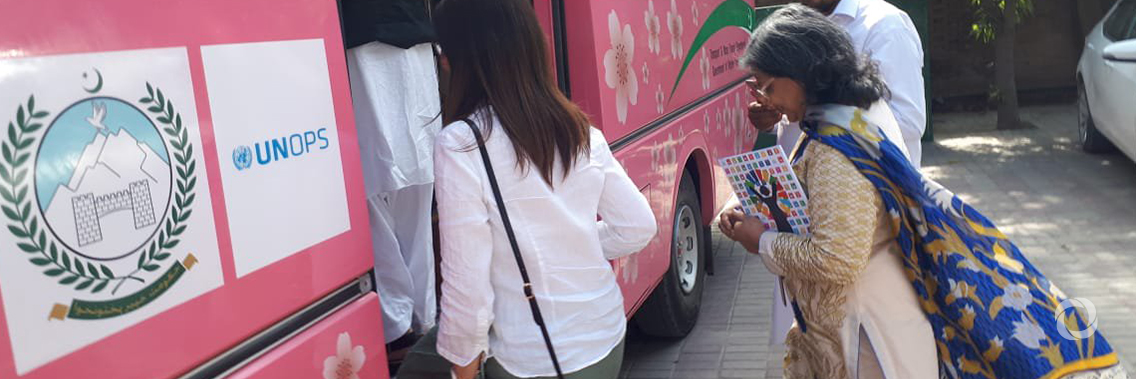
The Sakura bus service is a game changer. In partnership with the governments of Japan and Pakistan and UN Women, UNOPS is helping improve the transportation options available to women from the Khyber Pakhtunkhwa province. Under the project, 14 buses meant exclusively for women passengers and both boys and girls under the age of 12 will run through popular routes in the cities of Mardan and Abbottabad, the most populated areas in the Khyber Pakhtunkhwa province. A public service operated by women conductors, the buses will offer passengers a safe and reliable journey across the city, at a fraction of the cost of private options such as rickshaws and minivans.
The project, which launched earlier this year in both Mardan and Abbottabad, has already generated a sense of security amongst women passengers with one mother saying that the new service will give her peace of mind when her young daughter travels alone.
Original source: UNOPS
Published on 25 June 2019