

Add us as your preferred source on Google to see more of our content in Search.
 Add to Preferred Sources
The Amazon rainforest fires have prompted a global outcry, UN closes down humanitarian programmes in Yemen and the world crisis of water quality cuts economic growth by a third. Here is what you missed from last week’s headlines in the international development sector:
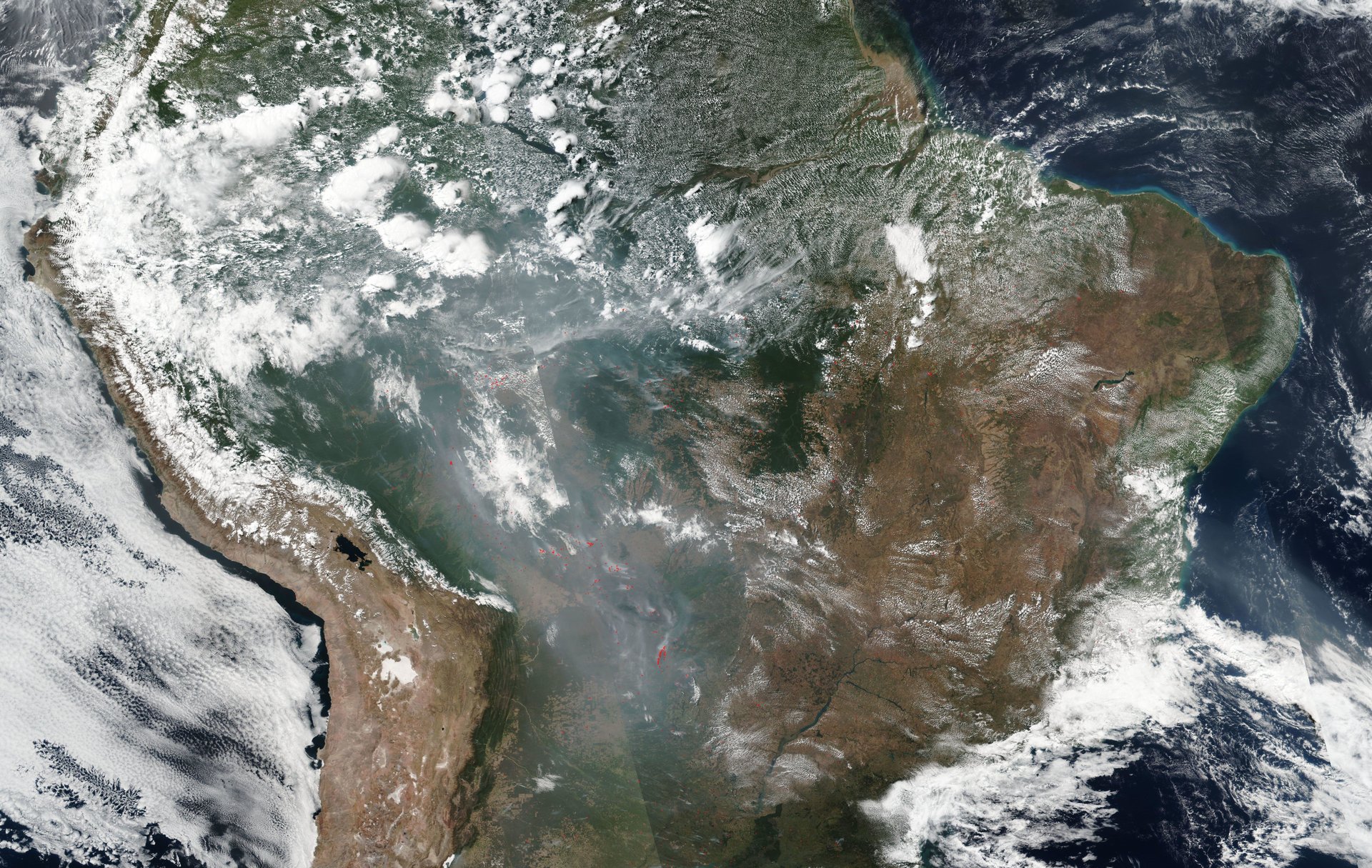
Main story: Amazon rainforest on fire
Thousands of fires are burning in Brazil, many of them in the world’s biggest rainforest – the Amazon. Although the forest fires tend to intensify in this region during the dry season as land is cleared to make way for crops or grazing, the WWF has blamed this year’s sharp increase on accelerating deforestation in the Amazon, which is seen as crucial to keeping climate change in check. Moreover, satellite data published by the Brazil’s National Institute for Space Research (INPE) has shown an increase in fires of 85% this year. The severity of the fires, and the response by Brazil’s government, has prompted a global outcry and protests.
Un Secretary-General tweeted on Thursday that he was ”deeply concerned” by the situation.
“I’m deeply concerned by the fires in the Amazon rainforest. In the midst of the global climate crisis, we cannot afford more damage to a major source of oxygen and biodiversity,” he said on Twitter. “The Amazon must be protected.”
In July, deforestation of the Amazon spiked to a level not seen in more than a decade. According to preliminary satellite data from Brazil’s space agency, trees were being cleared at the rate of five football pitches every minute. Scientists say this year could be the first for 10 years in which 10,000 sq km of Amazon are lost.
Inger Adersen, the UN Under-Secretary-General and Executive Director of the UN Environment Programme, released a statement on Friday, saying that the UN Environment Programme stands ready to work with Member States – including Brazil – in responding to this present crisis.
”Brazil has a long tradition of action to protect the Amazon and we will continue to work with the Government and people of Brazil, providing the science, tools and assessments to guide evidence-based policy, convening Member States to address pressing environmental challenges, and advocating on behalf of the Amazon and other forests across the world.”
UNEP Executive Director added:
”We urge Member States to come together and take necessary measures to extinguish the ongoing fires, to prevent further fires from being started and to protect the Amazon for the benefit of Brazil and the world.”
The Amazon fires was high on the agenda for G7 leaders at a summit in France this past weekend. International leaders gathered at the summit have agreed to provide logistical and financial support to help fight fires in the rainforest, with French President Emmanuel Macron saying G7 countries would release $22m (£18m).
Besides extinguishing the fires, experts say the priority should be building a buffer against the tipping point (after which the Amazon forest will irreversibly degrade into a dry savannah) and drawing down emissions. This means not just protection of the Amazon but massive reforestation, which will require far more financial support than anything seen until now.
Here’s what else has happened
UNICEF: The UN Children’s Fund appealed for more than US$70 million to provide life-saving humanitarian assistance to 900,000 children across Venezuela through the end of the year. Overall, an estimated 1.3 million children and adolescents living in Venezuela need protection services, while over 1 million children are out of school.
Healthy environment: The UN Environment Programme (UNEP) and the UN Human Rights Office signed a new cooperation agreement in an effort to promote and protect environmental and human rights. Strengthened cooperation between the two UN bodies will aim to drive better protection of environmental human rights defenders and their families, who frequently face violence – including killings and sexual violence, smear campaigns, and other forms of intimidation.
Yemen: The United Nations announced that it is being forced to close down several humanitarian programmes in Yemen because money pledged by Member States to pay for them has “failed to materialize”. At a pledging event for Yemen held in February, the UN and humanitarian partners were promised $2.6 billion to meet the urgent needs of more than 20 million Yemenis, but less than half of this amount has been received to date.
Pacific Islands: Pacific leaders issued the ‘Kainaki II Declaration for Urgent Climate Change Now’ – the strongest collective statement the Forum has issued on climate change. In the declaration, the leaders call on the international community to keep commitments made under the UNFCCC, namely, to replenish the Green Climate Fund (GCF) and complete work needed to enable the Adaptation Fund to serve the Paris Agreement on climate change.
Reports
Quality unknown: The invisible water crisis
The world faces an invisible crisis of water quality that is eliminating one-third of potential economic growth in heavily polluted areas and threatening human and environmental well-being, according to a new World Bank report.
Quality Unknown: The Invisible Water Crisis shows, with new data and methods, how a combination of bacteria, sewage, chemicals, and plastics can suck oxygen from water supplies and transform water into poison for people and ecosystems. To shed light on the issue, the World Bank assembled the world’s largest database on water quality gathered from monitoring stations, remote sensing technology, and machine learning.
It found that when Biological Oxygen Demand – a measure of how much organic pollution is in water and a proxy measure of overall water quality – crosses a certain threshold, GDP growth in downstream regions drops by as much as a third because of impacts on health, agriculture, and ecosystems.
The report also finds that as salinity in water and soil increases due to more intense droughts, storm surges and rising water extraction, agricultural yields fall. The world is losing enough food to saline water each year to feed 170 million people.
“Clean water is a key factor for economic growth. Deteriorating water quality is stalling economic growth, worsening health conditions, reducing food production, and exacerbating poverty in many countries,” said World Bank Group President David Malpass. “Their governments must take urgent actions to help tackle water pollution so that countries can grow faster in equitable and environmentally sustainable ways.”
Asia-Pacific Disaster Report 2019
The relentless sequence of natural disasters in Asia and the Pacific the past two years was beyond what the region had previously experienced or was able to predict – and this is a sign of things to come in the new climate reality, according to the latest report by the United Nations Economic and Social Commission for Asia and the Pacific (ESCAP).
The Asia-Pacific Disaster Report 2019 launched reveals that recent disasters, especially those triggered by climate change and environmental degradation, have deviated from their usual tracks and are growing in intensity, frequency and complexity. It is now more difficult to determine which areas should prepare for what kind of disaster.
According to the report, in 2018, almost half of the 281 natural disaster events worldwide occurred in the region, including eight out of the ten deadliest. Moreover, the Asia-Pacific Disaster Report includes for the first time the costs of slow-onset disasters, notably drought which results in a quadrupling of annual economic losses as compared to previous estimates. The annual economic loss for Asia and the Pacific is now $675 billion, or around 2.4 percent of the region’s GDP, of which $405 billion or 60 percent are drought-related agricultural losses, impacting the rural poor disproportionately.
“Countries across the region have committed themselves to the Sustainable Development Goals (SDGs) by 2030 — to ensure that no one is left behind. But they cannot achieve many of the SDG targets if their people are not protected from disasters that threaten to reverse hard-won development gains. This means not just building resilience in the priority zones but doing so across the entire region— reaching the most marginal and vulnerable communities,” said United Nations Under-Secretary-General and Executive Secretary of ESCAP Armida Alisjahbana at the report launch in Bangkok.
The Report also identifies four distinct hotspots in the region where fragile environments are converging with critical socio-economic vulnerabilities. As a result, a person in the Pacific is found to be three to five times more at risk than those in other parts of the region.
Events
3rd Meeting of the Intersessional Process considering the Strategic Approach and the Sound Management of Chemicals and Waste beyond 2020
Bangkok, Thailand
30 September – 4 October 2019
These meetings will support stakeholders in their efforts to elaborate the future arrangements of the Strategic Approach and the sound management of chemicals and waste beyond 2020 for consideration and adoption at the next session of the International Conference on Chemicals Management (ICCM5) to be held in Bonn, Germany, from 5 to 9 October 2020.
6th OECD Forum on Green Finance and Investment
Paris, France
29-30 October 2019
The upcoming forum will discuss emerging green and sustainable finance and investment issues, including the role of central banks in aligning the financial system with environmental objectives; environmental, social and governance (ESG) fund management; clean energy finance and investment mobilisation in emerging markets, and the role of public financial institutions in financing the Sustainable Development Goals (SDGs).
Forêt2019 – Joint Session of the UNECE Committee on Forests and the Forest Industry and the FAO European Forestry Commission
Geneva, Switzerland
4-7 November 2019
The meeting will bring together forestry experts and decision-makers from the region and serve as a policy and technical forum for countries to discuss and address forest issues on a regional basis.
WHO Global Meeting to Accelerate Progress on SDG target 3.4 on NCDs and Mental Health
Muscat, Oman
9-12 December 2019
The World Health Organization is organizing the Global Meeting to Accelerate Progress on SDG Target 3.4 on Noncommunicable Diseases and Mental Health. The overarching goal of the Global Meeting it to accelerate the implementation of national responses to address NCDs and mental health conditions with a view to reduce premature mortality and scale up interventions to reach SDG target 3.4 by 2030.
Global Refugee Forum
Geneva, Switzerland
17-18 December 2019
The aim of the Global Refugee Forum is to accelerate actions by governments, the private sector, international institutions and organisations, the non-governmental sector, and civil society in implementing the new Global Compact on Refugees. The Global Refugee Forum is meant to generate impactful commitments and other pledges from these actors, geared towards making tangible, long-term policy and practice shifts to improve the lives of refugees and host communities worldwide.