
Add us as your preferred source on Google to see more of our content in Search.
 Add to Preferred Sources
Investing in early warning services is critical if countries and communities are to meet the challenge of climate change, the World Meteorological Organization’s Secretary-General Petteri Taalas said as the Global Commission on Adaptation launched a landmark report on the economic benefits of action.
The report has been published ahead of the 2019 Climate Action Summit convened by UN Secretary-General António Guterres on 23 September in New York to boost ambition and accelerate efforts to implement the Paris Agreement on Climate Change.
“It’s highly important that we start mitigating climate change and aim at reaching the Paris targets between 2 and 1.5 degrees Celsius,” said Mr Taalas, referring to the temperature increase limits set out on the 2015 Paris Agreement, which seeks to rein in global warming by curbing greenhouse gas emissions from industry, energy production, transport, and other sources.
“But besides that, it’s highly important that we start paying a growing amount of attention to adaptation, and that’s why the Global Commission on Adaption was established. We are fully behind the goals of this commission and, for us, a very powerful way to adapt to climate change is to invest in early warning services,” he said.
The Global Commission on Adaptation, created in October 2018, brings together leaders from politics, business, multilateral organizations, and science to identify solutions and drive action, and counts Mr. Taalas among its 34 members.
The commission’s report sets out a vision to greater resilience to weather and climate hazards – such as floods and storms – which, without early warning systems, risk turning into economically-damaging disasters.
It finds that adaptation can produce significant economic returns: the overall rate of return on investments in improved resilience is high, with benefit-cost ratios ranging from 2:1 to 10:1, and in some cases even higher.
Specifically, the analysis finds that investing US$1.8 trillion globally in five areas from 2020 to 2030 could generate US$7.1 trillion in total net benefits. Besides early warning, these areas are climate-resilient infrastructure, improved dryland agriculture, mangrove protection, and investments in making water resources more resilient. These areas represent only a portion of the total investments needed and total benefits available.
The report says that climate adaptation can also deliver a “triple dividend”— it avoids future losses, generates positive economic gains through innovation, and delivers additional social and environmental benefits.
It also calls for adaptation that addresses underlying inequalities in society and brings more people, especially people most vulnerable to climate impacts, into decision making. The reality is that those most affected by climate change did the least to cause the problem – making adaptation a human imperative. Without action, it says, millions of people will be pushed further into poverty, leading to increased conflict and instability.
Climate change doesn’t respect borders: it’s an international problem that can only be solved with co-operation and collaboration, across borders and worldwide. It is becoming increasingly clear that in many parts of the world, our climate has already changed and we need to adapt with it.
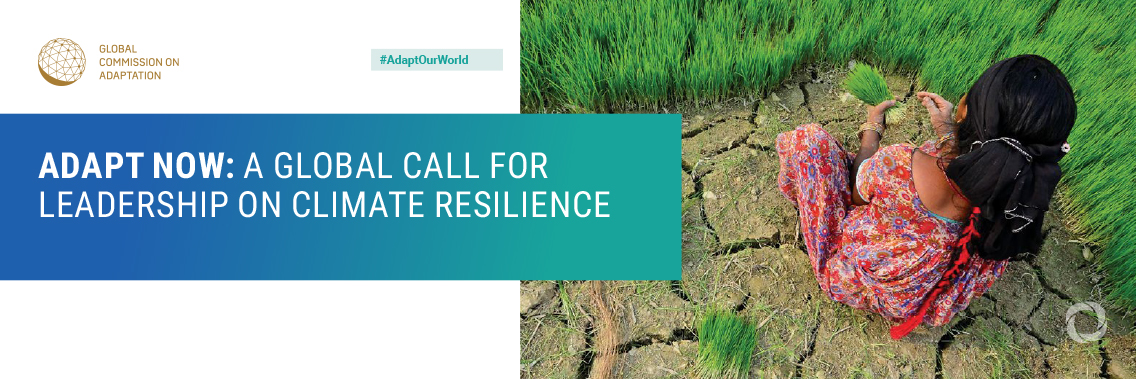
Read and download the report: A Global Call for Leadership on Climate Resilience.
Original source: WMO
Published on 09 September 2019