

Add us as your preferred source on Google to see more of our content in Search.
 Add to Preferred Sources
In 1990, I was the Director of International Cooperation in the Ministry of External Relations and Cooperation in Burundi, my home country. After the first World Summit for Children that year, I was asked to coordinate the Development of a “National Plan of Action (NPA) for the Survival, Protection, and Development of Children” as a follow-up commitment of Member States to the Summit. I was the team leader of an ad hoc committee put in place by the Government of Burundi to work in collaboration with UNICEF.
While designing the NPA, I became very passionate about the results the committee was suggesting for Burundi, including roles and responsibilities of different ministries and partners and all other stakeholders. I felt so excited about it and wanted to be fully involved in the implementation of the Plan. As it turned out, the UNICEF Country Representative in Burundi at that time who was the co-leader of this activity convinced me that this was a possibility.
She said: “Sylvana, I like the vision you are showing in leading this Plan, and I think its implementation would gain in having you provide support to the line ministries, which have to put in place actions to implement the National Plan.”
So I accepted the idea and signed a short-term consultancy with UNICEF. The time I spent with the UNICEF team as a consultant convinced me that it was the place for me, devoting all my time specifically to vulnerable children, as it had always been my dream.
When I was in high school I told my father that I would like to become a nurse. He asked why, and I said because I would love to have an opportunity to devote my time to people who are suffering. I felt I should stand strong to give hope to weak people. My father told me I did not necessarily need to be a nurse to do that.
“You could go further in your studies and get a university degree. I know you are very capable,” he said. “You might have more options to help people in need with a University degree,” he added.
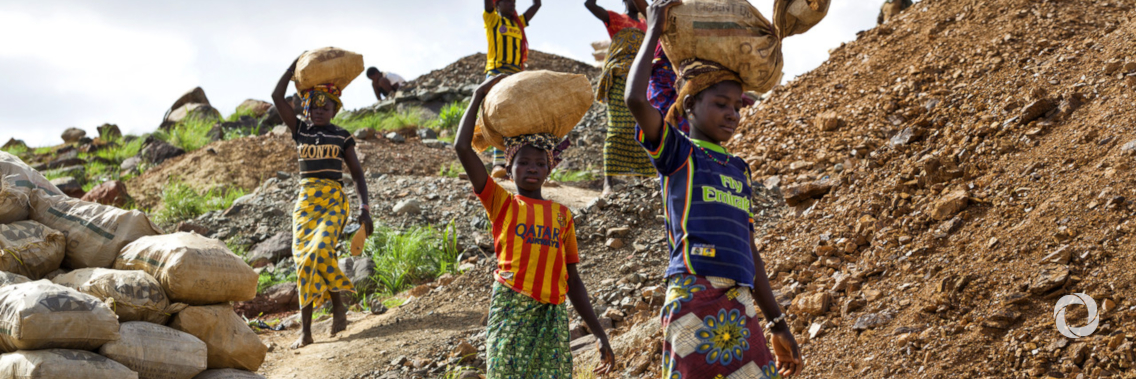
On one of my visits to a gold mine and quarry site in Burkina Faso, while working as UNICEF Country Programme Manager, I was struck at first by the number of very young children on gold mine sites with their mothers or older sisters. Infants were breathing in mining particles and dust, they were tired and hungry, and they should all have been in a caring environment. Other children as young as six were breaking and crushing stones with heavy hammers. They told me that often they work for the whole day and find nothing.
It was a tough scene to confront. I just kept thinking that these could be my children. There was something in particular about Roubiata, who was eight years old. She reminded me of my youngest daughter, who was her age when I was stationed in Haiti. I remember her being proud and excited to show me her grades and comments from teachers when I would pick her up from school. Tears came to my eyes at these good memories that contrasted with the scene before me.
I sat next to Roubiata on a stone, with pain inside me. Her eyes were appealing to me. We started to talk. She told me she began working in the site when she was six.
“My father told me I should come and earn money for my siblings to get food. Very early in the morning, I leave the house, with nothing to eat for the day,” she told me.
After her long and hard day at the gold mine, she would still have to fetch water for her family and prepare the evening meal.
“Auntie,” she said looking up at me, “I want to go to school,” I asked her why. “Because I know children in my village who go to school. They are not tired like I am when they come back in the evening.”
I asked the head of the Community Development Association, one of UNICEF’s partners in a project to remove children from the gold mine, to make sure that Roubiata would be enrolled in school. This is part of what UNICEF supports – helping children in gold mines to go to school.
A few months later I returned to the same site on a regular field monitoring visit. Amazingly, when I walked into the school courtyard the little girl raced to throw herself into my arms. Roubiata had recognized me.
“Auntie, this is my school!” she screamed.
She ran back into her classroom to bring her notebook and showed what she wrote in it with pride. I won’t ever forget how she showed me what a difference we can make in children’s lives. My dream is to see all those 100,000 children in the gold mines in Burkina Faso have the same chance to attend school and to realize their rights.
In my years of experience in humanitarian and development work, the eighteen years with UNICEF have been the most rewarding for me. Touching the populations I work for makes me feel very satisfied on a personal level.