
The most financed sectors before and after the adoption of 2030-Agenda. The numbers behind the outsider sectors.


Add us as your preferred source on Google to see more of our content in Search.
 Add to Preferred Sources
In 2015 heads of state and governments agreed to make the world a better place by 2030 and adopted the 17 Sustainable Development Goals and the 2030-Agenda. Which were the sectors that received the most finance and which were the least financed before the SDGs adoption? Has the picture changed after the 17 SDGs were agreed upon by the world leaders?
DevelopmentAid analyzed the statistical data for the 2014-2015 period and compared those results to the latest available information from 2016-2017. Here are the TOP-3 sectors that benefited from the most Official Development Assistance (ODA) from the country-members of the Development Assistance Committee (DAC) before the adoption of the SDGs in 2015.
The Government & Civil Society sector, with total commitments of 24.8 billion USD, consists of over 15 subcategories such as anti-corruption, human rights, democratic participation and civil society, conflict prevention and resolution. The OECD member providing the highest volume of aid to this sector in this period was the United States, with almost 33% or 8.2 billion USD.
Energy was the second most-financed sector with commitments of 17.9 billion USD. This sector is comprised of the development of renewable and non-renewable resources, the maintenance of energy distribution networks, regulations and other related areas. The country that committed most aid to the development of the Energy sector was Japan, with a share of almost 37% or 6.7 billion USD.
The third most financed sector during the 2014-2015 period was Education. The total commitments for this sector from the DAC countries amounted to 17.2 billion USD. Germany committed the largest amount of aid – 4.1 billion USD – which is almost 24% of the ODA committed to the sector. It was followed by France and the United States, with aid of 2.7 and 2.5 billion USD respectively.
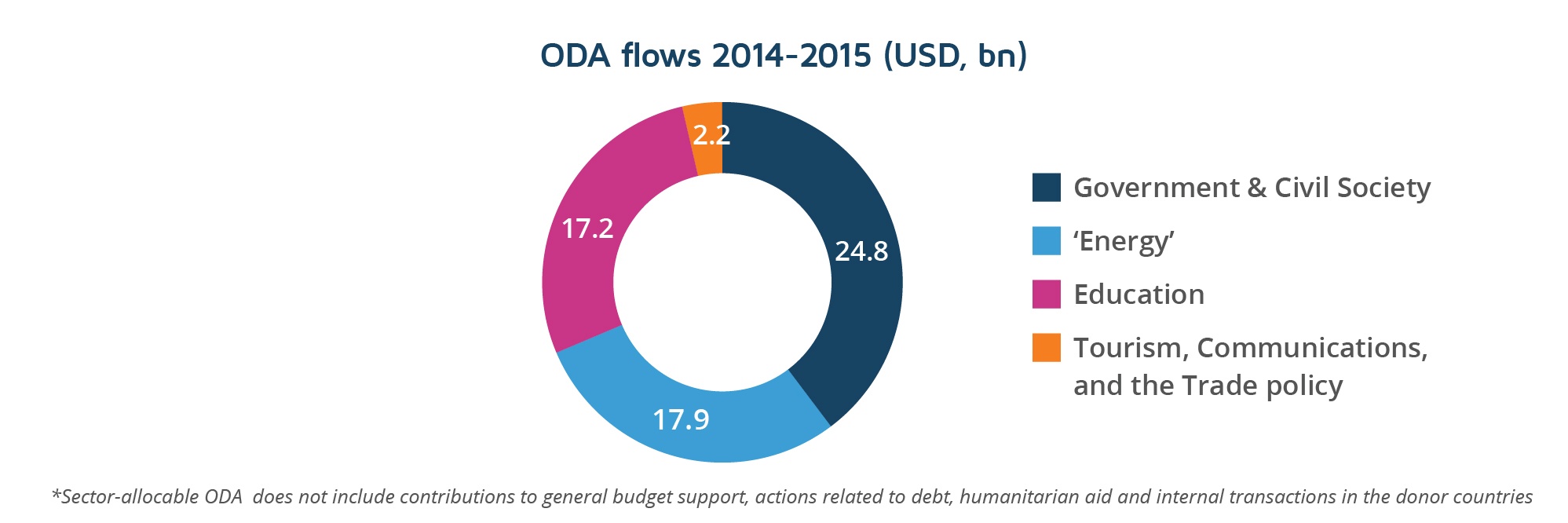
The three most financed sectors in the 2014-2015 period attracted almost 26% or 60 billion USD of the total amount of ODA flow to developing countries provided by the 30 DAC member states.
On the other side of the table, the least financed sectors for the mentioned period were the Tourism, Communications and the Trade Policy sectors which altogether attracted almost 2.2 billion USD or 0.9% of the ODA commitments for 2014-2015.
So, did the picture of international aid distribution commitments change after the historic UN Summit in New York when the 2030-Agenda and its 17 Goals were adopted? The statistics reveal that a slight change in priorities can be observed. Here are the TOP-3 sectors which attracted the highest volume of international aid in 2016-2017.
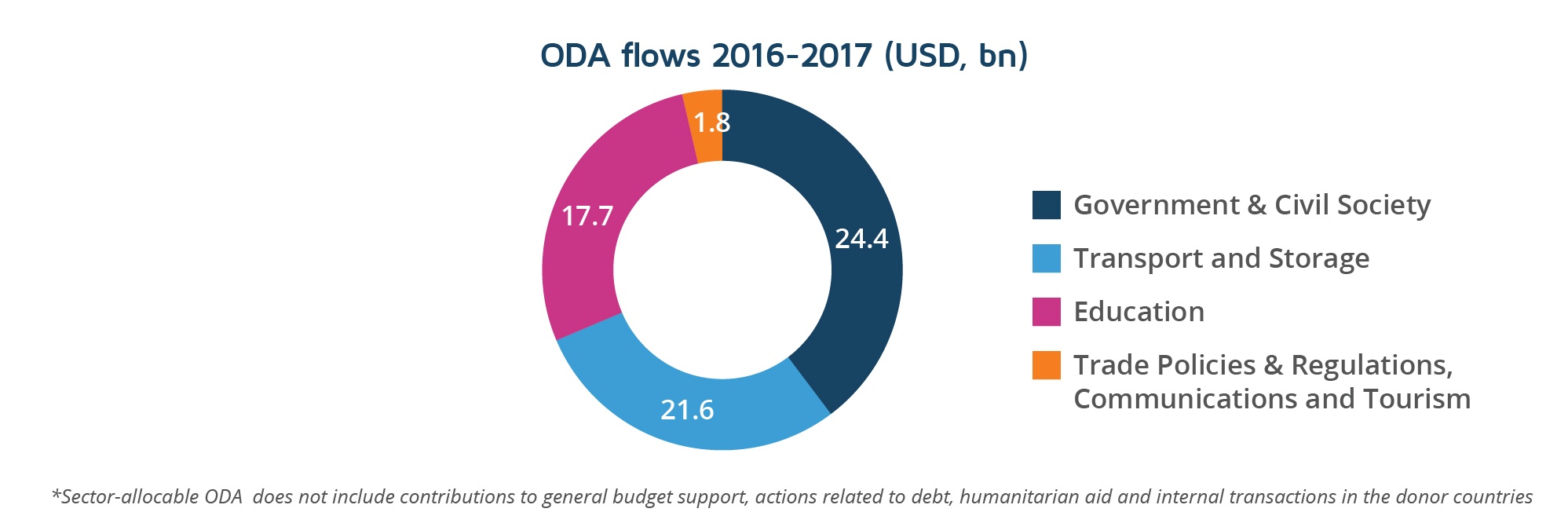
Government & Civil Society continues to be the sector that receives the most aid and the volume of commitments to this sector encountered a slight decrease compared to the previous period, totaling 24.4 billion USD.
Surprisingly, the Energy sector dropped to 5th place in the overall ODA commitment flow chart and was replaced by the Transport and Storage sector. Road repairs and the development of air, water, rail and road transport, as well as other related areas attracted 21.6 billion USD of international aid. The increase in the amount committed to the Transport and Storage sector is explained by Japan’s constantly rising aid allocation: in 2017 this amount was 7.7 billion USD, compared to 4.8 in 2014 (almost a 40% increase) and therefore Japan was the country that contributed the most to Transport and Storage sector aid commitments with 15.8 billion USD or 72% of the total amount of aid attracted by this sector in 2016-2017. Education continues to be the third most-financed sector with 17.7 billion USD allocated by 30 DAC member-countries.
No significant changes occurred in the contributions allocated to the least-financed sectors: Trade Policies & Regulations, Communications and Tourism continue to attract altogether less than 1% of ODA – dropping to 0.7% or 1.8 billion USD in the 2016-2017 period.
Stay tuned to the latest development sector news and articles prepared by DevelopmentAid by registering and subscribing to our Newsletter.