
Add us as your preferred source on Google to see more of our content in Search.
 Add to Preferred Sources
Health expenditure will outpace GDP growth over the next 15 years in almost every OECD country, according to new OECD forecasts. Health spending per capita will grow at an average annual rate of 2.7% across the OECD and will reach 10.2% of GDP by 2030, up from 8.8% in 2018, according to a new OECD report.
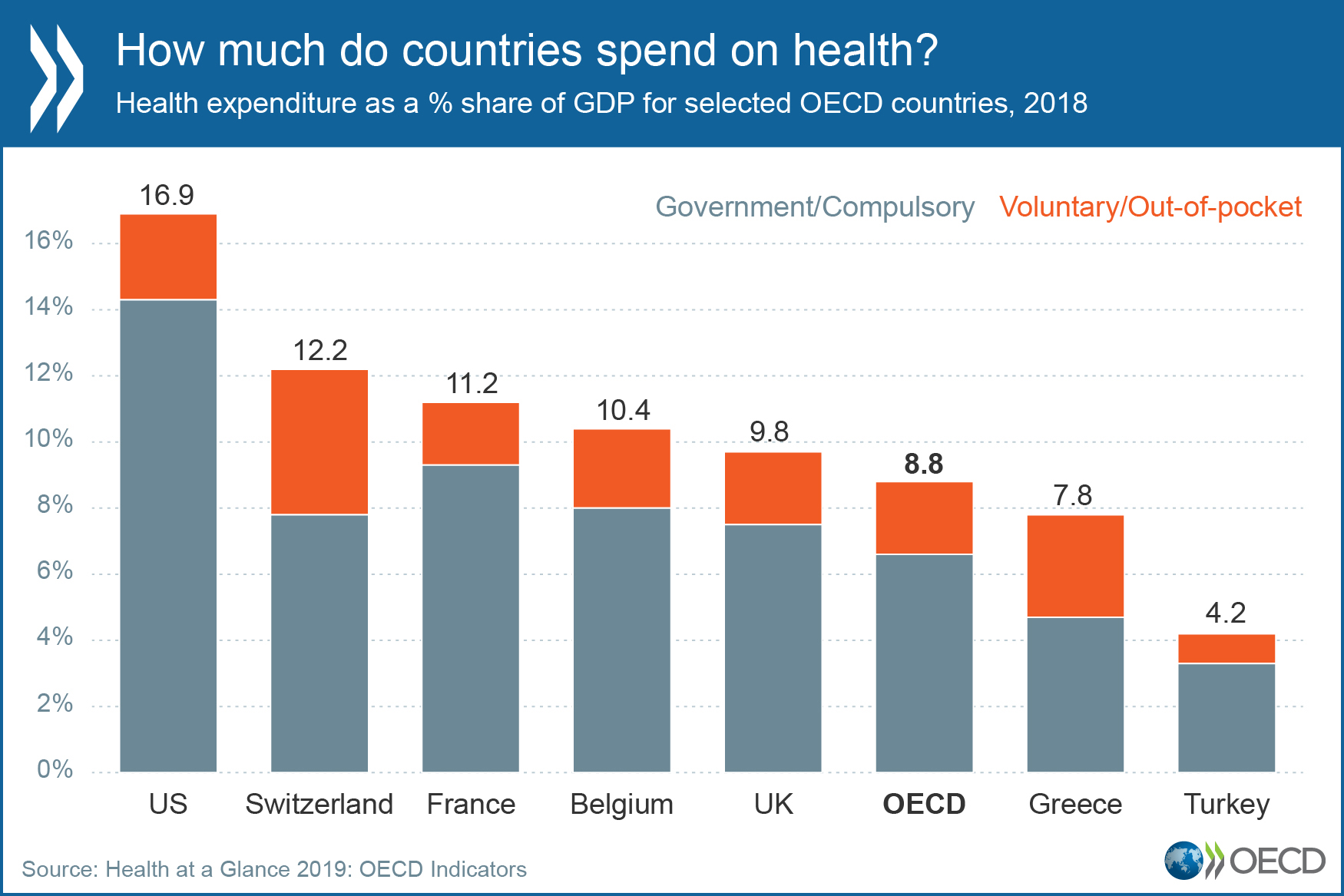
Health at a Glance 2019: OECD Indicators says that the United States spent the most on health care in 2018, equivalent to 16.9% of GDP, above Switzerland, the next highest spending country, at 12.2%. Germany, France, Sweden and Japan all spent close to 11% of GDP, while a few countries spent less than 6% of their GDP on health care, including Mexico, Latvia, Luxembourg, and Turkey at 4.2%
Health at a Glance outlines areas where spending could be more effective:
- Increased use of generic drugs could save costs, but at the moment are only half the volume of pharmaceuticals sold across OECD countries. Generics accounted for more than three-quarters of the volume of pharmaceuticals sold in Chile, Germany, New Zealand and the United Kingdom, but less than one-quarter in Luxembourg and Switzerland in 2017.
- Health and social systems employ more workers now than ever before, with about one in every ten of all jobs in OECD countries found in health or social care. Shifting tasks from doctors to nurses and other health professionals can alleviate cost pressures and improve efficiency.
- Increasing patient safety not only improves health, it can also save money. Almost 5% of hospitalised patients had health care-associated infection in 2015-17.
Health at a Glance 2019 highlights some worrying patterns in health outcomes and unhealthy lifestyles.
A person born today can expect to live almost 81 years on average in OECD countries. But life expectancy gains have slowed recently in most OECD countries, especially in the United States, France and the Netherlands. 2015 was a particularly bad year, with life expectancy falling in 19 countries.
“Health systems can and must do better to improve the health of our populations. Measuring how health systems change people’s lives for the better is essential if we are to put resources where they can have most effect,” said Stefano Scarpetta, OECD Director for Employment, Labour and Social Affairs.
Read and download the Health at a Glance 2019: OECD Indicators.
Original source: OECD
Published on 07 November 2019