
Add us as your preferred source on Google to see more of our content in Search.
 Add to Preferred Sources
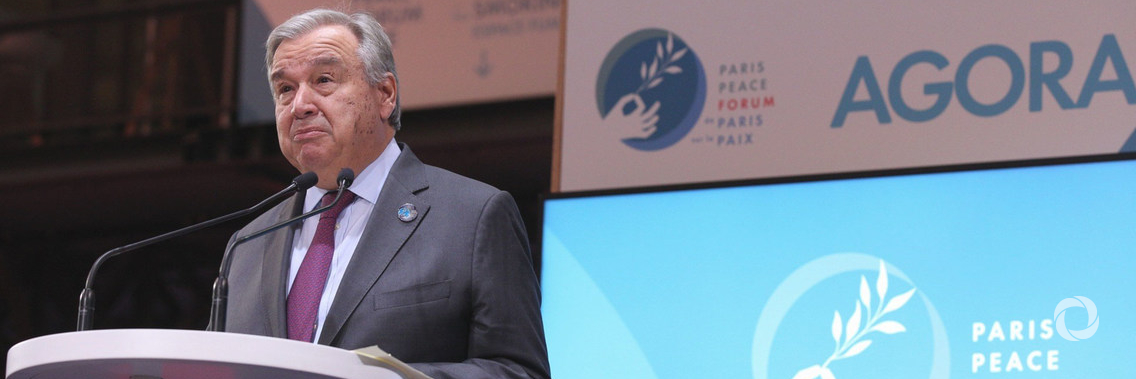
In a speech to the Paris Peace Forum in Paris, UN Secretary-General António Guterres said that to thrive, multilateralism had to adapt, mindful that “conflicts persist, creating suffering and displacement: our world is unsettled”.
Drawing parallels with the geopolitical landscape in the early 20th Century, Mr. Guterres described today’s world as neither bipolar, unipolar, nor multipolar, but rather “chaotic and uncertain”.
The world is facing five major risks, declared the Secretary-General. Firstly, an economic, technological and geostrategic fault line. This sees the planet divided in two, with the two largest economies dividing the world between them, each imposing their own financial and economic rules on their spheres of influence.
“We must do all we can to avoid this ‘Great Fracture’ and preserve a global system, a universal economy that respects international law, a multipolar world with solid multilateral institutions”.
The second risk lies in the social contract between citizens and governments, leading to a wave of demonstrations around the world, said Mr. Guterres, which demonstrates a growing distrust in institutions and political leaders.
“The people are suffering”, he declared, “and want to be heard”.
This leads to a third risk, said the UN chief: a solidarity gap, and rise in inward-looking attitudes, in which the most vulnerable – minorities, refugees, migrants, women, and children – are the first to suffer:
“Fear of foreigners is being used for political ends. Intolerance and hatred are becoming commonplace. People who have lost everything are being blamed for all the world’s ills. This exacerbates the polarization of political life and the risk of divided societies”.
The fourth risk, Mr. Guterres spelled out, is the climate crisis, a “race against time for the survival of our civilization, a race that we are losing”. The UN chief described record temperatures, receding icecaps, expanded deserts, and destructive storms, such as those he has witnessed as UN chief in Dominica, Mozambique and the Bahamas.
“If we fail to act now”, said Mr. Guterres, “history will remember that we had all the means needed to fight back, but that we chose to do nothing”.
A technological divide, declared Mr. Guterres, is the fifth emerging global fault-line, because, whilst new technology has the potential to be a powerful tool for peace and sustainable development, it can also increase risk and accelerate inequalities.
Solutions outlined by the Secretary-General include education systems that integrate lifelong learning, because “we must no longer simply learn, but learn how to learn.”
The Secretary-General concluded his speech with a vision of multilateralism, that can adapt to the challenges of today and tomorrow, and make the UN more effective and agile.
Multilateralism, he said, must be networked, and close to the people, working hand in hand with regional organizations, but also with international financial institutions, development banks and specialized agencies.
It must also be inclusive, he added, with the full participation of civil society, including young people, business, academic and philanthropic circles, and tackle gender equality, an issue that the UN is addressing, with a strategy to achieve parity well before 2030.
The UN chief called for a “sustained strategic vision” to solve the world’s interdependent and long-term challenges, noting that the international community has shown, in the past, that it can come together and rise to the occasion: “So let us fight, fight and not give up”.
Original source: UN News
Published on 11 November 2019