
Add us as your preferred source on Google to see more of our content in Search.
 Add to Preferred Sources
The Energy Community Secretariat’s Annual Implementation Report shows that all Contracting Parties which have coal in their energy mix are not in compliance with the emission ceilings established under their National Emission Reduction Plans (NERPs) for at least one of the three pollutants (nitrogen oxides, sulphur dioxide and dust) of the Large Combustion Plants Directive.
Kosovo failed to comply with the ceilings for all three, while Bosnia and Herzegovina and North Macedonia both failed to reach the ceilings for sulphur dioxide and dust. Ukraine’s 67 plants falling under the NERP narrowly met the emission ceilings this year, while Moldova failed to report its annual emissions of 2018. Given the lack of adoption of the NERP in Serbia, large combustion plants have to comply with the emission limit values of the Directive on an individual basis. For the majority of Serbia’s plants, this is not yet the case with emissions of sulphur dioxide being particularly worrisome.
The Secretariat’s assessment also revealed that a number of power plants subject to the Directive’s opt-out mechanism, which have to cease operation after 31 December 2023 by reaching 20.000 operating hours after 1 January 2018, maybe closing already starting next year. If operated at the same level as in 2018, Montenegro’s Plevja will have to shut down already next year, unless measures are taken for a technical upgrade to meet the stricter emission limit values of the Industrial Emissions Directive. Bosnia and Herzegovina’s Tuzla is next with a foreseeable cease of operation in May 2021, followed by three plants in Serbia, which would reach the end of their 20.000 hours before December 2023 if operation would continue in the same manner as in 2018.
Director of the Secretariat, Mr. Janez Kopač, said: “The clock is ticking for coal-fired power plants in the Energy Community. The situation is especially critical in the Western Balkans as the deadline for some plants to go offline is literally around the corner if they continue to operate at high usage. The Energy Community Contracting Parties must take urgent action on emissions abatement, renewables, and energy efficiency, areas where they need to up their game. The Energy Community does not have time to waste in terms of following in the EU’s footsteps with the adoption of 2030 targets on energy efficiency, renewable energy and greenhouse gas emission reduction”.
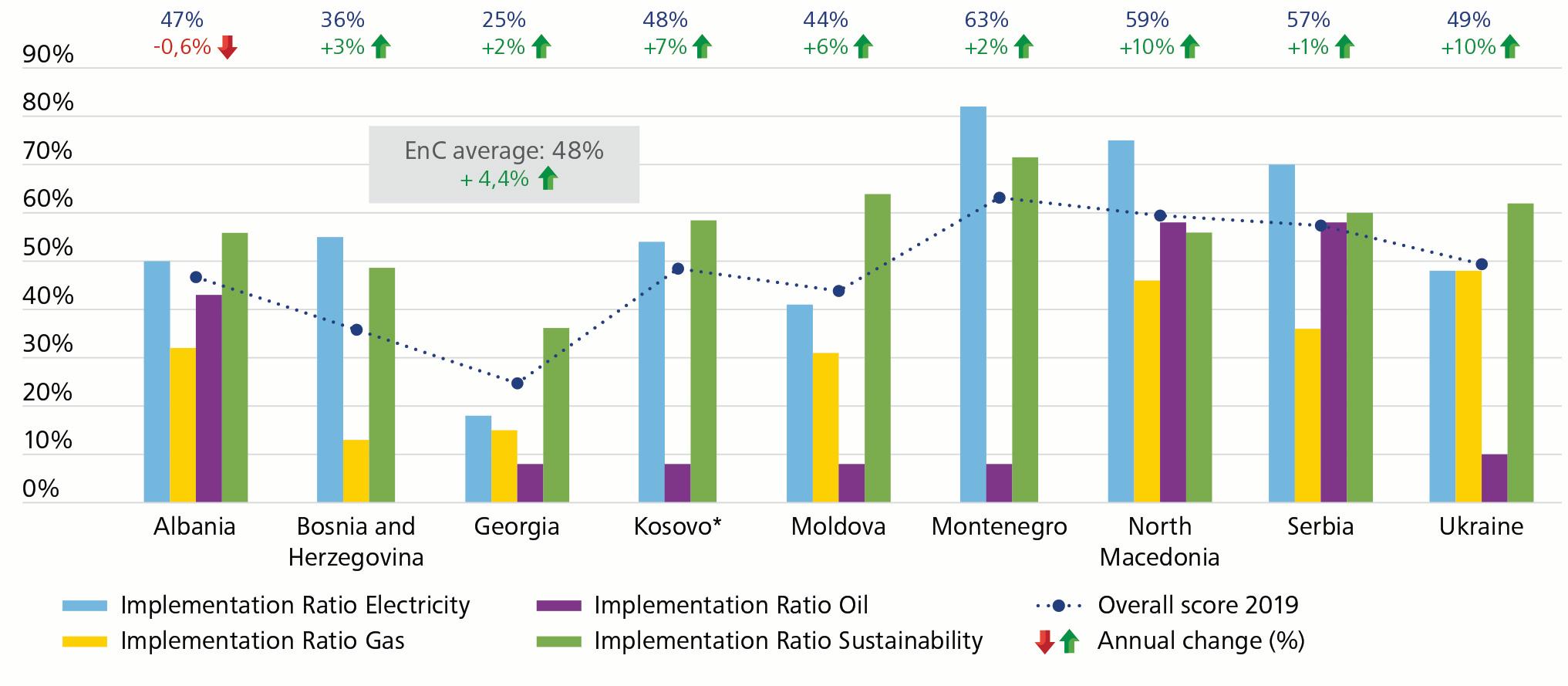
The Secretariat’s Annual Implementation Report 2019 features dedicated chapters on electricity, gas, oil, infrastructure, national regulatory authorities, renewable energy, energy efficiency, environment, climate, competition and statistics. The implementation score has increased from 43% to 48% during this reporting period. While Montenegro remained the leader, for the first time, North Macedonia with its bold reform measures has surpassed Serbia to claim second place. Ukraine, now in fourth place, made a quantum leap in moving from a non-transparent single-buyer electricity market to a governance corresponding broadly to the European target model and finally initiated serious steps towards unbundling Europe’s largest transmission system.
This year’s Implementation Report zooms in on the Energy Community’s enforcement and dispute resolution activities. Since 2008, the Secretariat has investigated 103 cases, with environmental and State aid cases on the rise. Bosnia and Herzegovina remains the country with the largest number of open infringement cases, followed by Ukraine and Serbia.
Read and download the Annual Implementation Report.
Original source: Energy Community
Published on 18 November 2019