

Add us as your preferred source on Google to see more of our content in Search.
 Add to Preferred Sources
WFP and the Government of Myanmar have renewed their strategic partnership, education and sanitation for Palestine refugees and humanitarian aid to help Ukrainians in winter. Here is what you missed from last week’s headlines in the international development sector:
WFP and government of Myanmar renew cooperation to end hunger
The United Nations World Food Programme (WFP) and the Government of Myanmar have renewed their strategic partnership through the signing of a Letter of Understanding.
Under the partnership, WFP and the Government will further boost collaboration for the implementation of WFP’s current five-year Country Strategic Plan (CSP) providing one million conflict-affected people per year in Kachin, Rakhine, Shan and other states and regions with food and nutrition assistance. Resilience-building and emergency preparedness and response activities, at national and state/regional levels, continue to remain a priority.
“The signing of this agreement reflects the strong commitment of the Government towards working hand-in-hand with WFP to tackle hunger and malnutrition in Myanmar, with a view to achieving Zero Hunger,” said Stephen Anderson, WFP Country Director.
Japan contributes over US$ 11 million for food, education and sanitation for Palestine refugees
The Government of Japan signed two contribution agreements amounting to 1,214,000,000 Japanese Yen (approximately US$ 11.15 million) with the United Nations Relief and Works Agency for Palestine Refugees in the Near East (UNRWA).
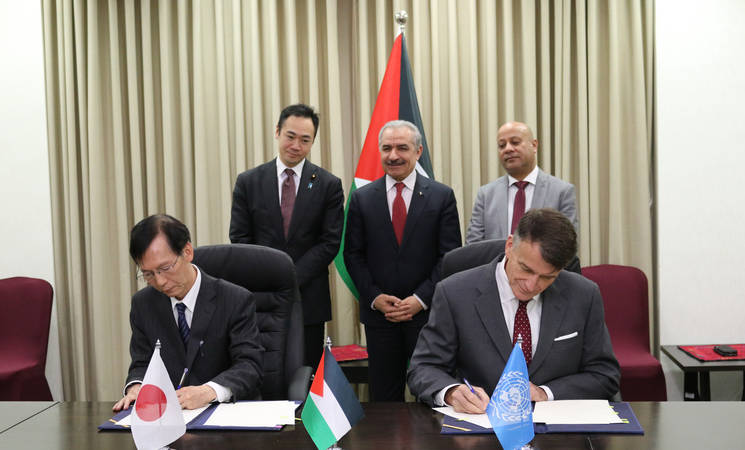
Of this important contribution which will be disbursed in a few days, JPY 600,000,000 (US$ 5.51 million) will immediately enable UNRWA to continue to provide food assistance to 98,000 Palestine refugees in Gaza through the Social Security Net Programme (SSNP) and, thus, help mitigate the impact of poverty and food insecurity to those most in need. An additional JPY 614,000,000 (US$ 5.64 million) will contribute to the construction of a school in the Gaza Strip that will provide 1,000 students access to quality education. This additional contribution will also support the construction of a sewerage system in Ein el-Sultan camp in the West Bank to improve the living conditions there. Both infrastructure projects will be implemented throughout 2020 and 2021.
“I am very happy to share with you that the Government of Japan has decided to contribute over US$ 11 million to UNRWA at this critical time. We are determined more than ever to send a message to Palestine refugees through the assistance that: ‘A friend in need is a friend indeed. Japan will be there with you.’ At a time when the region is experiencing serious humanitarian crisis,” Ambassador Magoshi said.
EU provides €8 million in humanitarian aid to help Ukrainians in winter
The European Commission announced an additional €8 million for the vulnerable people in Ukraine affected by the ongoing conflict in the east of the country. This funding brings EU humanitarian allocation to Ukraine in 2019 to €23 million.
Janez Lenarčič, EU Commissioner for Crisis Management, said: “More than five years of ongoing conflict have exhausted people’s ability to take care of their basic needs. The EU is continuing to help the most vulnerable people on both sides of the contact line. This funding will help them withstand the harsh winter conditions.”
With the new funding, the EU will support conflict-affected civilians in non-government and government-controlled areas, primarily those living along the line of contact, with heating during the harsh winter, as well as access to water. It will also help repair healthcare facilities and schools damaged during the hostilities, facilitate access to healthcare services and supply medical equipment and medicines.
Here’s what else has happened
African Development Bank: The African Development Bank’s Board of Directors has approved a grant to the government of Sudan to accelerate the adoption of solar-powered irrigation pumps in the country’s West Kordofan and North Kordofan states.
Zimbabwe: Last week, the United Nations World Food Programme (WFP) in Zimbabwe completed its last cash distribution of 2019, which supported some 19,000 vulnerable residents in Harare’s sub-urban district of Epworth.
Montenegro: Almost 70,000 people from three municipalities and two residential areas on the Montenegrin coast will enjoy better water supply thanks to an EBRD €24 million loan to finance improvements to the regional water supply network.
Reports
Drop in cholera cases worldwide, as key endemic countries report gains in cholera control
The number of cholera cases decreased globally by 60% in 2018, the World Health Organization (WHO) announced in a report that points to an encouraging trend in cholera prevention and control in the world’s major cholera hotspots, including Haiti, Somalia and the Democratic Republic of the Congo.
“The decrease we are seeing in several major cholera-endemic countries demonstrates the increased engagement of countries in global efforts to slow and prevent cholera outbreaks and shows the vital role of mass cholera vaccination campaigns,” said WHO Director-General Dr. Tedros Adhanom Ghebreyesus. “We continue to emphasize, however, that the long-term solution for ending cholera lies in increasing access to clean drinking water and providing adequate sanitation and hygiene.”
There were 499 447 cases of cholera and 2990 deaths in 2018, according to reports from 34 countries. While outbreaks are still ongoing in various countries, the caseload represents a significant downward trend in cholera transmission that has continued into 2019, according to data collected by WHO.
Read and download the report: Ending Cholera: A Global Roadmap to 2030.
Events
Adaptation Futures 2020
New Delhi, India
27-30 April 2020
Adaptation Futures is the flagship event of the World Adaptation Science Program, which is one of the four components of World Climate Programme (WCP) based on the World Meteorological Organisation Congress XVI Resolution 18. As a premier event in the global adaptation spectrum, Adaptation Futures is a unique platform to facilitate dialogues towards action-oriented solutions from a diverse range of stakeholders that includes academia, practitioners, scientists and policymakers from across the world.
Land and Poverty Conference 2020: Institutions for Equity and Resilience
Washington, DC, USA
16-20 March 2020
The Land and Poverty conference 2020 presents the latest research and innovations in policies and good practice on land governance around the world. This conference has become one of the largest international events on land governance, attracting over 1,400 participants from governments, academics, civil society, and the private sector.
Global Symposium on Soil Biodiversity (GSOBI20)
Rome, Italy
10-12 March 2020
The Global Symposium on Soil Biodiversity (GSOBI20), ‘Keep soil alive, protect soil biodiversity’ will be a science-policy meeting, held over three days at the UN Food and Agriculture Organization (FAO) headquarters in Rome, Italy.
The main objective is to fill some critical knowledge gaps and promote discussion among policymakers, food producers, scientists, practitioners and other stakeholders on solutions to live in harmony with nature, and ultimately, achieve the SDGs through the conservation and sustainable use of soil biodiversity.