
25 years of uneven progress: Despite gains in education, world still a violent, highly discriminatory place for girls
Add us as your preferred source on Google to see more of our content in Search.
 Add to Preferred Sources
More girls are going to school and staying in school than ever before, but remarkable gains in education have made little headway in helping shape a more equal, less violent environment for girls, UNICEF, Plan International and UN Women warned in a new report.
The report, released ahead of the 64th session of the Commission on the Status of Women, notes that the number of out-of-school girls has dropped by 79 million in the last two decades. In fact, girls became more likely to be in secondary school than boys in just the last decade.
Yet, violence against women and girls is still common. In 2016, for example, women and girls accounted for 70 percent of detected trafficking victims globally, most for sexual exploitation. An astonishing 1 in every 20 girls aged 15-19 – around 13 million – has experienced rape in their lifetimes, one of the most violent forms of sexual abuse women and girls can suffer.
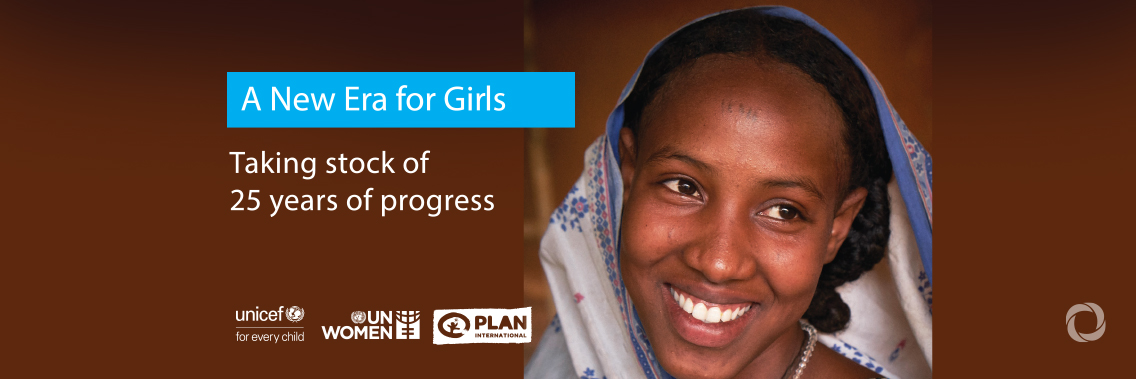
The report, A New Era for Girls: Taking stock on 25 years of progress, is issued in the context of the Generation Equality campaign and to mark the 25th anniversary of the Beijing Declaration and Platform for Action – the historic blueprint for advancing women’s and girls’ rights.
“Since 1995 in Beijing, when a specific focus on ‘girl-child’ issues first emerged, we have increasingly heard girls assert their rights and call us to account. But the world has not kept up with their expectations of responsible stewardship of the planet, a life without violence, and their hopes for economic independence,” said UN Women Executive Director Phumzile Mlambo-Ngcuka. “As long as women and girls have to use three times the time and energy of men on looking after the household, equal opportunities for girls to move from school into good jobs in safe workplaces are going to be out of reach. For everyone’s sake that’s got to change, along with making sure that the skills girls learn are right for the new tech and digital jobs of the future, and that the violence against them ends.”
Girls today are at a startling risk of violence in every space – both online and in the classroom, home and community – leading to physical, psychological and social consequences. The report notes that harmful practices such as child marriage and female genital mutilation (FGM) continue to disrupt and damage the lives and potential of millions of girls globally. Each year, 12 million girls are married in childhood, and 4 million are at risk of FGM. Globally, girls aged 15-19 are as likely to justify wife-beating as boys of the same age.
The report calls for action in the following areas:
- Celebrating and expanding opportunities for girls of all backgrounds, ethnicities, and income and social status levels to be bold and ambitious changemakers and solution designers – actively engaging their voices, opinions and ideas in dialogues, platforms and processes that relate to their bodies, communities, education and futures.
- Increasing policy and programme investments to scale up promising models that accelerate progress for and with adolescent girls aligned to today’s world reality, including their skills development for the fourth industrial revolution and a generational movement to end gender-based violence, child marriage and FGM.
- Increasing investments in the production, analysis and use of high-quality age- and sex-disaggregated data and research in areas where knowledge is limited – such as gender-based violence, 21st-century skills acquisition, adolescent nutrition and mental health.
Read and download the report: A New Era for Girls: Taking stock on 25 years of progress.
Original source: UN Women
Published on 04 March 2020