
Add us as your preferred source on Google to see more of our content in Search.
 Add to Preferred Sources
UN launches COVID-19 plan, $2.5 trillion coronavirus crisis package for developing countries and regional economic growth in developing Asia will decline sharply in 2020. Here is what you missed from last week’s headlines in the international development sector:
UN launches COVID-19 plan that could ‘defeat the virus and build a better world’
The UN chief launched a new plan to counter the potentially devastating socio-economic impacts of the COVID-19 pandemic, calling on everyone to “act together to lessen the blow to people”.
“The new coronavirus disease is attacking societies at their core, claiming lives and people’s livelihoods”, said Secretary-General António Guterres, pointing out that the potential longer-term effects on the global economy and individual countries are “dire”.
The new report, “Shared responsibility, global solidarity: Responding to the socio-economic impacts of COVID-19”, describes the speed and scale of the outbreak, the severity of cases, and the societal and economic disruption of the coronavirus.
UN calls for $2.5 trillion coronavirus crisis package for developing countries
With two-thirds of the world’s population living in developing countries (excluding China) facing unprecedented economic damage from the COVID-19 crisis, the UN is calling for a US$2.5 trillion package for these countries to turn expressions of international solidarity into meaningful global action.
The speed at which the economic shockwaves from the pandemic has hit developing countries is dramatic, even in comparison to the 2008 global financial crisis, says a report published by UNCTAD, the UN trade and development body.
“The economic fallout from the shock is ongoing and increasingly difficult to predict, but there are clear indications that things will get much worse for developing economies before they get better,” UNCTAD Secretary-General Mukhisa Kituyi said.
Developing Asia growth to fall in 2020 on COVID-19 impact
Regional economic growth in developing Asia will decline sharply in 2020 due to the effects of the novel coronavirus (COVID-19) pandemic, before recovering in 2021, according to the Asian Development Outlook (ADO) 2020, the Asian Development Bank’s (ADB) annual flagship economic publication.
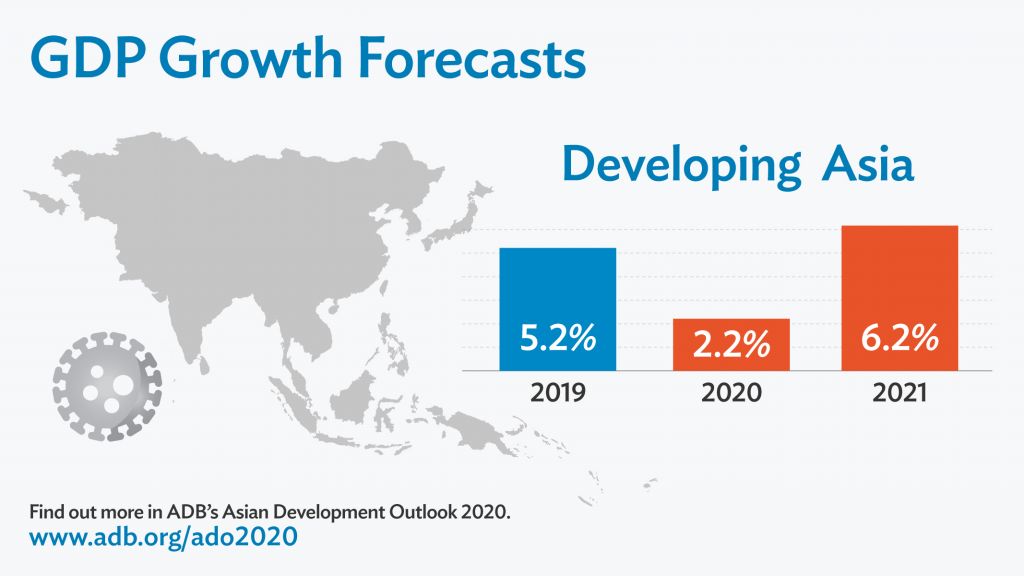
The report forecasts regional growth of 2.2% in 2020, a downward revision of 3.3 percentage points relative to the 5.5% ADB had forecast in September 2019. Growth is expected to rebound to 6.2% in 2021, assuming that the outbreak ends and activity normalizes. Excluding the newly industrialized economies of Hong Kong, China; the Republic of Korea; Singapore; and Taipei, China, developing Asia is forecast to grow 2.4% this year, compared to 5.7% in 2019, before rebounding to 6.7% next year.
DevelopmentAid Editorials
Experts’ Opinions| Challenges and solutions for improving adolescent health in LMIC countries
Investing in the health and development of adolescents is essential for achieving the millennium development goals, promoting public health and ensuring economic development. Not only do adolescents suffer from significant mortality and morbidity, most adult health problems, from HIV to lung cancer and heart disease, but also have their roots in the attitudes and behaviors that begin in the second decade of life. There is an urgent need to invest in adolescent help, particularly in Low to Middle-Income Countries (LMIC) where the needs are greatest and the resources most limited. What do global health experts say about this? Check their answers below.
Australia’s ODA in 2019/20: focus and numbers
Australia’s development strategy aims to promote its national interests and focuses primarily on the Indo-Pacific region, where 90% of its development assistance is directed. The country has allocated US$2.5 billion to development for the year 2019/20 which, in real terms, represents a budget cut, a current trend which is expected to continue in the following years.
Here’s what else has happened
CEB: The Council of Europe Development Bank (CEB) issued a €1 billion 7-year maturity COVID-19 Response Social Inclusion Bond. The funding will be used to support CEB member countries in mitigating the social and economic impact of the ongoing COVID-19 crisis.
WFP: WFP has donated two mobile storage units in support of the Royal Government of Bhutan COVID-19 preparedness and response. The facility will be used to help authorities preposition food to meet the needs of half the population for three months.
EBRD: The EBRD provided a record level of support for trade activity in March as demand rose in response to the impact of the coronavirus pandemic across the emerging countries where it invests. The Bank responded to the economic crisis caused by COVID-19 with the launch of an initial €1 billion Solidarity Package in support of its partners.
France: The United Nations World Food Programme (WFP) welcomes a € 500,000 contribution towards the fight against malnutrition in South Sudan where 1.3 million children under the age of five are expected to be acutely malnourished and in need of urgent treatment this year.
Reports
UN steps up response to climate-related security risks
The United Nations is stepping up efforts to address climate-related security risks amid growing recognition of the role of climate change in exacerbating the risk of conflicts. A new report by the United Nations University (UNU) Centre for Policy Research aims to support both the UN and its partners in developing climate-sensitive approaches to preventing conflict.
Read and download the report: Conflict Prevention in an Era of Climate Change.
UNWTO launches a call for action for tourism’s COVID-19 mitigation and recovery
The World Tourism Organization (UNWTO) has released a set of recommendations calling for urgent and strong support to help the global tourism sector not only recover from the unprecedented challenge of COVID-19 but to ‘grow back better’.
The Recommendations are the first output of the Global Tourism Crisis Committee, established by UNWTO with high-level representatives from across the tourism sector and from within the wider United Nations system.
Read and download the UNWTO Recommendations for Action.
Events
WTO Public Forum 2020
Geneva, Switzerland
29 September – 2 October 2020
The Forum will examine the important role the multilateral trading system has played over the past quarter of a century and will look ahead to how the WTO might be strengthened to address existing and future challenges to trade and the global economy, not least unexpected crises such as the COVID-19 pandemic.
23rd International AIDS Conference (AIDS 2020: Virtual)
Online conference
6-10 July 2020
In the light of the COVID-19 pandemic, AIDS 2020: Virtual, organized by the International AIDS Society, will enable delegates to access and engage with the latest HIV science, advocacy and knowledge traditionally presented at the conference. It will be a compelling combination of virtual sessions and community networking, including exhibitions, workshops, the Global Village, satellites and pre-conferences, that will reach audiences around the world.