
Add us as your preferred source on Google to see more of our content in Search.
 Add to Preferred Sources
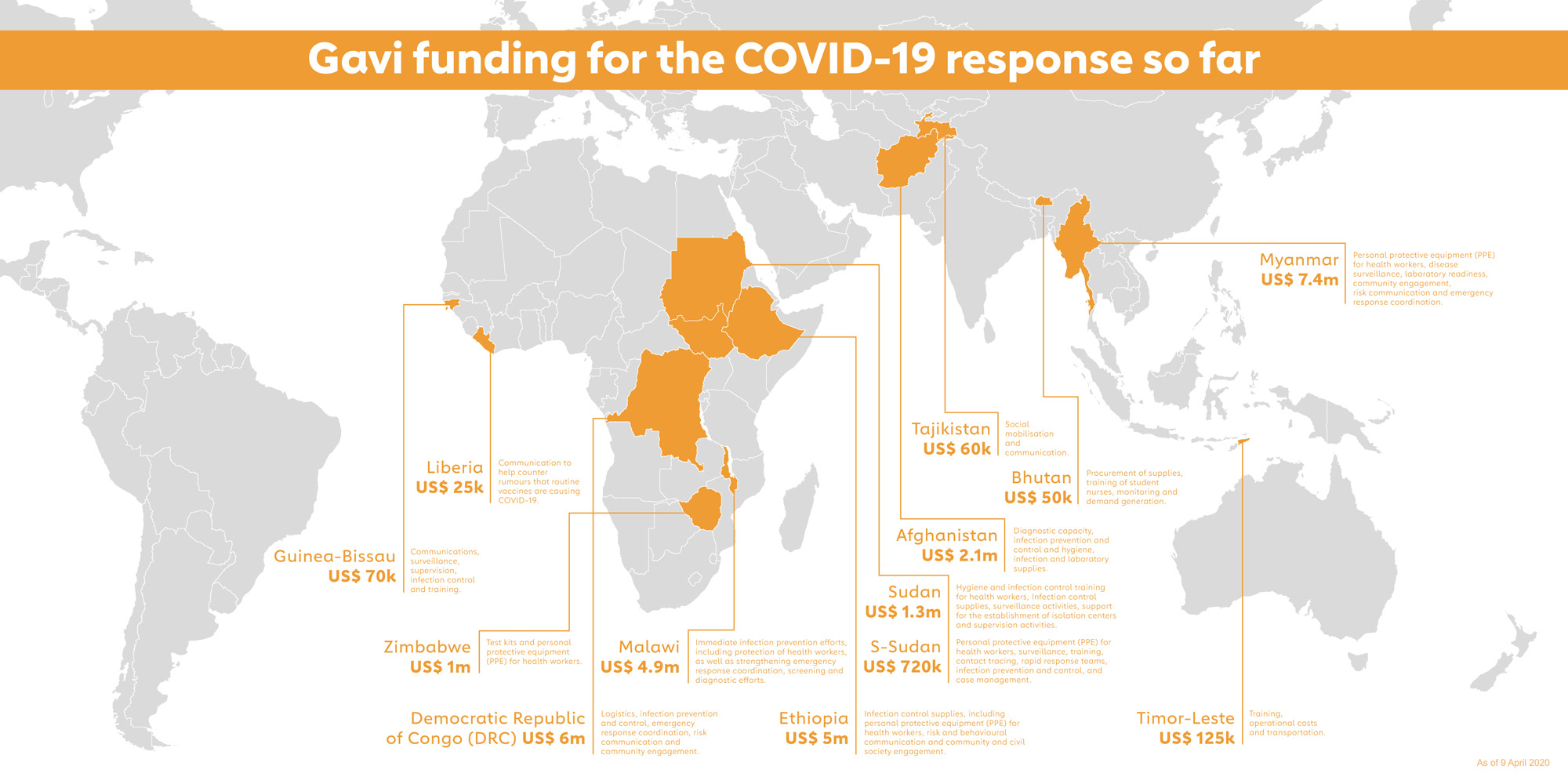
Gavi, the Vaccine Alliance, will provide US$ 29 million in urgent initial funding to 13 lower-income countries to support their response to COVID-19, helping them to protect health care workers with personal protective equipment (PPE), perform vital surveillance and training, and fund diagnostic tests.
There are further requests or interest from 21 countries, meaning more support from a total of up to US$ 200 million is likely to be approved in the coming days and weeks. This early funding is designed to provide immediate support until more substantial support from other sources is unlocked.
The immunisation infrastructure that Gavi has helped build over the past two decades is also being used to help fight the pandemic. Across the world, staff in Ministries of Health and partner organisations trained and funded with Gavi support are now forming part of the COVID-19 response effort. In Karachi, Pakistan, technology funded by Gavi to monitor immunisation is now being used to monitor and track COVID-19 cases.
So far, more than 21,500 cases and 681 deaths from COVID-19 have been officially reported in 66 Gavi-supported lower-income countries, however with the low availability of testing the true number is likely to be much higher. India, Pakistan and Indonesia have reported the largest number of cases, and the spread of the virus is beginning to be reported in sub-Saharan Africa, where the number of countries reporting cases jumped from 5 to more than 30 in less than a week.
A Gavi analysis of Imperial College modelling suggests that, without any mitigation strategies, COVID-19 could lead to 12.9 million deaths in the 73 lowest-income countries, while a UNDP study suggests that income losses in developing countries could exceed US$ 220 billion.
“Health systems across the developing world face their biggest test in living memory, and Gavi is helping them to meet it,” said Dr. Seth Berkley, CEO of Gavi, the Vaccine Alliance. “We are urgently offering vital funding and resources to help countries respond and protect the heroic health workers who will be the front line against this pandemic. Our support goes further than immediate funding: we have spent 20 years helping to strengthen the health systems, recruit and train the health workers, and improve the infrastructure that will now be more important than ever. This work will continue as we stand side by side with countries to both battle COVID-19 and keep immunisation programmes running. This infrastructure will also be critical to the roll-out of eventual COVID-19 vaccines.”
In March, the Gavi Board agreed to make available up to US$ 200 million of its funding for health systems to help countries respond to the COVID-19 pandemic. Gavi is considering further extending its array of support beyond the immediate response to help countries recover more quickly.
The following 13 countries have had applications approved in record time, with the process of gathering applications and doing detailed due diligence to ensure the funding is directed to where it can make the biggest difference taking place in a matter of weeks. Seven further applications are under review. Gavi has also agreed to extend grants to Vietnam, which were set to end in June 2020, until the end of the year.
- Myanmar: US$ 7.4 million approved for personal protective equipment (PPE) for health workers, disease surveillance, laboratory readiness, community engagement, risk communication and emergency response coordination.
- Democratic Republic of Congo (DRC): US$ 6 million approved for logistics, infection prevention and control, emergency response coordination, risk communication and community engagement.
- Ethiopia: US$ 5 million approved for infection control supplies, including personal protective equipment (PPE) for health workers, risk and behavioural communication, and community and civil society engagement.
- Malawi: US$ 4.9 million approved for immediate infection prevention efforts, including protection of health workers, as well as strengthening emergency response coordination, screening and diagnostic efforts.
- Afghanistan: US$ 2.1 million approved for diagnostic capacity, infection prevention and control, and hygiene, infection and laboratory supplies.
- Sudan: US$ 1.3 million approved for hygiene and infection control training for health workers, infection control supplies, surveillance activities, support for the establishment of isolation centers and supervision activities.
- Zimbabwe: US$ 1 million approved for test kits and personal protective equipment (PPE) for health workers.
- South Sudan: US$ 720,000 approved for personal protective equipment (PPE) for health workers, surveillance, training, contact tracing, rapid response teams, infection prevention and control, and case management.
- Timor-Leste: US$ 125,000 approved for training, operational costs and transportation.
- Guinea-Bissau: US$ 70,000 approved for communications, surveillance, supervision, infection control and training.
- Tajikistan: US$ 60,000 approved for social mobilisation and communication.
- Bhutan: US$ 50,000 approved for procurement of supplies, training of student nurses, monitoring and demand generation.
- Liberia: US$ 25,000 approved for communication to help counter rumours that routine vaccines are causing COVID-19.
Gavi has also been working with UNICEF Supply Division, the World Health Organization (WHO) and other partners to mitigate risks of vaccine supply disruption due to current transport restrictions. As a result, no programmatic interruptions have been reported to date due to transport issues; however, vaccine programmes across Gavi countries continue to be severely impacted due to other COVID-19-related issues.
Original source: Gavi
Published on 09 April 2020