
Add us as your preferred source on Google to see more of our content in Search.
 Add to Preferred Sources
The world has changed dramatically in the three months since the last update of the World Economic Outlook in January. A rare disaster, a coronavirus pandemic, has resulted in a tragically large number of human lives being lost.
As countries implement necessary quarantines and social distancing practices to contain the pandemic, the world has been put in a Great Lockdown. The magnitude and speed of collapse in the activity that has followed is unlike anything experienced in our lifetimes.
This is a crisis like no other, and there is substantial uncertainty about its impact on people’s lives and livelihoods. A lot depends on the epidemiology of the virus, the effectiveness of containment measures, and the development of therapeutics and vaccines, all of which are hard to predict. In addition, many countries now face multiple crises—a health crisis, a financial crisis, and a collapse in commodity prices, which interact in complex ways. Policymakers are providing unprecedented support to households, firms, and financial markets, and, while this is crucial for a strong recovery, there is considerable uncertainty about what the economic landscape will look like when we emerge from this lockdown.
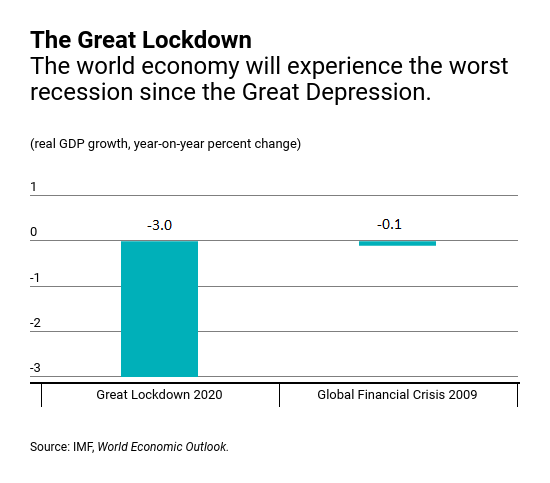
Under the assumption that the pandemic and required containment peaks in the second quarter for most countries in the world, and recedes in the second half of this year, in the April World Economic Outlook, IMF projects global growth in 2020 to fall to -3 percent. This is a downgrade of 6.3 percentage points from January 2020, a major revision over a very short period. This makes the Great Lockdown the worst recession since the Great Depression, and far worse than the Global Financial Crisis.
Assuming the pandemic fades in the second half of 2020 and that policy actions taken around the world are effective in preventing widespread firm bankruptcies, extended job losses, and system-wide financial strains, IMF projects global growth in 2021 to rebound to 5.8 percent.
This recovery in 2021 is only partial as the level of economic activity is projected to remain below the level was projected for 2021, before the virus hit. The cumulative loss to global GDP over 2020 and 2021 from the pandemic crisis could be around 9 trillion dollars, greater than the economies of Japan and Germany, combined.
This is a truly global crisis as no country is spared. Countries reliant on tourism, travel, hospitality, and entertainment for their growth are experiencing particularly large disruptions. Emerging market and developing economies face additional challenges with unprecedented reversals in capital flows as global risk appetite wanes, and currency pressures, while coping with weaker health systems, and more limited fiscal space to provide support. Moreover, several economies entered this crisis in a vulnerable state with sluggish growth and high debt levels.
For the first time since the Great Depression both advanced economies and emerging market and developing economies are in recession.
In the meantime, we face tremendous uncertainty around what comes next. Commensurate with the scale and speed of the crisis, domestic and international policy responses need to be large, rapidly deployed, and speedily recalibrated as new data becomes available. The courageous actions of doctors and nurses need to be matched by policymakers all over the world so we can jointly overcome this crisis.
Read and download the World Economic Outlook.
Original source: IMF
Published on 14 April 2020