
Add us as your preferred source on Google to see more of our content in Search.
 Add to Preferred Sources
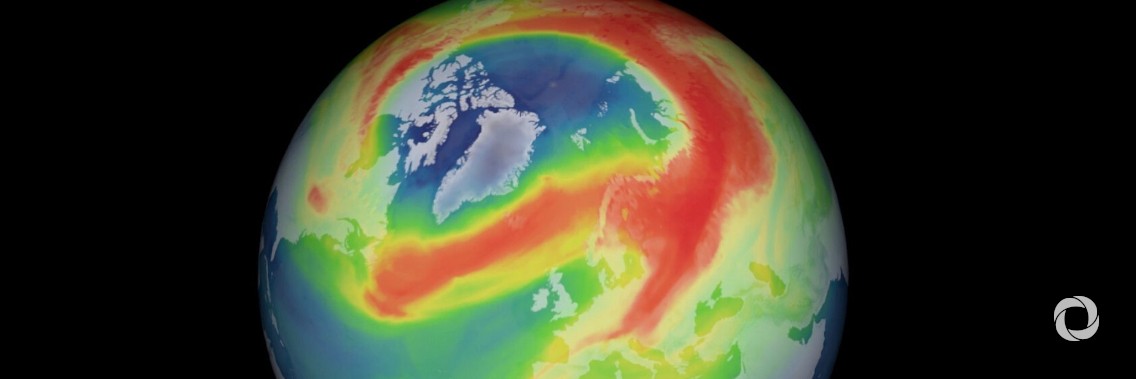
Depletion of the ozone layer, the shield that protects life on Earth from harmful levels of ultraviolet radiation, reached an unprecedented level over large parts of the Arctic this spring.
This phenomenon was caused by the continuing presence of ozone-depleting substances in the atmosphere and very cold winter in the stratosphere (the layer of the atmosphere between around 10 km and round 50 km altitude).
The last time similarly strong ozone depletion was observed over the Arctic was during spring 2011, and ozone depletion in 2020 was even stronger.
The ozone hole closed in April with an increase in stratospheric temperatures which culminated in an influx of ozone-rich air from the lower atmosphere.
The depletion would have been even worse if it had not been for a successful international agreement called the Montreal Protocol on Substances that Deplete the Ozone Layer. This led to a phaseout of substances such as chlorofluorocarbons (CFCs). But they remain in the atmosphere for several decades and their concentrations are still high enough to cause severe ozone destruction.
“The Arctic stratosphere continues to be vulnerable to ozone-depleting substances linked to human activities,” said WMO Secretary-General Petteri Taalas. “The degree of ozone loss experienced in any particular winter depends on the meteorological conditions. The 2020 ozone loss shows that we have to remain vigilant and maintain continuous observations,” said WMO Secretary-General Petteri Taalas.
The formation of an ozone hole is driven by extremely cold temperatures (below -80°C), sunlight, wind fields and damaging chemicals. The majority of the ozone depletion in the Arctic takes place inside the so-called polar vortex: a region of fast-blowing circular winds that intensify in the fall and isolate the air mass within the vortex, keeping it very cold.
This winter (2019-2020) the severity of the Arctic ozone depletion was supported by unusually weak upper-atmospheric “wave” events. These waves drive masses of air through the upper atmosphere traveling upward from the lower atmosphere in middle latitudes which disturb the vortex around the Arctic and bring ozone rich air from other parts of the stratosphere.
In addition to that the stratospheric polar vortex over Arctic was strong and combined with consistently very low temperatures for long period of time promoting the creation of a large area of polar stratospheric clouds and the chemical processes that deplete ozone with the appearance of the sun over the Arctic.
As a result of these unusual atmospheric conditions, ozone concentrations above the Arctic reached a record low for the month of March, decreasing to less than 220 Dobson Units, which is normally considered ‘ozone hole levels,’ and at the peak down to 205 Dobson units. The typical lowest ozone values observed over the Arctic in March are at least 240 Dobson Units.
As the meteorological conditions and temperatures are different from year to year, the severity of the ozone depletion also fluctuates. This means that occasional large Arctic ozone depletions are still possible.
Scientists are monitoring the extent to which climate change is leading to stratospheric cooling, which enhances the possibilities for observing temperatures under -78°C especially in the Arctic. Those are needed for the polar stratospheric cloud formation.
Original source: IMO
Published on 01 May 2020