
Add us as your preferred source on Google to see more of our content in Search.
 Add to Preferred Sources
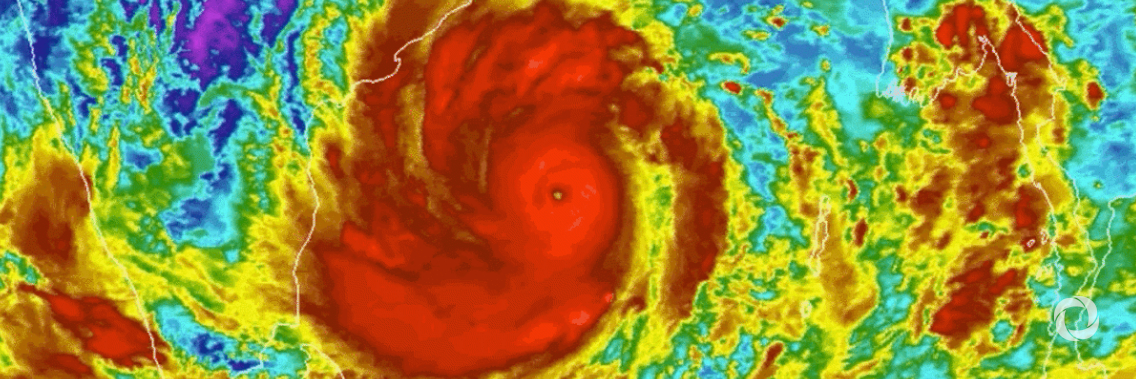
Tropical cyclone Amphan intensified rapidly in the Bay of Bengal to become a “Super Cyclonic Storm” – the equivalent of a strong Category 4/weak Category 5 on the Saffir Simpson scale.
It is expected to make landfall on 20 May as an extremely severe cyclonic storm (strong Category 3 equivalent), bringing dangerous winds, storm surge and flooding to coastal areas of West Bengal in India and Bangladesh.
Amphan is on track for densely populated areas at a time when restrictions due to the COVID-19 pandemic is complicating disaster management – and making it more necessary than ever before.
The Indian Meteorological Department in New Delhi, which acts as WMO’s Regional Specialized Meteorological Centre for Tropical Cyclones, warned of a storm surge of about 4-5 meters above astronomical tide that is likely to inundate low-lying areas of West Bengal during landfall, and of about 3-4 meters for Bangladesh.
It said Amphan would make landfall with a maximum sustained wind speed of 155-165 km/hour, gusting to 185 km/hour.
The tropical cyclone season in the Bay of Bengal and Arabian Sea has two peaks, around May and around November and, in the past, the basin witnessed huge casualties.
Extensive and coordinated disaster risk reduction campaigns have, in recent years, limited casualties.
For instance, extremely severe cyclonic storm Fani made landfall in Odisha, India on 3 May 2019. Accurate advance forecasts and a huge, well-coordinated disaster risk reduction campaign, including the evacuation of hundreds of thousands of people, were credited with keeping the death toll to a minimum. This was in contrast to the 1999 Odisha cyclone which caused thousands of deaths in India.
Original source: WMO
Published on 18 May 2020