
Add us as your preferred source on Google to see more of our content in Search.
 Add to Preferred Sources
The European Commission has put forward its proposal for a major recovery plan. To ensure the recovery is sustainable, even, inclusive and fair for all Member States, the European Commission is proposing to create a new recovery instrument, Next Generation EU, embedded within a powerful, modern, and revamped long-term EU budget.
The Commission has also unveiled its adjusted Work Programme for 2020, which will prioritise the actions needed to propel Europe’s recovery and resilience.
The coronavirus has shaken Europe and the world to its core, testing healthcare and welfare systems, our societies and economies, and our way of living and working together. To protect lives and livelihoods, repair the Single Market, as well as to build a lasting and prosperous recovery, the European Commission is proposing to harness the full potential of the EU budget. Next Generation EU of €750 billion as well as targeted reinforcements to the long-term EU budget for 2021-2027 will bring the total financial firepower of the EU budget to €1.85 trillion.
European Commission President Ursula von der Leyen said: “The recovery plan turns the immense challenge we face into an opportunity, not only by supporting the recovery but also by investing in our future: the European Green Deal and digitalization will boost jobs and growth, the resilience of our societies and the health of our environment. This is Europe’s moment. Our willingness to act must live up to the challenges we are all facing. With Next-Generation EU we are providing an ambitious answer.”
The money raised for Next Generation EU will be invested across three pillars:
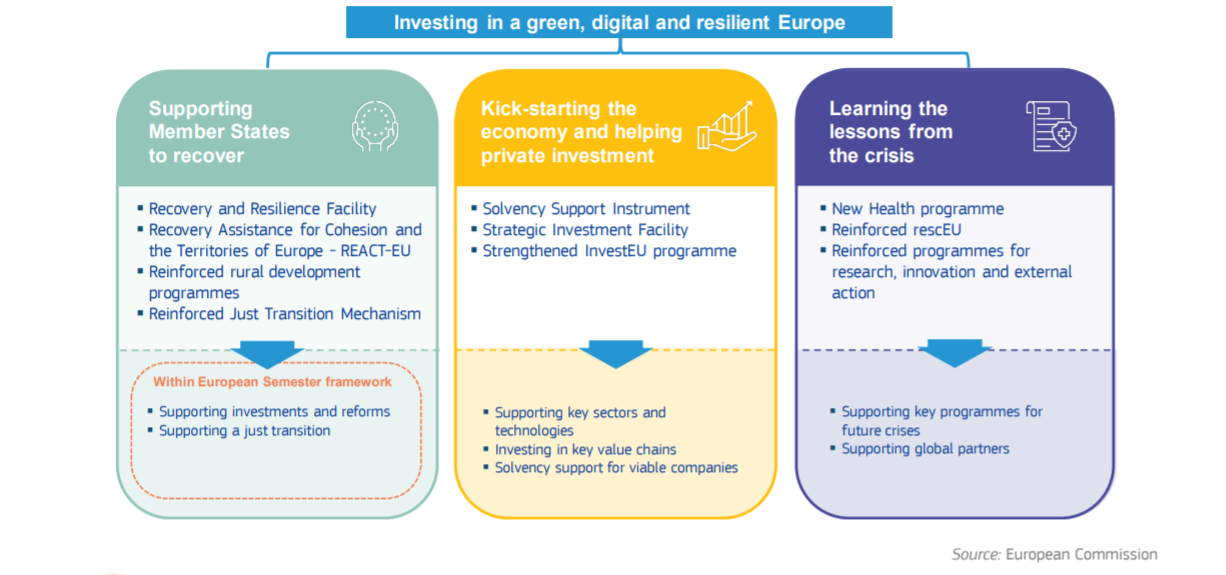
1️⃣ Supporting Member States to recover, repair, and emerge stronger from the crisis.
Public investment has a vital role to play in a balanced and sustainable recovery. The bulk of the funding from Next Generation EU (more than 80%) will, therefore, be used to support public investment and key structural reforms in the Member States, concentrated where the crisis impact and resilience needs are greatest.
The Recovery and Resilience Facility together with cohesion policy and the Just Transition Mechanism will be instrumental in achieving these important goals. Their delivery will be embedded in the European Semester. In addition, the reinforced European Agricultural Fund for Rural Development will support rural areas in making the structural changes necessary in line with the European Green Deal.
2️⃣ Kick-starting the economy and mobilising private investment.
Urgent action is needed to kick-start the economy and create the conditions for a recovery led by private investment in key sectors and technologies. This investment is particularly crucial to the success of Europe’s green and digital transitions. The Commission estimates that investment needs amount to at least €1.5 trillion in 2020-2021. Investment in key sectors and technologies, from 5G to artificial intelligence and from clean hydrogen to offshore renewable energy, holds the key to Europe’s future.
Healthy companies are a prerequisite for success in this investment drive, yet hundreds of thousands of companies are likely to come under severe financing pressure by the end of the year. The Commission is, therefore, proposing a new Solvency Support Instrument to provide urgent equity support to sound companies put at risk by the crisis.
The Commission is also proposing to strengthen InvestEU, Europe’s flagship investment programme, to mobilise investment across the Union in areas such as sustainable infrastructure and digitisation.
3️⃣ Learning the lessons of the crisis and addressing Europe’s strategic challenges.
The Commission is proposing a new Health Programme to strengthen health security and prepare for future health crises. RescEU, the Union’s Civil Protection Mechanism, will be expanded and reinforced to equip the Union to prepare for and respond to future crises.
Horizon Europe will be reinforced to fund vital research in health, resilience, and the green and digital transitions. The EU will support its global partners through an additional €16.5 billion for external action, including development and humanitarian aid.
Other EU programmes will be strengthened to align the future financial framework fully with recovery needs. These include the Common Agricultural Policy and the European Maritime and Fisheries Fund, to strengthen the resilience of the agri-food and fisheries sectors and to provide the necessary scope for crisis management.
Original source: European Commission
Published on 27 May 2020