
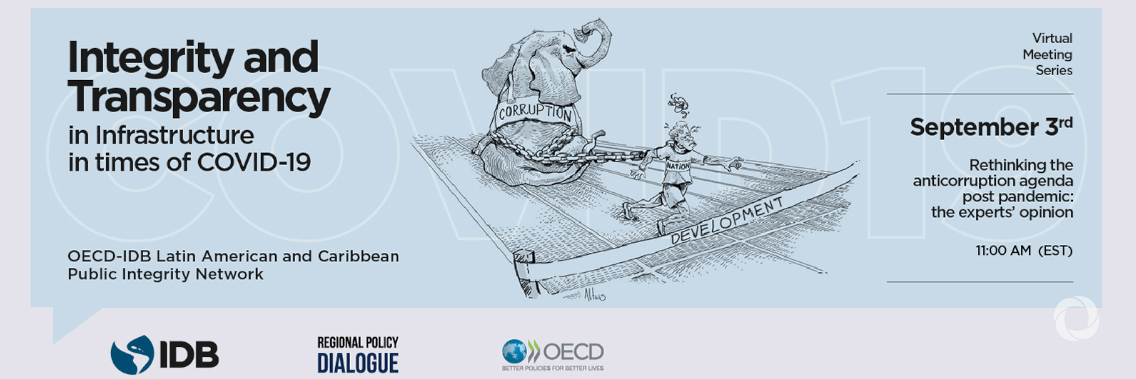
Virtual | OECD-IDB Latin American and Caribbean Public Integrity Network Integrity and Transparency in Infrastructure in times of COVID-19
Add us as your preferred source on Google to see more of our content in Search.
 Add to Preferred Sources
? 3 September 2020 ? 11:00 AM – 1:00 PM (EST)
Virtual meeting
During emergencies of all nature, governments implement decisions to stimulate the economy and ensure a quick response to mitigate social and economic damages. These decisions increase integrity risks in the use of public resources. All emergency laws provide greater discretion for the redistribution and expansion of existing budget allocations, the creation of new public spending sources (e.g. specific trust funds), authorizations for direct public purchases, and the distribution of grants to citizens and companies, among many other procedures.
Given the urgency to alleviate the crisis, the measures adopted usually include reducing the compliance of certain processes or regularly scheduled controls, without reinforcing existing transparency or accountability mechanisms. Within weeks of injecting financial aid packages, the first signs of irregularities have appeared: conflict of interests, prices above market levels, hiring of ad hoc created firms, among other problems. The COVID-19 crisis also poses a challenge for the post-pandemic economic recovery, in which investment in infrastructure with adequate transparency and integrity safeguards will play a crucial role, in areas such as water and sanitation, transportation, energy, and extractive industries.
To debate on these present and future challenges, the OECD–IDB Integrity Network for LAC created in 2017, turns out to be adequate space, since it brings together the main actors of the Integrity Systems of the countries in the Region. Its objective is to lead high-level debates for the exchange of best practices and lessons learned from the implementation of transparency and integrity policies at the international and sectoral levels, including the use of information technologies.
For the 2020 edition, the OECD-IDB Regional Policy Dialogue through four sessions distributed over two weeks, the objective will be to discuss among participants about the lessons learned from the COVID-19 pandemic and to identify best practices to pursue integrity and transparency during and after the emergency.
Session 1. Rethinking the anti-corruption agenda in the post-pandemic agenda: the experts’ opinion
The increasing spread of the coronavirus has led governments in the region to introduce unprecedented measures to contain the epidemic. These measures not only had a great impact on regional public finances but also challenged the functioning of the integrity systems to prevent and control corruption in Government. This agenda ranges from participation and social accountability, transparency, and public integrity, to public procurement systems, auditing, money laundering, and criminal prosecution regimes. In this session we invited a group of experts to reflect on the questions for the future after the pandemic: Were anti-corruption systems prepared to respond to the crisis?; How can governments in the region ensure transparency and integrity in the reactivation stage of their post-pandemic economies?; Will there be a role for infrastructure investment?; How should governments in the region encourage the fight against corruption by key-actors such as civil society organizations and the private sector?
Original source: IADB