
Add us as your preferred source on Google to see more of our content in Search.
 Add to Preferred Sources
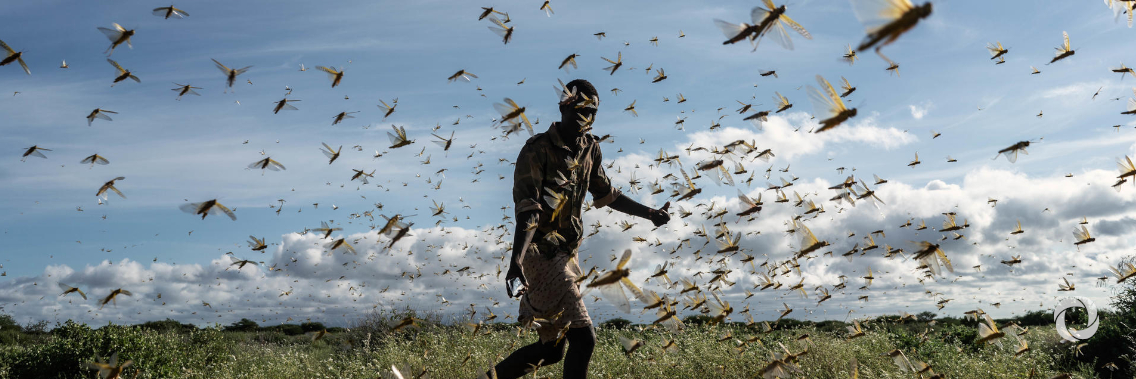
In Ethiopia, an infestation of desert locusts is inflicting untold damage to crops, leading to a deterioration of the food security situation and an additional threat to livelihoods.
This summer, IOM has positioned itself to assist thousands of people affected by a severe outbreak of desert locusts in some regions. Over the next four months, 7,500 households – or approximately 45,000 individuals – will receive cash grants to buy food and other essentials in the affected regions of Oromia and Somali.
Described by the Food and Agriculture Organization (FAO) as “the most destructive migratory pest in the world,” desert locusts are currently destroying tens of thousands of hectares of crops, grazing land, and forests in Ethiopia, Kenya, Somalia, Sudan, South Sudan, and Yemen.
Ethiopia is now at the epicentre of these large swarms that arrived at the end of 2019 in an outbreak reported to be the worst in decades.
“Thick clouds of ravenous insects have invaded Borena in Oromia region, at the border with Kenya, where they are devouring large quantities of vegetation, crops, pasture, and fodder, and causing widespread damage to the environment,” said Ester Ruiz De Azua, Emergency and Post-Crisis Coordinator for IOM Ethiopia. “They are threatening drinking points for livestock and even invading homes.”
The World Bank warns that, without broad-scale control, conservative estimates for locust-related losses including for staple crops, livestock production, and asset damages could reach USD 8.5 billion for countries in the wider East Africa region, Djibouti and Yemen.
Moreover, with the locusts spreading in cycles, a recent re-escalation means the most affected regions and zones of the country will remain under this menace until at least the end of this year.
This has worsened the situation for communities already affected by the impacts of the COVID-19 pandemic, insecurity, and displacement due to communal violence and strained access to food, leaving the most vulnerable facing poverty and hunger.
While response teams conduct locust-control operations, IOM – working with the government and the country’s Cash Working Group – has begun implementing a food security and livelihoods project that will extend multi-purpose cash grants to the most affected.
The multi-purpose cash grants to support the livelihoods of most vulnerable locust-affected populations is funded by the European Union’s Civil Protection and Humanitarian Aid Operations Department (ECHO) through a EUR 2 million facility.
“The EU has been committed to support efforts to address the desert locust infestation not only in Ethiopia but also in the Horn of Africa,” says Yassine Gaba, the Head of Office of the EU Humanitarian Aid in Ethiopia. “We are confident that this support to IOM will address immediate needs of the most vulnerable, whose livelihoods have been adversely affected by the desert locusts.”
The cash grants will primarily address people’s immediate food needs, based on the food basket set by the government, while supporting water, sanitation, and hygiene (WASH), education and shelter needs.
Amounting to ETB 1,500 (approximately USD 40) per household each month for over four months, the cash transfers are unconditional and will be handled through financial service providers such as the Ethiopian Postal Services (EPS) and Somali Microfinance Institution (SMFI).
The next step before the start of cash disbursements: identifying deserving beneficiaries. There, government and community leaders will play an important part before distribution starts in the coming weeks.
Original source: IOM