

Add us as your preferred source on Google to see more of our content in Search.
 Add to Preferred Sources
Ministers, United Nations representatives, community groups, and migrants gathered to discuss the migration dynamics and migratory movements in Central Asia and the wider region at the government-led regional cooperation platform known as the Almaty Process. The migration phenomenon came under the spotlight in the Kyrgyz capital Bishkek this week.
“There are 10 million people on the move in Central Asia,” noted Dejan Keserovic, IOM’s Sub-regional Coordinator for Central Asia. “But it’s not a crisis, it’s a process. What we are trying to do here is to help Central Asian governments to regulate migration for the benefit of the migrants themselves, but also for the benefit of the Almaty Process member states.”
Like the carpets that make the region famous, migration is rich, intricate, colourful and multi-layered. The challenge of moving people to where the jobs are has been exacerbated in recent times by new controls in Russia – the largest destination country for Central Asian migrants – which has meant hundreds of thousands of Central Asians are barred from access to that labour market.
This has led to massive increases in migration to other countries and regions, principally Turkey, Europe and the Gulf States, but also in migration within the region as Kazakhstan has seen a boom in its construction and services industries.
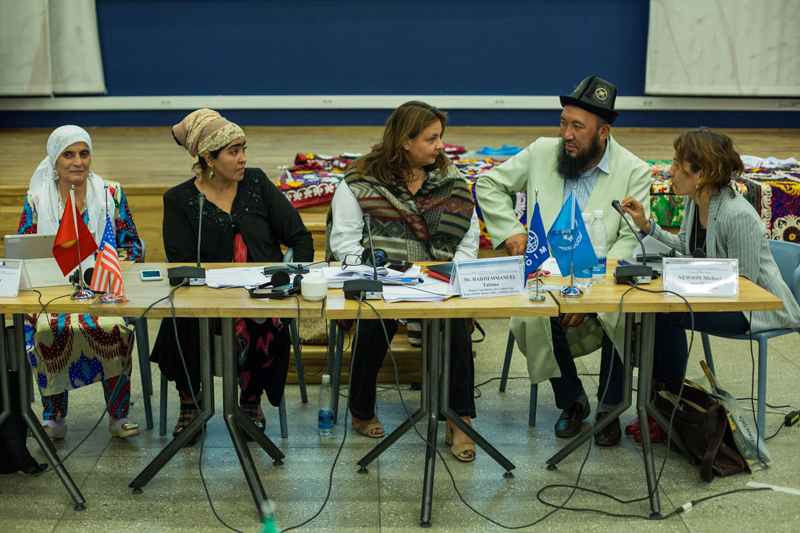
Almazbek Zholchuevich Asanbaev is Deputy Head of Kyrgyzstan’s State Migration Services and chaired this week’s high-level summit, along with representatives from IOM and UNHCR. He acknowledged that mixed migration flows contain “not only labour migrants and immigrants, but also unwanted elements such as terrorists and extremists. We have been discussing the ways of information sharing and ways of solving problems that are faced by labour migrants and people susceptible to recruitment by extremists.”
Closing the high-level meeting of Ministers, Alan Meltzer, Charge d’Affaires at the US embassy in Bishkek stressed that as migration is a transnational issue is must be subject to a regional approach and frank dialogue.
“This can help shape policies that address the needs of the most vulnerable migrant populations, including refugees, asylum seekers and migrant victims of crime and trafficking,” he said.
“Informed policy can also help fight xenophobia by demonstrating how migrants, in all their diversity, contribute to the growth of economies and the enrichment of society.”
Tatiana Hadjiemmanuel, Head of IOM’s office in Almaty said that the days of migration-focused events in Bishkek helped to address migrant vulnerability by getting the causes and drivers out in the open. “During forums like this we can make huge progress into addressing protection gaps and get consensus on policy response to migrant vulnerabilities all through the migration process. This is the only government-led process in Central Asia that gets inter-agency cooperation, and it is succeeding in sustainably resolving migrant vulnerabilities.”
The Almaty Process promotes sustained dialogue and exchange of information on migration issues and on refugee protection challenges such as, but not limited to irregular migration, human trafficking, migrant vulnerabilities, migrant integration, human mobility and the human rights of migrants. Its member states are Afghanistan, Azerbaijan, Kazakhstan, the Kyrgyz Republic, Tajikistan, Turkey and Turkmenistan, with Iran and Pakistan as observers.
Original source: IOM
Published on 28 September 2017