
Add us as your preferred source on Google to see more of our content in Search.
 Add to Preferred Sources
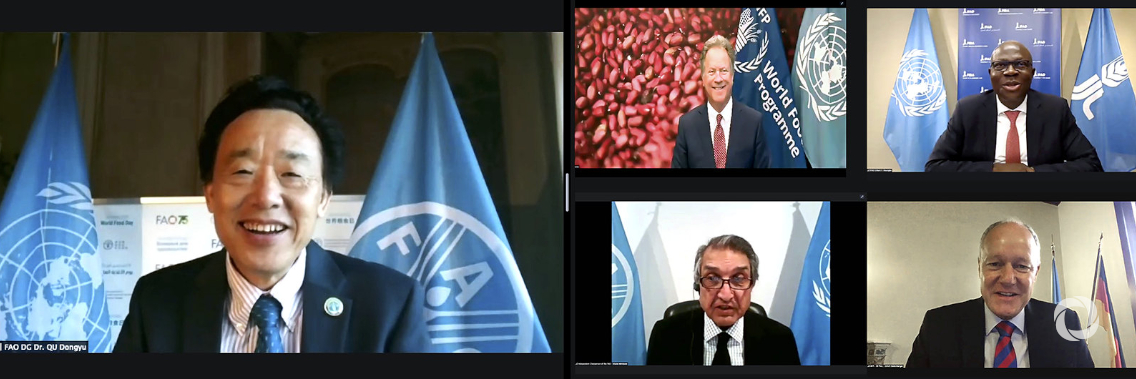
The Director-General of the UN Food and Agriculture Organization (FAO), QU Dongyu, the President of the International Fund for Agricultural Development (IFAD), Gilbert Houngbo, and the Executive Director of the World Food Programme (WFP), David Beasley, pledged to step up their joint efforts to end global hunger, particularly amid the impacts of the COVID-19 pandemic.
It was the first time the heads of the three UN Rome-based agencies (RBA) had met since WFP was awarded the Nobel Peace Prize 2020.
“As we are marking FAO’s 75th anniversary this week, more than ever, we need to continue the partnership the RBAs have forged and renew our energy to fight hunger and build a better world,” Qu said, noting that “the challenge to leave no-one behind and no land behind can only be addressed through collective action and partnership.”
WFP Executive Director Beasley described the Nobel Peace Prize as “a call to action” to make the world aware of what the UN agencies are confronting. He noted that the award had alerted the international community to the link between conflict and food insecurity and emphasised the significance of next year’s Food Systems Summit in effecting change. “Let it inspire us, encourage us, to do more and never give up,” he said.
The meeting discussed the status of joint RBA action plans and programmes at the regional and country levels. The FAO Director-General indicated that RBA collaboration had increased since the last informal joint meeting of the three boards in September 2019.
“Our most effective collaboration is happening at the country level: the number of joint RBA programmes has almost doubled since 2017 reaching more than 50 countries today,” Qu said. “That is what our Members expect from us: to move forward in concrete ways.”
Turning his attention to specific programmes, the Director-General detailed the Rome-based agencies’ action to expand efforts in the Sahel region through a $180 million programme that is being developed, which is aimed at strengthening the resilience of populations vulnerable to COVID-19, conflicts, and climate change.
He then alluded to the Canada-funded RBA Resilience Initiative in the Democratic Republic of the Congo, the Niger, and Somalia where the three agencies are collaborating to strengthen food security resilience and nutrition using an innovative approach that bridges humanitarian and development issues, with a particular focus on gender-specific needs.
IFAD President Houngbo stressed the need to step up collaboration not only between the Rome-based agencies but with other UN agencies and institutions, depending on specific issues.
Original source: FAO