
Add us as your preferred source on Google to see more of our content in Search.
 Add to Preferred Sources
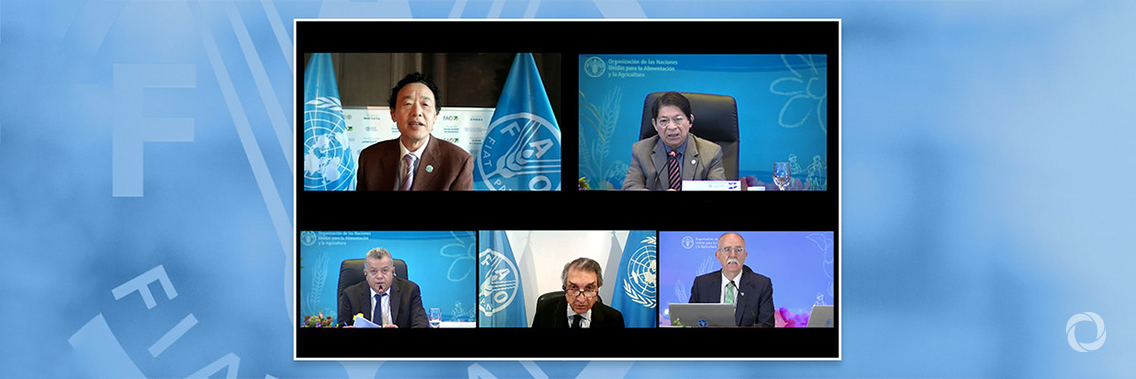
The 36th session of FAO’s Regional Conference for Latin America and the Caribbean hosted virtually by the Government of Nicaragua, started with Members exchanging their experiences, strategies, and ideas on the fight against COVID-19 pandemic, while the FAO Director-General QU Dongyu stressed the importance of strengthened collaboration and innovation, particularly to support the most vulnerable people highly affected by the pandemic.
From the outset, the Director-General praised the efficient response of the region so far to keep food supply chains working amid the impacts of the pandemic.
“I have seen that your countries adopted a slogan in this pandemic: Agriculture will not stop!” Qu said. “I pay tribute to the millions of farmers, entrepreneurs, food processors, workers, traders, and merchants, who made sure that every single day food was available in every city, town, and village from the Rio Bravo to Patagonia,” he added.
Qu noted, however, that Latin American and Caribbean countries need to strengthen their efforts as COVID-19 continues its rampage, mainly affecting the poorest and most vulnerable people.
“Over 34 million jobs have been lost in this region, and the UN projects that up to 28 million people could fall into extreme poverty, which means a high likelihood of also suffering severe food insecurity,” he said.
In this context, Qu highlighted how FAO has been at the forefront of addressing the challenges posed by the pandemic through the COVID-19 Response and Recovery Program, aimed at preventing a global food emergency, while strengthening the resilience and inclusiveness of food systems and livelihoods.
“The Program enables donors to leverage the Organization’s convening power, real-time data, early warning systems, and technical expertise to direct support where and when it is needed most,” he said.
The Director-General also referred to the Hand-in-Hand Initiative as a new approach and platform to promote enhanced collaboration among national and local authorities, the private sector, civil society scientists, NGOs, and many others.
“It is a new business model for collaboration, which uses a broad spectrum of partnerships and leverages the technical and data capacity of the Organization, to determine the best options to reach the most vulnerable and have the greatest impact on poverty and hunger,” he said.
Qu noted that the region is a pillar of global food security and encompasses a very large share of the world’s biodiversity, forests, water and productive soils and has pioneered important policies to eradicate poverty and reach zero hunger.
To unleash the region’s full potential in terms of food and agriculture, the Director-General called on Members to promote innovation and digital technologies; create new opportunities for rural people by taking advantage of the new demands of urban consumers; and expand trade and access to markets for farmers and agri-food entrepreneurs, through science-based and fair multilateral rules.
The FAO Director-General also stressed that the UN agency is making profound changes to address the global challenges of food and agriculture. As an example, he mentioned the establishment of a dedicated Office for Small Island Developing States (SIDS), Least Developed Countries (LDCs), and Landlocked Developing Countries (LLDCs) and noted that 18 of the 33 countries in the region belong to one or more of the aforementioned groups. Qu also spoke of the new FAO Office for Innovation and the Office of Climate Change, Biodiversity and Environment.
FAO Members in Latin America and the Caribbean meet every two years to discuss issues of common concern, define priorities, and guide FAO’s work in support to the region’s food and agriculture.
Original source: FAO