
IAEA Director General highlights the crucial role of nuclear technologies in fighting pandemics and climate change
Add us as your preferred source on Google to see more of our content in Search.
 Add to Preferred Sources
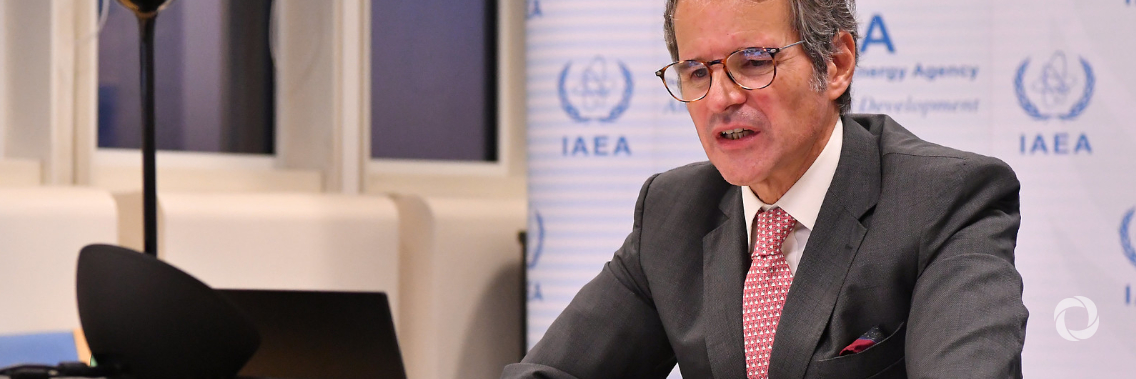
In addressing the United Nations General Assembly for the first time since his appointment as Director-General of the IAEA, Rafael Mariano Grossi spoke of the global impact of COVID-19 and climate change as well as of the role of nuclear technologies in tackling these and other development challenges.
In his statement, delivered via video message to an online session of the General Assembly, Mr. Grossi presented the Report of the IAEA and spoke about how the IAEA adapted its operations during the lockdown last spring, moving many of its activities online and organizing meetings, training courses and webinars including sessions supporting radiologists, nuclear power plant operators and nuclear safety specialists in carrying out their work in the face of the pandemic. He recalled the IAEA’s emergency COVID-19 support to its Member States in the use of RT-PCR, a nuclear-derived technique used for the detection of the virus that causes the disease.
“We launched the largest operation in the Agency’s history to help countries confront the coronavirus,” Mr. Grossi said. “Nearly 1,500 consignments of equipment for virus detection and diagnosis, and other supplies, have been delivered to some 125 countries.”
Mr. Grossi spoke of the new IAEA Zoonotic Disease Integrated Action (ZODIAC) initiative to help the world be better prepared for future pandemics. ZODIAC will include a global network of diagnostic laboratories working towards the monitoring, detection, and control of zoonotic diseases – diseases transmitted from animals to humans.
To carry out time-sensitive safeguards verification work during the pandemic, the IAEA chartered airplanes to transport inspectors during the period of travel restrictions. This and other measures enabled the IAEA to continue its work inspecting nuclear facilities around the globe– verifying that the use of nuclear material is not diverted from peaceful purposes.
Mr. Grossi said that the Agency continues to verify the non-diversion of nuclear material declared by Iran under its safeguards agreement and that evaluations regarding the absence of undeclared nuclear material and activities continue.
The monitoring of the nuclear programme of the Democratic People’s Republic of Korea (commonly referred to as North Korea) continues using open source information such as satellite imagery, as the IAEA does not have access to the country. He called on the country’s government to comply with its obligations under relevant Security Council resolutions and cooperate with the IAEA.
“The Democratic People’s Republic of Korea’s nuclear activities remain a cause for serious concern. The continuation of the country’s nuclear programme is a clear violation of relevant Security Council resolutions and is deeply regrettable,” he said. “The Agency is intensifying its readiness to play its essential role in verifying the Democratic People’s Republic of Korea’s nuclear programme.”
Mr. Grossi highlighted the role of nuclear power in tackling climate change. He reflected on his participation at the United Nations Framework Convention on Climate Change (COP25) conference held in Madrid in December 2019. “I wanted to send a very clear message — that nuclear power is part of the solution to the climate crisis. I am keen to ensure that the Agency’s voice is heard on the great benefits of nuclear power,” he said.
The 442 nuclear power reactors in operation across 31 countries provide 10 percent of the world’s electricity and one-third of its low carbon electricity, Mr. Grossi noted, adding that the benefits of nuclear technologies are only possible when used safely and securely.
Original source: IAEA