

Add us as your preferred source on Google to see more of our content in Search.
 Add to Preferred Sources
“God, send us rain!”, exclaimed Ion wiping the sweat from his sunburned face. Along with 197,000 people working in the agricultural sector of Moldova, a small landlocked country on the outskirts of Europe, he hoped that 2020 would be a favorable year with a high yield. However, neither his hopes nor his business strategy held up well as the sun burned his crops, the wind dried the land, the pests affected his yield and COVID-19 kept the input suppliers away. Agriculture experts insist that had the state and the farmer implemented a more digitalized approach to agri-management, the situation would have changed radically.
Digitalization, or digitization, of agriculture, which is seen as one of the paths to more sustainable and high-value agriculture, is about optimizing the use of the resources that are available to farmers. Despite the widely popular image of drones and self-driving machinery in the fields, there is an immense back-end operation of data collection and e-government infrastructure that represent the full scope of digitalization.
In more practical terms this means a new, digital way of real-time data collection by means of sensors, satellites, and drones, followed by its storage on clouds and its processing via mobile applications or artificial intelligence (AI).
So, what benefits does digitalization bring and why do some people believe it is a curse?
“There is a myth among Moldovans that digitalization involves only drones and robots, and automatically kills the need for the workforce. In fact, digitalization means an increased need for more qualified personnel for administration, developing and maintenance,” says Dr. Oleg Stiopca, Ph.D., eDrone – Educational for Drone project coordinator in Moldova.
According to him, this misconception is driven by a lack of response from some farmers, who, by tradition, are afraid of all that is new and instead rely on their fifth sense rather than a satellite weather forecast.
“Indeed, relying on nature and hoping for the best are the main components of the ‘business strategies’ of many medium and even large farms in developing countries. But, at the same time, excessive heat, bundled with winds, followed by heavy rains and hail, compromises thousands of hectares of crops and damages the soil. If farmers had access to a more precise weather forecast, to stored multi-annual data on soil humidity and air-borne analysis of pests from neighboring fields and regions, the situation would dramatically change and the decision-making process would be different,” says Stiopca.
The information held in databases allows for more rational use and detailed control of inputs, which, in turn, enables advances in efficiency allows such as labor cost reduction, identifying and preparing for diverse climatic conditions that have an impact on production processes, and monitoring the spread of diseases and pests. Supporters of digitalization claim that predictive models, backed up by big data and AI, will allow for the forecasts of pest and disease outbreaks, will generate recommendations for improved seed planting in fields and, last but not least, enable the selection of the best crop varieties.
Furthermore, the availability of yearly datasets detailing sales information can support the prediction of the best time to market certain agricultural products.
Drones in agriculture
There are multiple sectors and areas where unmanned aerial vehicles (UAVs), aka drones, are used. According to the EU Digital Transformation Monitor, the value of global drone sales reached US $8.5bn in 2016 and is expected to surpass US$12bn this year. Agriculture is one of the primary sectors where drone technology is expected to see a sharp rise in popularity and growth. The agri-sector processes to which drones can bring additional value and improvements are:
- Soil and field analysis
- Crop monitoring
- Health assessment
- Irrigation
- Crop spraying
- Aerial planting
Meanwhile, in Moldova, one of the poorest developing countries in Europe, the first 1000 ha of crops have been sprayed using drones with farmers paying US$10 per hectare. Thus, among the advantages discovered by Moldovan farmers are lower costs for services, lower costs for inputs (drones use up to 10 liters of solution per hectare whereas, traditional spraying methods use up to 100 liters), and less damage to the environment due to fewer quantities being applied.
When questioned by DevelopmentAid, Moldovan drone pilots also mentioned that the sprayings they do is mainly undertaken at night, in order not to affect bees and other insects that are active during the day. In Moldova, the poisoning of bees has become an alarming phenomenon in recent years.
This is an example of the “Farming as a Service” model: fixed costs (buying drones) are converted into variable costs (farmers are charged for services such as drone rental). Companies that provide this kind of services are called AgTechs.
AgTech – converting intelligence into crops
There are some that say agro-business start-ups, known as “Agtechs”, are the main engines driving the digitalization of agriculture. However, the change is actually being led by private investments whereby companies are looking to enter niche markets that are currently unexploited.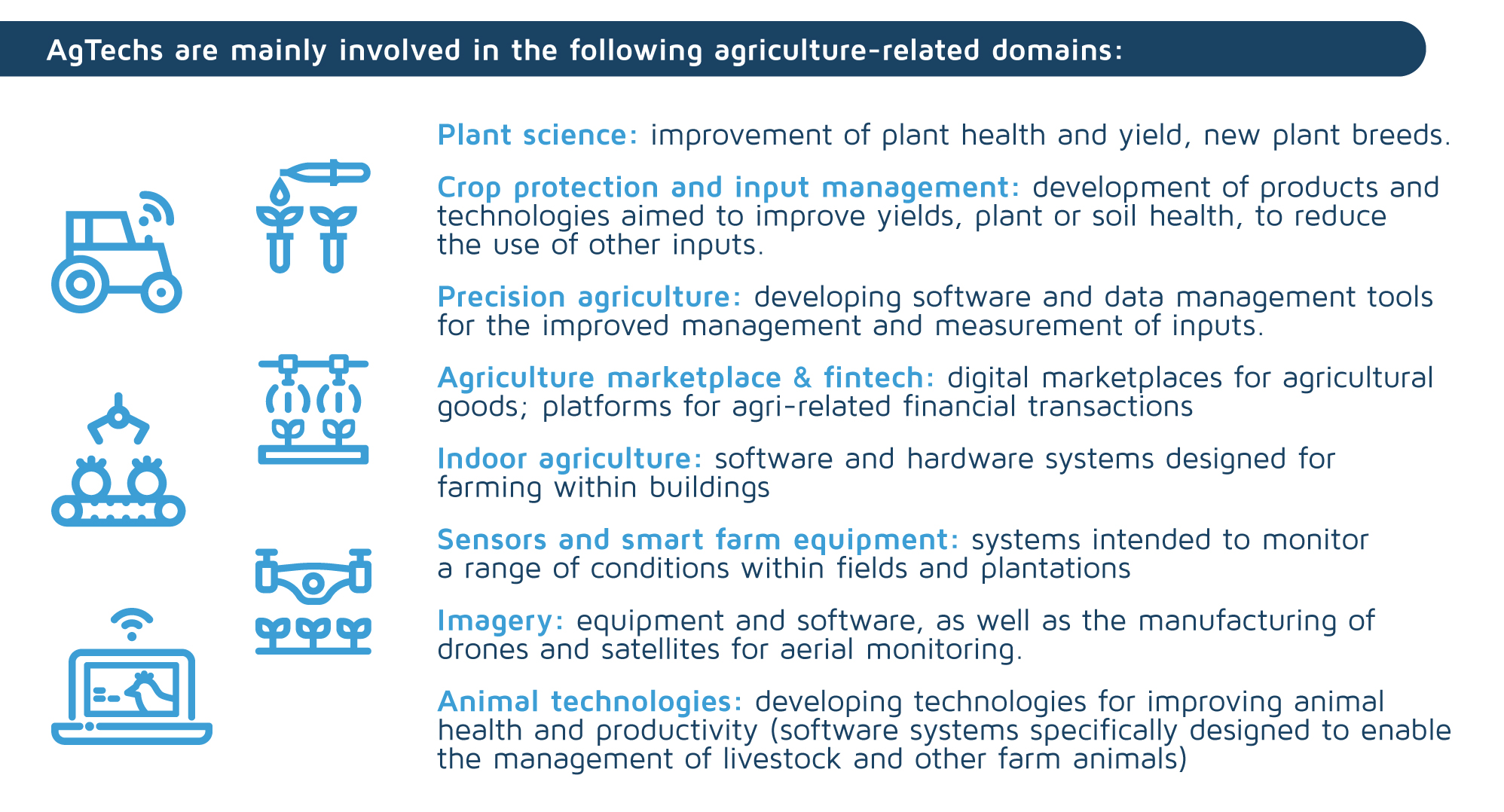
According to the 2019 Agrifood Tech Investment Review A, in 2018, the amount of capital investments in Agtechs totaled US $1.6 billion across 209 deals and the following year. In 2019 investors pumped a record $ 2.7 billion into the Agtech sector
Source: Finistere Ventures, 2019 AgriFood Tech Investment Review
A brief look at the investments in AgTech shows that while indoor agriculture (i.e. greenhouse, vertical farming in a controlled environment) led in terms of growth reaching US$541 million in 2019, representing an almost twofold growth in investments since 2018, crop protection and input management continued to lead with 37% of the total invested capital, or US$967 million, in 2019. Digital technologies (imagery, precision agriculture, and sensors, and farm equipment) made up approximately 41% of the total activity by the number of deals in 2019 although the Finistere review notes that invested capital across precision agriculture technologies has remained relatively flat during the past four years, standing at US$116 million in 2019.
According to Crunchbase data, investments in Agtech companies in 2020 are poised to repeat or even exceed the levels achieved in previous years.
Many companies already established in traditional agricultural markets are among the investors in Agtech, possibly anticipating the prospects of digital transformation in agriculture.
“There is high interest in agriculture digitalization and Agtechs in Moldova”, says Sergiu Jaman, the CEO of the Agrobiznes media platform, which had recently finalized the first edition of the AgTech Academy in Moldova, funded by USAID, through its High-Value Agriculture Activity and Startup Moldova program. “The youth is interested in AgTech. This is the future. Digitalization allows farmers to reduce costs, improve productivity and take smarter decisions. It also contributes to increased transparency in the agri-sector and a more solid-base for taxation”.
“I have seen too many farmers praying for rain and pest resilience instead of using water for smarter irrigation and taking notes of periods when pests spread. By going digital, farmers will unlock their potential to increase yields and reduce costs”, concluded Jaman.
Digital initiatives and funding opportunities around the world can be followed by subscribing to the DevelopmentAid newsletter.