
Add us as your preferred source on Google to see more of our content in Search.
 Add to Preferred Sources
The UN begins to push towards a more sustainable energy future, 12 million women lost access to contraception and current challenges for tourism. Here is what you missed from last week’s headlines in the international development sector:
UN begins to push towards more sustainable energy future
Renewable energy is “crucial for building a sustainable, prosperous and peaceful future”, the UN chief said on March 10, launching an accelerated drive for clean energy and climate action.
“Our challenge is clear: to achieve net-zero emissions by 2050, the world must cut carbon emissions by at least 45 percent below 2010 levels within the next decade”, Secretary-General António Guterres said.
He was addressing more than 20 ministerial-level “Global Champions” at the virtual High-level Dialogue on Energy – the global platform where governments, businesses, and others can come together to recommit to more sustainable energy use.
He underscored that the world was “way off track” and needed to use the COVID-19 recovery period to build a sustainable economy, driven by renewables.
“If we want this energy transition to be just, and to succeed in creating new jobs, a cleaner and healthier environment and a resilient future, developing countries need strong support”, said the top UN Official.
Leading up to an Energy Summit in September, Mr. Guterres saw the dialogue as an opportunity to “accelerate the deployment of renewables globally and ensure that the developing world has access to them”.
12 million women lost access to contraception due to disruptions caused by the pandemic
UNFPA, the UN sexual and reproductive health agency, released new data indicating that nearly 12 million women in 115 countries lost access to family planning services, leading to 1.4 million unintended pregnancies resulting from the disruptions caused by COVID-19 over the past year.
“Pregnancies don’t stop for pandemics or any crisis. We must ensure that women and girls have uninterrupted access to life-saving contraceptives and maternal health medicines,” says UNFPA Executive Director, Dr. Natalia Kanem. “The devastating impact that COVID-19 has had on the lives of millions of women and girls in the past year underscores just how vital it is to ensure the continuity of reproductive health services.”
The COVID-19 pandemic has been the fastest-moving global public health crisis in a century, causing a strain was never before seen on global health systems, many of which were forced to divert resources away from their reproductive health services. Women also lost access to health services due to mobility restrictions or fear of traveling to health facilities. The data, by UNFPA and Avenir Health, estimates the net impact of these service delivery disruptions.
In the 115 low-and-middle-income countries studied, women faced an average disruption in their family planning services of 3.6 months over the past year, suggesting that many health systems were resilient enough to eventually adapt and continue to provide services. The worst disruptions were largely concentrated in April and May.
Tightened travel restrictions underline current challenges for tourism
One in three destinations worldwide is now completely closed to international tourism. According to the latest data from the World Tourism Organization (UNWTO), the emergence of new variants of the COVID-19 virus has prompted many governments to reverse efforts to ease restrictions on travel, with total closures to tourists most prevalent in Asia and the Pacific and Europe.
The UNWTO Travel Restrictions Report provides a comprehensive overview of the regulations in place in 217 destinations worldwide. While previous editions had shown a movement towards easing or lifting restrictions on travel, the latest report shows that the persistent seriousness of the epidemiological situation has caused governments to adopt a more cautious approach.
As of the beginning of February, 32% of all destinations worldwide (69 in total) are completely closed for international tourism. Of these, around just over half (38 destinations) have been closed for at least 40 weeks. At the same time, 34% of worldwide destinations are now partially closed to international tourists.
UNWTO Secretary-General Zurab Polilikashvili says: “Travel restrictions have been widely used to restrict the spread of the virus. As we work to restart tourism, we must recognize that restrictions are just one part of the solution. Their use must be based on the latest data and analysis and consistently reviewed so as to allow for the safe and responsible restart of a sector upon which many millions of businesses and jobs depend.”
DevelopmentAid Editorials
UN donor states fail to pledge expected funds to help disaster-stricken Yemen
The Yemen pledging event on 1 March failed to raise the amount needed to deal with the world’s worst humanitarian disaster that this war-torn African country is facing. The event, organized by the governments of Sweden and Switzerland in cooperation with the United Nations, sought to raise US$3.85 billion in donations with US$1.9 billion being needed to prevent famine alone.
60 million children in just 8 countries will need urgent food assistance to survive 2021
Save the Children estimates that the COVID-19 pandemic has significantly increased the number of children in need with 60 million of those living in just eight countries.
The COVID-19 global pandemic has caused a rise in human rights abuse
Apart from many other consequences of the COVID-19 pandemic, it has also brought a deterioration in human rights as governments around the world introduced harsh restrictions and limited citizens’ freedom.
Here’s what else has happened
The European Commission has announced on March 11- €17 million in humanitarian aid to address the needs of the most vulnerable in Haiti and the Caribbean, which have been worsened by the COVID-19 pandemic.
WFP: The Executive Director of the UN World Food Programme issued an urgent plea for peace in Yemen and called for funding to help the most vulnerable hungry families as he wrapped up a two-day visit to the country where the worst famine the world has seen in modern history is now looming.
Japan: The United Nations World Food Programme has welcomed a total contribution of US$110 million from the Government of Japan towards its food assistance and livelihood support to vulnerable people in 37 countries across Asia, the Middle East, and Africa
Syria crisis: The daily suffering of Syrians is worse now than it has been at nearly any point throughout the decade-long conflict that has ravaged the country. This is the sobering message delivered by three senior Red Cross and Red Crescent officials as Syria enters the second decade of a relentless crisis.
Global Fund: The Global Fund applauds the U.S. government for approving US$3.5 billion in emergency funding for the Global Fund’s effort to fight the COVID-19 pandemic in low- and middle-income countries. This unprecedented support will rapidly accelerate the Global Fund’s response to the pandemic, which is critical to save lives and protect the gains our partnership has made against HIV, TB, and malaria over the last two decades. In the last year, COVID-19 has caused widespread disruption to HIV, TB, and malaria service delivery. The Global Fund’s COVID-19 response is mitigating the impact of the crisis on the three diseases, protecting health workers, and reinforcing health systems.
Reports
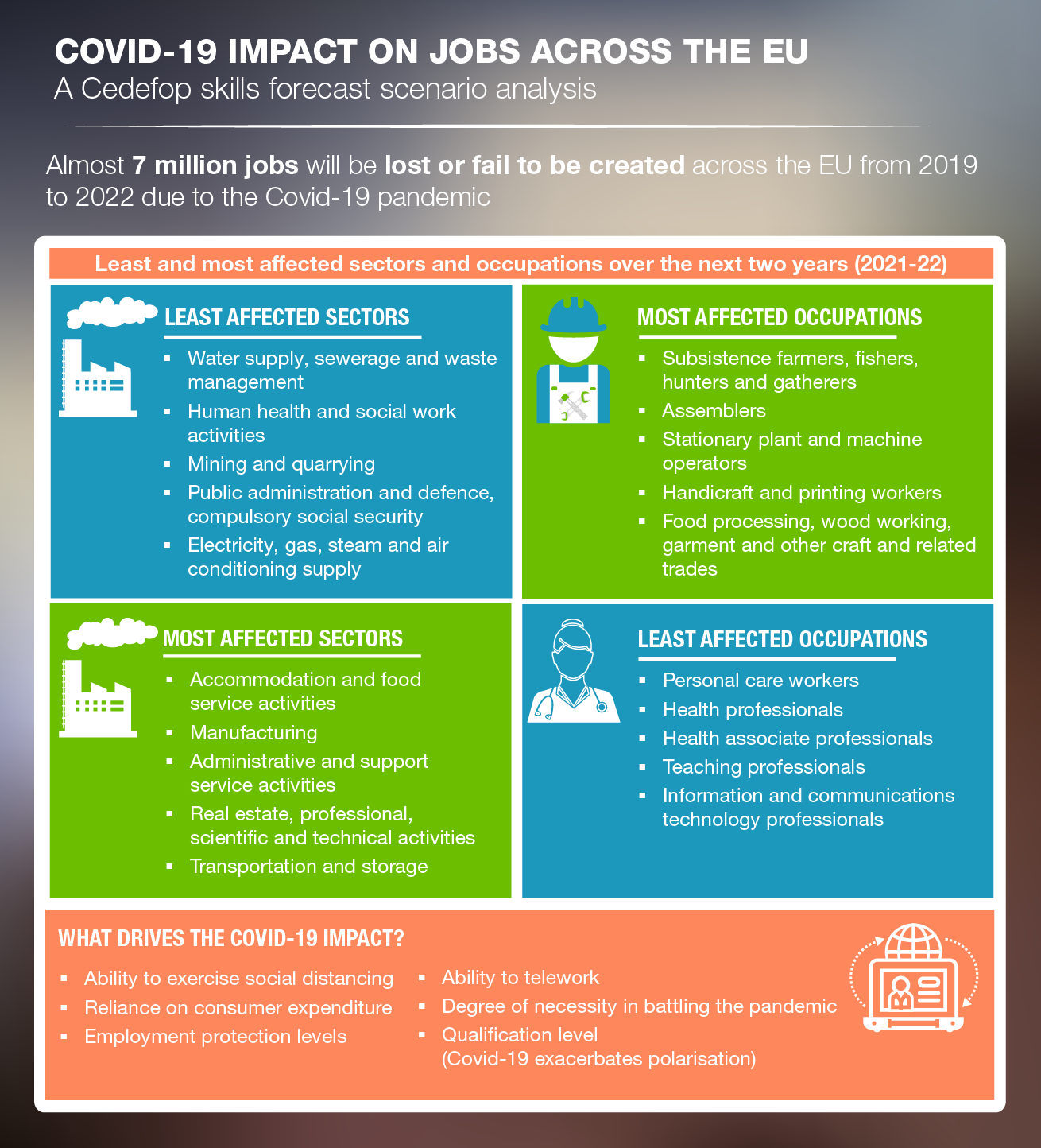
Coronavirus impact on jobs in EU sectors and occupations: a skills forecast analysis
The Cedefop skills forecast predicts that almost 7 million EU jobs will be lost or not created due to the coronavirus pandemic over the period 2019-22.
Read the full Cedefop skills forecast.
Investing in social protection key for Africa to recover better
Measured by the usual metrics of cases and deaths, Africa’s experience of the COVID-19 pandemic seems mild, but the social and economic impacts of the crisis have hit hard. Across the continent, an estimated equivalent of 60 million full-time jobs were lost in the second quarter of 2020 and up to an additional 40 million people were pushed into extreme poverty by the end of 2020.
The full “Social policy and social protection measures to build Africa better post-COVID-19” report.
How multinationals can advance gender equality in developing countries
A new report from UNCTAD outlines how governments and other stakeholders can ensure foreign investment by multinationals translates into real benefits for women.
Read the new report.
Events
The Sixty-Fifth Session of the Commission on the Status of Women (CSW65) | Virtual
? 15-26 March 2021
Virtual
In light of the evolving COVID-19 situation, and taking into account the latest guidance from the United Nations Secretary-General and the World Health Organization (WHO), the sixty-fifth session of the Commission on the Status of Women (CSW65) will take place in a hybrid format with mostly virtual meetings.
Representatives of Member States, UN entities, and ECOSOC-accredited non-governmental organizations (NGOs) from all regions of the world are invited to attend the session.
Themes:
- Priority theme: Women’s full and effective participation and decision-making in public life, as well as the elimination of violence, for achieving gender equality and the empowerment of all women and girls;
- Review theme: Women’s empowerment and the link to sustainable development (agreed conclusions of the sixtieth session)
Annual Meeting of the Boards of Governors of the IDB and IDB Invest | Virtual
? 17 -21 March ?9:00 AM – 1:30 PM (EDT)
Virtual
In late March or early April of each year, the Boards of Governors of the Inter-American Development Bank (IDB) and IDB Invest (whose legal name is the Inter-American Investment Corporation) hold their Annual Meeting in one of the Bank’s member countries. This official gathering is a forum for discussion among the IDB-IIC Governors, most of whom are Ministers of Finance, Presidents of Central Banks, or other high-level authorities from member countries. Representatives of multilateral financial institutions, development agencies, and private banks also attend.
The Sixty-first Annual Meeting of the Board of Governors of the Inter-American Development Bank and the Thirty-fifth Annual Meeting of the Board of Governors of IDB Invest will be held virtually.
Target Gender Equality Live: Women’s Empowerment in the Decade of Action | Virtual
? 16 March 2021 ?5:00 a.m. – 5:00 p.m. (EST)
Virtual
Organized on the sidelines of the International Women’s Day and Commission on the Status of Women events, Target Gender Equality Live will demonstrate the leadership of UN Global Compact on gender equality by showcasing the Women’s Empowerment Principles, promoting the Target Gender Equality global impact initiative and engaging women-led businesses. This interactive virtual event seeks to inspire and engage business and other stakeholders to take concrete action to advance gender equality and help to build private sector support and momentum in advance of the Gender Equality Forums taking place later in the year.
Target Gender Equality Live will showcase the work of Global Compact Local Networks and partner organizations, featuring a dynamic mix of live plenaries, on-demand programming, global networking, and practical tools and resources.
How OLAF Investigates Fraud Against the EU Budget | Webinar
? 18 March ? 15:00 CET/ 9:00 ET/ 6:00PT
Virtual
Join the DevelopmentAid webinar to find out how OLAF investigates fraud against the EU budget.
The conversation is going to focus on the following topics:
- OLAF in figures: How many investigations? How much money recovered? How many recommendations for actions to the state authorities? How many companies/individuals have been actually prosecuted?
- The position of OLAF in the EU structure.
- Cooperating with OLAF as a witness or a person/entity being investigated.
- Fraud prevention measures? Hercule Programmes?
Big cases of investigation.
You will have the possibility to ask questions directly at the webinar.
HOST: Sergiu Casu, Business Development Director, DevelopmentAid.
Speaker: Michał Pesta, External Relations Coordinator, International Operations and Investigations Unit OLAF.B.4.