
Add us as your preferred source on Google to see more of our content in Search.
 Add to Preferred Sources
As reports by humanitarian and international organizations applaud the decision by the Colombian government to grant legal status and right to work for one million Venezuelan migrants, the need for international funding and ongoing humanitarian assistance will remain, warns the International Rescue Committee.
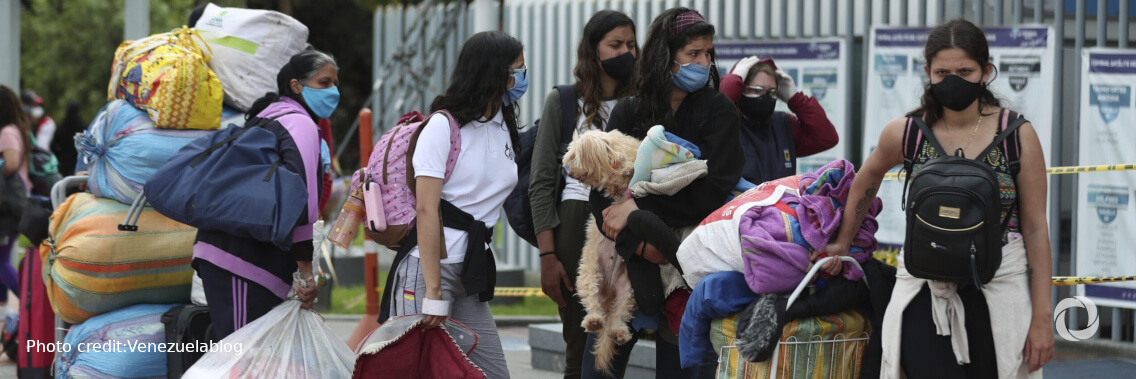
Over 94% of the Venezuelan population has been pushed into poverty due to deteriorating social conditions. Hunger, economic meltdown, violence, among other factors, have led 5.4 million Venezuelans to leave the country since 2014. Many have departed to neighboring countries, like Ecuador, Peru, and Colombia—the main hosting country, where 1.7 million have arrived.
Colombia continues to face challenges, despite the efforts of the Colombian government to welcome the increasing influx of Venezuelans, including the recent policy to grant legal status for one million people. The pre-existing challenges for Venezuelans have been exacerbated as Colombia has responded to the COVID-19 pandemic. For instance, at the national level, the unemployment rate doubled, reaching 21.9%; it was estimated that food insecurity would double as well, with 84% of migrants at risk; and UNICEF reported that 9 in 10 children have not been in school since March 2020.
Meghan Lopez, the IRC’s regional vice president for Latin America, said: “Venezuelan people are now more vulnerable and scared than ever. As many as 130,000 felt they had no option but to return to their home country, crossing again by foot. Others decided to continue their path and move to other countries, with no guarantee of finding better opportunities and in the face of rising regional xenophobia. The Venezuela crisis is the second largest mass displacement in the world but has received a fraction of the resources dedicated to other crises of similar scale.”
Recent assessments indicate that food, shelter, health care, and livelihoods support are among the most urgent humanitarian needs for these vulnerable populations. Just two months into the pandemic, a survey conducted by the IRC identified rises of up to 140% in the costs of food in Colombia, while 100% of the people supported in its health clinics reported they had lost the ability to make a steady income.
The IRC’s response to the Venezuela crisis
The IRC is on the ground delivering a collective response to support Venezuelan migrants holistically—and timely—where they need most: implementing programming with a mixed model of partnerships with local organizations and direct implementation in Colombia; providing support for vulnerable populations through local organizations in Venezuela; and starting to build relationships with partners at the Colombia-Ecuador border. In 2020, the IRC provided assistance for more than 87,000 Venezuelans.
The IRC’s programming includes protecting children and adolescents with psychosocial services and education; empowering people with cash assistance programs; granting access to health care, including sexual and reproductive health and primary attention; delivering child malnutrition services; and developing prevention and response programs to gender-based violence. Additionally, the IRC launched the Colombia instance of the Global Signpost project, InfoPa’lante, a digital platform to help displaced populations access information on civil and legal rights, employment, access to health care and COVID-19.
Since the beginning of the COVID-19 pandemic, the IRC has pivoted its programming to a provide safe, reliable, and innovative response, setting mobile health clinics and providing Personal Protection Equipment (PPE) for doctors and nurses.