
EIB President sees climate action, digital transformation and gender equality as levers to boost the African economy
Add us as your preferred source on Google to see more of our content in Search.
 Add to Preferred Sources
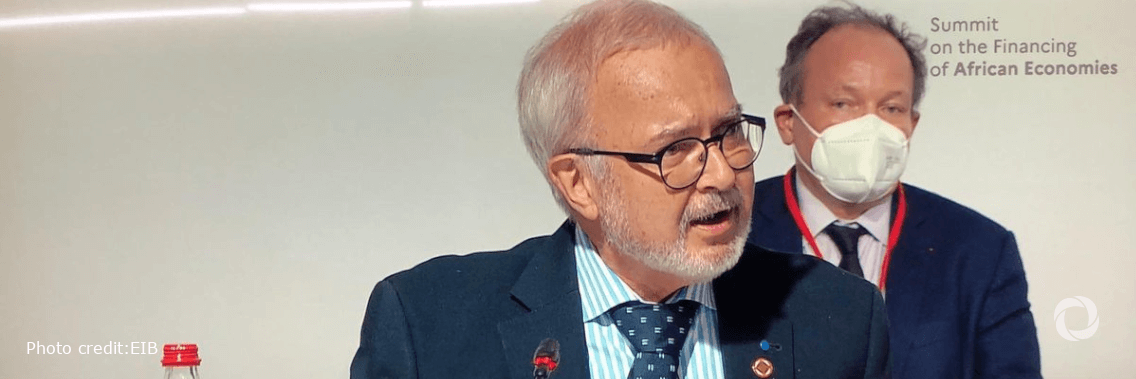
How to help Africa and allow the economic recovery of a continent that in 2020 experienced its first recession in twenty-five years, was the purpose of the summit on the financing of African economies held on May 18 in Paris with the presence of EIB President Werner Hoyer.
At the initiative of France, the summit aimed to bring concrete answers and initiatives to the financial asphyxia that threatens African countries after the Covid-19 pandemic. Inaugurated by President Emmanuel Macron who called for a “new deal for financing Africa”, it brought together some twenty African heads of state and European leaders as well as international institutions such as the IMF and the World Bank around two major topics of discussion. Financing and treatment of public debt in Africa which is rising sharply, on the one hand, strengthen the private sector and African SMEs on the second hand.
Highly visible, “Team Europe” was represented by the President of the European Commission Ursula Von der Leyen who called for “investing in young companies in Africa” and the President of the European Council Charles Michel according to whom it was necessary to change the software of Europe in Africa and to transform it to meet the current needs.
EIB President Werner Hoyer first recalled what the bank, present for 55 years in Africa, had done in 2020 to support and develop the economy of the continent. EIB provided last year a record amount of EUR 5bn of new financing to African partners. This represents an increase of 50% compared to 2019. 70% of support in Sub-Saharan Africa went to fragile states against 53% in 2019. President Hoyer emphasized the need to mobilize the private sector. Half of EIB support in 2020 went to private companies, representing 2.4 billion euros.
EIB’s current priorities for Africa concern four keywords added by Werner Hoyer: climate change, innovation, health, and gender. Europe’s climate bank is also a climate bank in Africa, where two-thirds of its activity concern projects to combat climate change. These projects are likely to promote sustainable growth and create jobs.
The second strong axis, investments must combine innovation with digital technology, explained Werner Hoyer. Reaching climate targets will only be possible with innovation and technology that we do not have found yet currently. The EIB has a long experience in this field to put at the service of Africa. Their innovation portfolio is the largest of any multilateral development bank in the world. The expertise developed inside the EU can be transferred outside the EU, argued Werner Hoyer.
He announced the launch by the EIB of a new Connectivity Toolkit to accelerate Africa’s digital transformation. The challenge is to enable the 900 million Africans out of 1.3 million inhabitants who do not have access to the Internet to benefit from digital services.
Health is another key priority at a time when the covid-19 pandemic has highlighted Africa’s clear weaknesses in local vaccine manufacturing and pharmaceutical production capacity. Europe and the EIB need to step up their support for health services, by mobilizing private and public sector investments. EIB already gets a dedicated life sciences team working on this. In a united and coordinated strategy, “Team Europe” can provide a clear value-added in health issues, explained Werner Hoyer, recalling the support of Europe to initiatives such as COVAX with a contribution that amounts to 600 million euros to date.
Werner Hoyer finally recalled the emblematic success of the program “she invests”. Starting with only EUR 150 million, the EIB has mobilized EUR 1 billion in new investments in one year to improve opportunities for women and girls. This program will be doubled to EUR 2 billion in cooperation with African partners announced Werner Hoyer. This is a crucial step to enhance women’s capacity to participate in the economy and to empower themselves.
In conclusion, the EIB president insisted that financing Africa’s debt would not be enough to enable its development and economic recovery. In many regions, there is a huge financing gap for equity investments, whether in green infrastructure or entrepreneurship. Hence the importance of promoting a market for equity investment in African SMEs as the European investment fund, the subsidiary of the European Investment Bank, has been doing for the past 20 years in Europe. This action should be massively extended to Africa. The message is clear: EIB is open to generate more business in Africa.