
Add us as your preferred source on Google to see more of our content in Search.
 Add to Preferred Sources
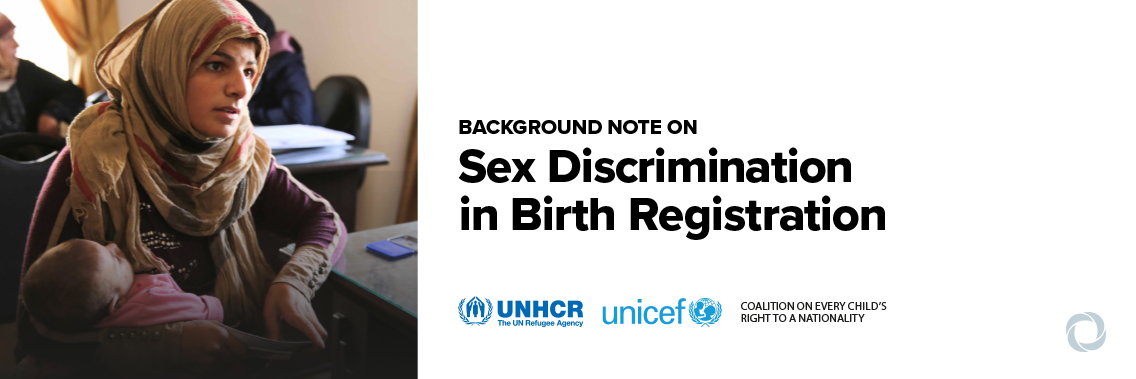
A joint report released by UNHCR, the UN Refugee Agency, and the United Nations Children’s Fund (UNICEF), shows that in many countries women can face discrimination which obstructs or hinders their ability to register births, exposing their children to the risk of becoming stateless.
The latest analysis in the report “Sex Discrimination in Birth Registration” found that such barriers may exist in legislation or cultural norms which inform birth registration practices.
In some countries, it is fathers or another male family member who are assigned the legal responsibility of registering a child’s birth and mothers can only do so in exceptional circumstances. If the father does not register the birth, the child may go unregistered.
In some settings, doctors, midwives, or tribal chiefs who attend a child’s birth are prioritized over the mother in the list of community members who have the right to register the birth.
In addition, there are countries where a mother’s legal right to register her child’s birth depends on her ability to prove that the child was born in wedlock, typically requiring a marriage certificate.
“Critical to preventing childhood statelessness is the ability of both parents to register the births of their children. Preventing women from having equal rights to do so risks leaving a child without a crucial form of legal identity and proof of entitlement to a nationality,” said Grainne O’Hara, UNHCR’s Director of International Protection.
One in four children under the age of 5 is not registered at birth, according to UNICEF data. And even when they are, they may not have proof of registration. An estimated 237 million children under five years old worldwide are currently without a birth certificate.
A birth certificate serves as evidence of a child’s eligibility for nationality by proving the country in which they were born, and by documenting the identity of their parents.
“It is critical that all children are registered at birth to ensure their health and wellbeing. Without a birth certificate, a child is at greater risk of statelessness and exclusion from essential services including health care and education. Our analysis shows clearly that governments around the world should take urgent action so that discrimination does not prevent women from registering the births of their children on an equal basis as men,” said Cornelius Williams, UNICEF Associate Director of Child Protection.
UNHCR and UNICEF’s joint analysis also showed that States as diverse as Guinea, South Sudan, Mozambique, and Nepal have taken steps to reform civil registration laws, affording equal rights to women for birth registration.