
Add us as your preferred source on Google to see more of our content in Search.
 Add to Preferred Sources
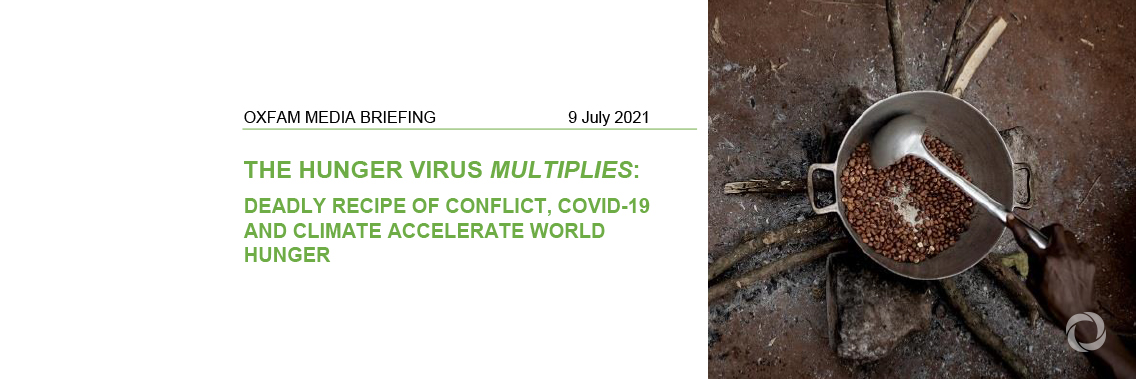
A new Oxfam report says that as many as 11 people are likely dying of hunger and malnutrition each minute. This is more than the current global death rate of COVID-19, which is around seven people per minute.
The report, ‘The Hunger Virus Multiplies’ says that conflict remains the primary cause of hunger since the pandemic, pushing over half a million people into famine-like conditions – a six-fold increase since 2020.
Overall, 155 million people around the world are now living in crisis levels of food insecurity or worse – that is 20 million more than last year. Around two out of every three of these people are going hungry primarily because their country is in war and conflict.
The report also describes the massive impact that economic shocks, particularly worsened by the coronavirus pandemic, along with the worsening climate crisis, have had in pushing tens of millions more people into hunger. Compounding these challenges, we have seen a 40 percent surge in global food prices – the highest rise in over a decade.
“Today, unrelenting conflict on top of the COVID-19 economic fallout, and a worsening climate crisis have pushed more than 520,000 people to the brink of starvation. Instead of battling the pandemic, warring parties fought each other, too often landing the last blow to millions already battered by weather disasters and economic shocks. The statistics are staggering, but we must remember that these figures are made up of individual people facing unimaginable suffering. Even one person is too many,” Oxfam America’s President and CEO Abby Maxman said.
Despite the pandemic, global military spending rose by $51 billion – enough to cover six and a half times what the UN says it needs to stop people from going hungry. Meanwhile, conflict and violence have led to the highest ever number of internal displacement, forcing 48 million people to flee their homes at the end of 2020.
Maxman continued, “Starvation continues to be used as a weapon of war, depriving civilians of food and water and impeding humanitarian relief. People can’t live safely or find food when their markets are being bombed and crops and livestock are destroyed.”
“My husband is very old to work, and I am sick. We had no choice but to send our children to ask people for food or collect leftovers from restaurants. Even the food they managed to collect was not enough,” Bahjah, a mother of eight from the Hajjah governorate in Yemen, who had to flee multiple times, told Oxfam.
Maxman said: “The pandemic has also exposed and exacerbated the deep inequality of our world. The wealth of the 10 richest people increased by $413 billion last year. This is 11 times more than what the UN says is needed for its entire global humanitarian assistance. This is a symptom of a broken system.”
Some of the world’s worst hunger hotspots, including Afghanistan, Ethiopia, South Sudan, Syria, and Yemen continue to be battered by conflict and have witnessed a surge in extreme levels of hunger since last year.
More than 350,000 people in Ethiopia’s Tigray region are experiencing famine-like conditions according to recent IPC analysis – the largest number recorded since Somalia in 2011, when a quarter-million Somalis died. More than half the population of Yemen are expected to face crisis levels of food insecurity or worse this year.
Hunger has also intensified in emerging epicenters of hunger ―middle-income countries such as India, South Africa, and Brazil― which also saw some of the sharpest rises in COVID-19 infections.
Some examples of the hunger hotspots detailed in the report include:
- Yemen: Blockades, conflict and a fuel crisis have caused staple food prices to more than double since 2016. Humanitarian aid was slashed by half, curtailing humanitarian agencies’ response and cutting food assistance for 5 million people. The number of people experiencing famine-like conditions are expected to almost triple to 47,000 by July 2021.
- South Sudan: Ten years since its independence, over 100,000 people are now facing famine-like conditions. Continued violence and flooding disrupted agriculture in the past year and forced 4.2 million people to flee their homes. Less than 20% of the $1.68 billion UN Humanitarian appeal for South Sudan has so far been funded.
- Brazil: Measures to curb the spread of the virus forced small businesses to close and over half the working Brazilians to lose their jobs. Extreme poverty nearly tripled, from 4.5% to 12.8%, and almost 20 million were pushed to hunger. The federal government secured support only to 38 million vulnerable families, leaving millions without a minimum income.
- India: Spiraling COVID-19 infections devastated public health as well as income, particularly for migrant workers and farmers, who were forced to leave their crops in the field to rot. Over 70% of people surveyed in 12 states have downgraded their diet because they could not afford to pay for food. School closures have also deprived 120 million children of their main meal.
- Sahel: Countries most torn by conflict, such as Burkina Faso, saw more than a 200 percent rise in hunger between 2019 and 2020 – from 687,000 to 2.1 million people. The worsening violence in the central Sahel and the Lake Chad Basin forced 5.3 million people to flee and fueled food inflation to a five-year high. The climate crisis worsened the situation: floods have increased by 180% since 2015, devastating crops and hitting the incomes of 1.7 million people.
Mulu Gebre, 26, who had to flee her hometown in Tigray, Ethiopia while 9 months pregnant, told Oxfam: “I came to Mekele because I heard that food and milk were offered for infants. When I arrived here, I couldn’t find food even for myself. I need food especially for my child, who is now only four months –and already born underweight.”
Maxman added: “Women, informal workers, displaced people, and other marginalized groups are hit hardest by conflict and hunger. Women and girls too often eat last and least. They face impossible choices, like having to choose between traveling to the market and risking being assaulted, or staying home and watching their families go hungry.”
“Governments must stop conflict from continuing to fuel catastrophic hunger and instead ensure aid agencies reach those in need. Donor governments must immediately and fully fund the UN’s humanitarian appeal to help save lives now. Security Council members must also hold to account all those who use hunger as a weapon of war.”
“We need the US to take a leading role in ending this hunger crisis by pushing for an end to the conflicts driving this hunger catastrophe, providing the vital funding to help save lives now, and helping communities build secure futures. We must back long-term solutions like the People’s Vaccine and social protection programs as part of a just recovery and take aggressive action to tackle the climate crisis that puts us all at risk. Even with a relatively resilient food system in the US, this climate crisis has come into stark view in recent days. As temperatures soared, once again vulnerable people who we rely on for the food on our tables paid the price. This is just another example of the devastating impacts other nations and food producers – many who have even fewer resources to cope – have seen during ongoing conflict, COVID-19 and the climate crisis.”