


Add us as your preferred source on Google to see more of our content in Search.
 Add to Preferred Sources
Last updated: October 2026 by Daniil Filipenco
When a large number of skilled and educated professionals leave their home country or territory to find work and live elsewhere, where they can benefit from higher pay and better conditions, it’s called brain drain — that is the short definition from the Cambridge Dictionary.
For a country that spent resources and trained these professional doctors, nurses, teachers, and engineers, this means a loss of their services, the taxes they would have paid, and the know-how they could have gained. But the effects of brain drain may not always be negative, which we’ll discuss later on in the article, after we dive into the causes of brain drain. We will also explore the effects it has on the source and destination countries.
Migration is an omnipresent phenomenon in human history. It refers to the movement of people from one place to another for temporary or permanent settlement and is often driven by social, economic, or personal reasons. Substantial migratory waves of educated individuals from one country within relatively short periods of time can lead to the occurrence of brain drain. The least developed and developing countries typically experience brain drain more often than developed countries as they offer lower standards of living and thus find it more difficult to retain or attract highly skilled professionals.
What is brain drain?
The concept of brain drain describes waves of substantial levels of migration of highly educated individuals from one country to another. Generally, brain drain refers to the transfer of human capital from developing to developed countries but it can also occur horizontally, relating to the migration of highly skilled professionals (such as engineers, physicians, etc.) between developed countries.
What are the numbers behind brain drain?
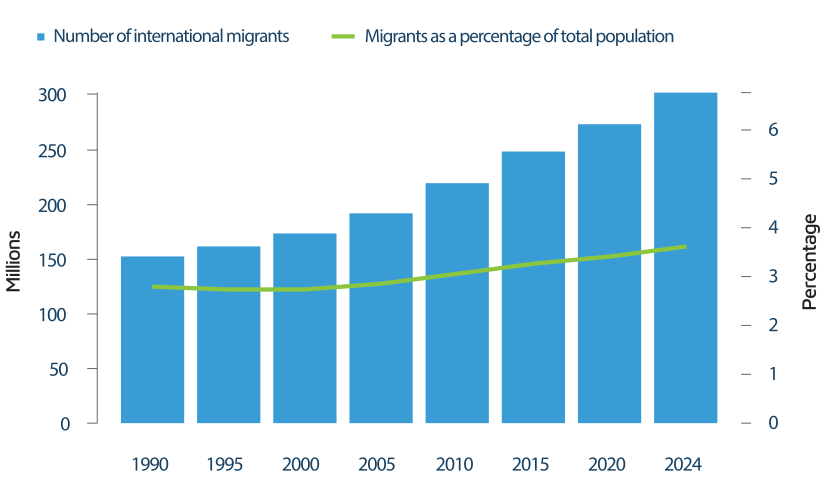
The numbers describing brain drain are large. In 2024, around 304 million people lived outside their country of birth, according to the International Migrant Stock report published by the United Nations Department of Economic and Social Affairs (UN DESA). The 2024 figure is double the 1990 figure (back then the number of international migrants around the world was 154 million).
At the same time, the report notes that despite the growth in numbers, only 3.7% of people worldwide were international migrants, a slight rise from 2.9% in 1990.
The graph below illustrates the global number of international migrants and their percentage of the global population between 1990 and 2024.
Source: UN
Causes of brain drain in developing countries
There are at least five overlapping causes of brain drain, with none of them solely responsible for the phenomenon.
1. Wide gaps in working conditions and career prospects between the home country of skilled workers and the destination country
A March 2024 survey carried out among Ghanaian doctors found that 71.8% of them intended to migrate. The top three destinations were: the United States of America (59.7%), the United Kingdom (39.1%) and Canada (34.8%).
2. Low wages
According to a survey reported by a Jamaican media outlet, The Gleaner, in February 2025, 49% of Jamaican teachers who either migrated or planned to migrate pointed to low pay as the main reason that influenced their choice.
3. Discrimination, political repression, and lack of freedom
A 2024 study in Northern Ghana discovered that nurses left the country after facing workplace discrimination and bullying. Some mentioned that even if they obtained higher qualifications and accumulated many years of experience, their opportunities (and salary) in the field were limited.
4. Natural disasters
The devastating earthquake that struck Haiti on January 12, 2010, severely damaged the country’s infrastructure and healthcare system. At the same time, it triggered the loss of skilled medical professionals, according to Haiti’s post-earthquake healthcare system study by Kligerman M, Walmer D, and Bereknyei Merrell S. The study found that many local health professionals emigrated, while others landed new jobs with international humanitarian organizations that offered much higher salaries than they earned before the disaster.
5. Conflicts
The conflict in Sudan, which led to a global-scale humanitarian crisis, has considerably accelerated the outflow of the local surgical workforce (a lot of Sudan-born doctors had already practiced abroad before the conflict, and around 30% of the roughly 3,000 medical graduates each year emigrated), according to a BMJ Global Health commentary from 2026.
Suggested reading: War-stricken Sudan needs more than humanitarian aid. Can the EU’s new financing model deliver?
Brain drain vs. brain gain vs. brain circulation vs. brain waste
When discussing the brain drain topic, readers may come across three related terms in the International Organization for Migration (IOM) glossary, as follows:
- Brain gain: the return of native-born skilled workers and the attraction of foreign-born experts.
- Brain circulation: skilled migrants moving between their origin country and other countries, carrying knowledge that can benefit both sides.
- Brain waste: the inability of migrants to use their education, skills, or professional experience in their new country to find a job matching their skill level, or any job whatsoever.
What are the effects of brain drain?
The migratory waves that have taken place in recent decades have led to dramatic changes in the global economic landscape as countries started to compete for a share of highly qualified human capital. Although the evidence suggests that developing countries suffer the most from brain drain, nonetheless the effects can be interpreted either positively or negatively according to the perspective of the source country, the receiving country, or the migrant.
 Some positive effects of brain drain
1. In education: Brain drain can stimulate education in source countries as people living there will see this as a passport to future emigration.
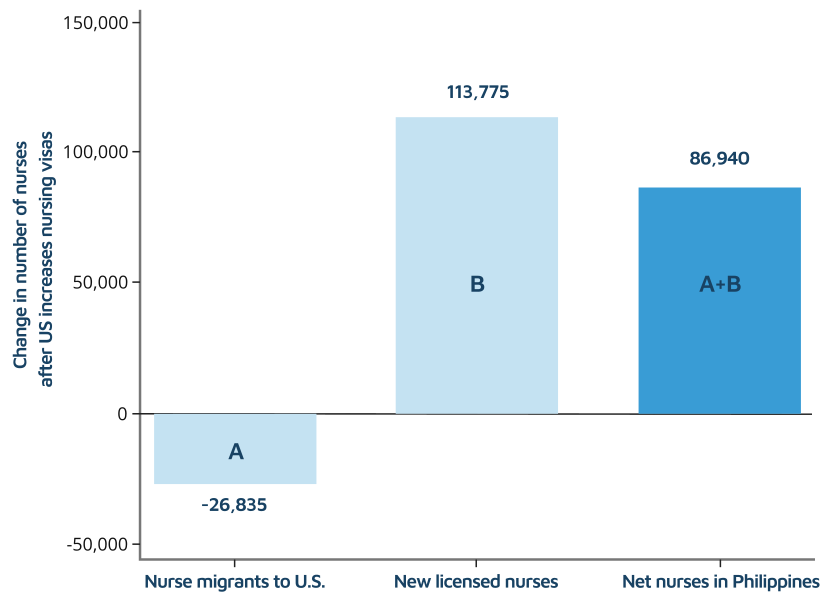
From 2000 to 2006, the United States increased the number of visas provided to Philippine nurses. This step had at least two notable traceable effects. First, 26,000 qualified nurses emigrated to the U.S.Second, the opportunity encouraged other people to train as nurses, which resulted in 113,775 new licensed nurses in the Philippines (an increase of over 86,000).
Source: World Bank
2. Economic feedback: Brain drain may lead to positive economic feedback for source countries as emigration will increase remittance flows, reduce international transaction costs, and enhance trade.
In 2025, the amount of money migrants sent home to families residing in low- and middle-income countries totaled US$728.6 billion, twice the amount registered 10 years ago, according to the UN’s International Fund for Agricultural Development (IFAD).
3. Diaspora networks: Brain drain can facilitate the development of strong diaspora networks and enhance the transfer of know-how, innovation, and technology between the destination and source countries
4. Circular migration: Brain drain can lead to circular migration, allowing the destination and home countries to share the benefits of labor mobility
 Some negative effects of brain drain
1. Lost potential: The loss of skilled and innovative individuals leads to the loss of socio-economic potential for the source countries
2. Less taxes: A loss of tax revenues for the source countries, which minimizes the potential for public spending
3. Workforce shortages in key sectors: Waves of substantial emigration can induce shortages of manpower for source countries in key sectors such as education or health.
4. Brain waste: Migrants may need to face a number of bureaucratic barriers in destination countries to be able to work in their field of expertise
Which countries are most affected by brain drain?
We included two data sets showing countries most impacted by brain drain. Each dataset has its own metric, and thus different countries are listed.
Table 1: Fragile States Index 2024 (released in 2025)
Every year, the U.S. think tank, Fund for Peace, publishes a report dubbed the Fragile States Index (FSI). The report takes into account 12 conflict risk indicators, one of which is the “Human Flight and Brain Drain” which takes into account the effects of human displacement on the economy due to political or economic reasons and how it affects the growth of a nation. The index is a risk score, and the outcomes are presented as index points from 0 to 10 – the lower the index, the better; the higher the score, the more pressure.
The average across 175 nations was 4.98 index points in 2024. The greatest value was 10 index points in Samoa (a small island country in Polynesia, Oceania), while the lowest was 0.3 index points in Australia. The metric explores the data from 2007 to 2024.
Source: TheGlobalEconomy.com
Sudan entered the top 10 list after a civil war broke out on April 15, 2023. Both Palestine and Sudan registered a 0.5-point increase in 2023-2024.
Table 2: International Migrant Stock 2024 (Top 10 countries by the number of migrants)
The table below shows data for 2024 from the United Nations (International Migrant Stock 2024: Origin).
Based on the latest available data from the United Nations Department of Economic and Social Affairs, India registered the largest migrant stock in 2024, followed by China, Mexico, Ukraine, and the Russian Federation.
A migrant (or emigrant) stock describes a country as a place of origin for international migrants globally.
Let’s examine the top three countries from the Fragile States Index (Table 1)
 Samoa
This nation topped the list in both 2023 and 2024 listings, with a score of 10.0.
The Polynesian island of Samoa is the leading nation grappling with the problem of brain drain. The acute shortage of teachers in schools has led to concerns about older students being tasked with teaching responsibilities to address the deficit.
The country’s Ministry of Education has tackled these issues by providing training and capacity-building for young teachers and increasing the number of disciplines taught by each teacher.
In 2024, Samoa’s Education Minister Seu’ula Ioane Tua’au admitted that the country faced a serious shortage of teachers.
In 2026, the results of the national exam turned out to be poor, and the Prime Minister, La’aulialemalietoa Leuatea Schmidt, said that a lot of teachers went to work overseas, and this problem can be solved if the country manages to bring in teachers from other countries.
Authorities ordered a review of the education system, according to the Pacific Media Network.
 Palestine
The country’s score increased from 8.9 to 9.4 in the FSI 2024 edition.
Prior to the conflict, young people in Palestine (recognized by 157 of the 193 UN member states as of September 2025) were pursuing educational and training opportunities abroad with the intention of returning to contribute to the economy of their homeland.
However, the escalation of the Israeli-Palestinian conflict has significantly worsened the situation, as indicated by the Fund for Peace’s report.
This exacerbation has profoundly impacted youth development and the overall situation within the country. Consequently, many young Palestinians now aspire to establish lives abroad, despite maintaining strong familial ties and a deep sense of connection to their native land.
 Jamaica
, with a score of 9.2, was placed third. Its 2022 census showed that the country is home to 2,774,538 people.
Jamaican-educated youths and highly qualified professionals opt to leave for North America and the United Kingdom which brings about significant social and economic challenges.
- In 2024, the UN’s International Organization for Migration estimated that around 1.25 million Jamaican-born people lived abroad.
- It has been estimated that the country is losing about 60% of its tertiary graduates to the United States, Canada, and the UK.
It has been observed that this loss of skills significantly impacts the nation’s education system and production sector.
- The nation is also losing teachers, who leave to find better opportunities. Between September 2024 and August 2025, 1,185 teachers quit, 332 (22%) fewer than in the previous period.
Frequently Asked Questions (FAQ)
What is brain drain?
Brain drain is a term that describes the movement of highly educated and skilled people, most often from lower-income to higher-income countries (but this process can also occur between higher-income nations, with specialists moving from one nation to another).
Based on data from the United Nations, in 2024 around 304 million people lived outside the country they were born in. In addition, data from the Organization for Economic Cooperation and Development (OECD) shows that 38% of migrants from non-OECD countries who live in one of the OECD countries had a tertiary education.
Which country has the highest rate of brain drain?
Samoa, a small island country in Polynesia, Oceania, is the country with the highest rate of brain drain. According to the Fragile States Index’s Human Flight and Brain Drain indicator, the country received a maximum pressure score of 10.0 in 2024.
If we take into account the number of people who emigrated from the country they were born in, then India tops the list with 18.5 million people, according to the United Nations (International Migrant Stock 2024: Origin).
Is brain drain always bad?
Not necessarily. Brain drain may have a positive side as well. For example, a 2025 review in Science found that emigration can benefit emigrants’ countries of origin through remittances, knowledge and skills transfers, foreign investment, and return migration.
How can developing countries reduce brain drain?
- In business: create better jobs locally, increase wages to a point at which people would prefer to remain in the country, improve working conditions, and make it easier to open a business.
- In education: invest in research and development, and give priority in university admission to students studying in fields like engineering and medicine.
- In the economy: provide incentives for skilled people to return, engage the diaspora via knowledge-sharing, and implement temporary return programs.
Read more about brain drain and its causes in a DevelopmentAid exclusive Experts’ Opinions
DevelopmentAid is the leading provider of business intelligence and recruitment tools for those active in the development sector. Join today to gain access to exclusive information on upcoming tenders and grants, potential partner organizations, short- and long-term projects for individual consultants, tender shortlisting, and awards.