
Add us as your preferred source on Google to see more of our content in Search.
 Add to Preferred Sources
The European Commission today presented the results of Special Eurobarometer survey on EU citizens’ views on development, cooperation and aid. The survey is based on fieldwork in the 28 EU Member States performed in November-December 2016.
“The latest data show that European citizens continue supporting strongly that Europe engages in partner countries to assist people in need and strengthen inclusive and sustainable development. Despite some differences, this support is strong within the entire EU. This is good news and reflects core European values,” Neven Mimica, Commissioner for International Cooperation and Development
The vast majority of EU citizens (89 %) think that it is “important to help people in developing countries”, which is the same level as in 2015. The highest level of agreement was recorded in Sweden (98 %), Cyprus and Luxembourg (97 %) and Ireland, Portugal and Spain (96 %). Even in the countries at the lower end of the spectrum, a very solid majority agreed with the statement: Bulgaria (75 %), Latvia (77 %), Estonia (78 %).
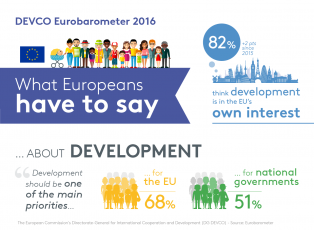
For a majority of respondents, tackling poverty in developing countries should be one of the main priorities of the EU (68 %,-1 ppt since 2015) and of their own government (51 %,+1 ppt). It can be noted that in all countries, respondents give more priority to international development at EU level than that at national level.
More than eight in ten (82 %,+ 2 ppt) believe that tackling poverty in developing countries is in the EU’s own interest. Almost eight in ten (78 %,+ 4 ppt) perceive tackling poverty in developing countries as a moral obligation, and three quarters (74%,+ 2 ppt) believe that it has a positive impact on EU citizens as well.
Seven out of ten (71 %) think that providing financial assistance to developing countries is an effective way to tackle poverty. Six out of ten (61 %) think that EU and Member State actions (development policy and financial assistance) are effective. A total of 74% of the respondEurobarometerents think that the EU and its Member States should keep the current levels financial assistance to developing countries, or that spending should be increased. Seven out of ten respondents (72%) believe that providing financial assistance to developing countries contributes to a more peaceful and fair world.
Similar changes can be seen in relation to irregular migration. While two thirds of respondents (68 %) agree that providing financial assistance to developing countries is an effective way to address irregular migration, the number has fallen by five percentage points since 2015.
When asked to define the most pressing challenges for developing countries, the most frequent issues mentioned were education, peace and security (both 38 %), health (33 %) and water and sanitation (31 %). In 2015, peace and security was perceived as the greatest challenge, followed by health and education.
The main obstacles to development are perceived to be corruption (54 %) followed by bad policies in developing countries (43 %) and conflicts (41 %). The ranking was the same in 2015.
When asked about the Sustainable Development Goals decided by the UN in 2015, almost six in ten (58 %) stated that they had not heard or read about them. Three out of ten (29 %) stated that they were aware of the goals but did not really know what they were. One out of ten (12 %) stated that they were aware of the goals and knew what they were. The proportion of those who are aware of the goals has increased by 5 percentage points since 2015.