

Add us as your preferred source on Google to see more of our content in Search.
 Add to Preferred Sources
Although the number of new coal-fired power plants has significantly decreased over the past six years, this positive trend must be maintained and even improved upon in order to phase out coal globally by 2040 and remain at the 1.5 degrees C scenario in terms of global warming.
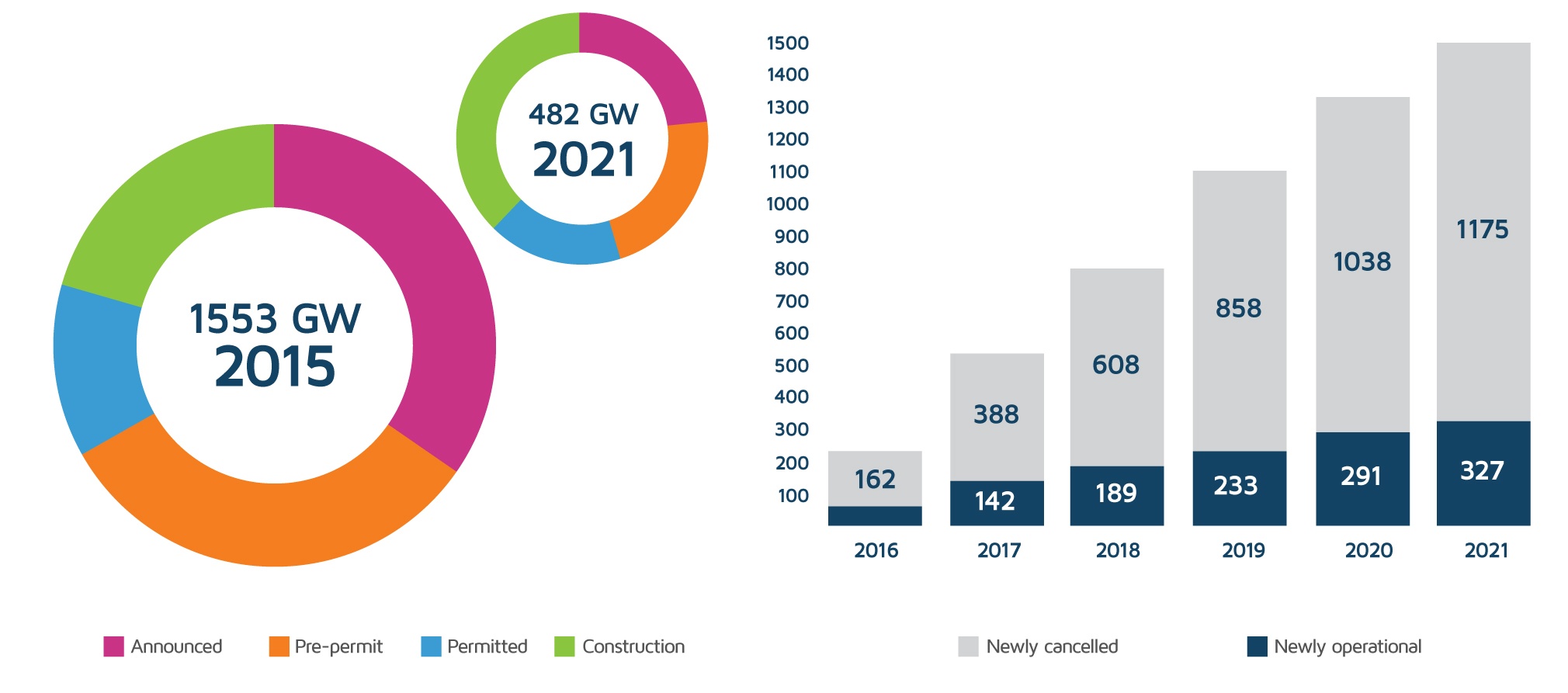
The latest report from the European climate change think-tank, E3G, shows that since the Paris Agreement was signed in 2015, the number of pre-construction coal projects has dropped by 76% globally. This clearly indicates that many countries have decided to phase out coal which is the most emissive fossil fuel.
In 2015, the world planned to construct coal-fired power capacity of 1553GW whereas today that figure stands at 482GW. Since 2015, China has cancelled the construction of coal plants with a total capacity of 484GW, non-OECD countries of 552GW, and OECD and EU countries of 139GW while the total capacity of the new coal projects that became operational within the same period is 327GW.
Fig.1. Reduction in size of the global coal project pipeline (left) and year-on-year tracking of projects that were canceled or newly operational (right)
Chris Littlecott, Associate Director at E3G, said that coal has become “increasingly uncompetitive in comparison to renewable energy, while the risk of stranded assets has increased”.
Progress is also visible in terms of the number of states that have decided not to engage in coal projects at all. Forty-four of these have joined the Powering Past Coal Alliance which is a coalition of governments, businesses, and organizations aiming to abolish coal-generated energy. Forty other countries (eight OECD and 32 non-OECD) have expressed their readiness to make a similar commitment although this is still only on paper. Thirty-six countries have ongoing coal projects or projects that are planned to start and four of these (Japan, South Korea, the United Arab Emirates, and Kazakhstan) have projects under construction but they have no other new constructions pending. Another 37 countries are still considering building new coal power plants whereas in 2015 there were 65 such states which represents a drop of 43%.
Phasing out coal is crucial to curb global warming as this fossil fuel is the single largest contributor to climate change, as well as the one that causes the most pollution. According to the UN Intergovernmental Panel on Climate Change (IPCC), in order to maintain a global temperature below 1.5 Celsius, OECD and EU countries must phase out coal by 2030 and the remaining countries by 2040. The IPCC also indicates that, in general, global coal consumption must decrease by 79% by 2030 to meet this target.