
Add us as your preferred source on Google to see more of our content in Search.
 Add to Preferred Sources
The International Federation of Red Cross and Red Crescent Societies (IFRC) is calling for urgent de-escalation of the situation at the Belarus-Poland border and for access for humanitarian organizations, to prevent more deaths.
At least 10 migrants are thought to have died as conditions reach below freezing along the 1000km border between Belarus and neighboring countries Poland, Lithuania, and Latvia.
“We are concerned about the increasingly serious situation on the Poland-Belarus border after large groups of migrants arrived there on November 8. We call for access for the Red Cross and other humanitarian organizations so that all people in need, at the border and other locations, can receive medical treatment, humanitarian assistance, and protection services,” said Andreas von Weissenberg, IFRC Europe’s head of Disasters, Climate, and Crises.
“While Belarus Red Cross has thankfully been given some access to provide vital life-saving aid to people enduring hunger and freezing conditions, we need that access to be regular and also get access on the other side of the border. People need to be treated humanely,” von Weissenberg said.
An estimated 2,000 people are living in makeshift camps near the border. Belarus Red Cross has been coordinating aid from partners since November 9, distributing food, water, blankets, and warm clothes. 50 staff and volunteers are involved in continuous response to the situation with migrants, 20 of them are involved sorting and distributing packages, as well as helping authorities set up heating tents for women and children.
Belarus Red Cross has also provided food, clothing, and hygiene kits for three children who were hospitalized in Grodno and is assisting migrants who come to its office in Minsk.
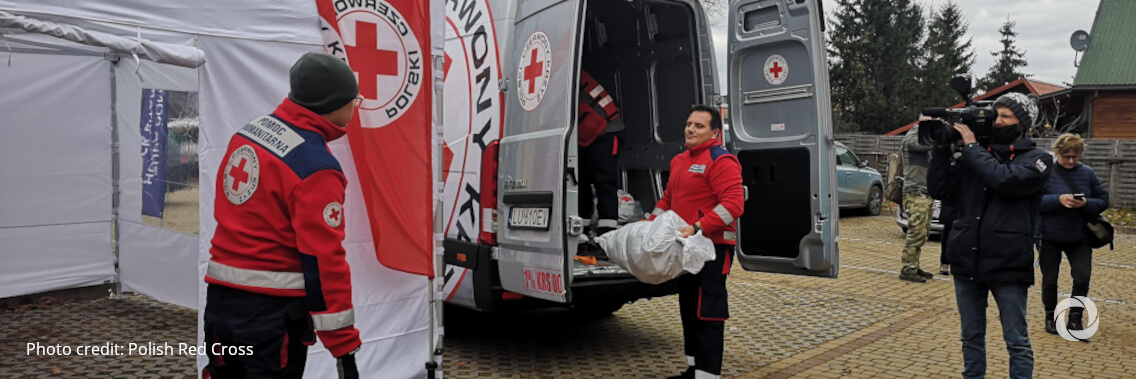
Andreas von Weissenberg said Polish Red Cross has also been responding to this crisis for several weeks.
“They are working with authorities to deliver blankets, sleeping bags, and clothes. Local branches are supporting migrants in Podlaskie and Lubelskie provinces, near the border, with food, water, and hygiene kits. They are providing first aid and helping people trace family members. But they need unhindered access to migrants at the border in line with our humanitarian mandate and in accordance with our fundamental principles.
“Access to humanitarian assistance and to protection in the territory must go hand in hand. All migrants arriving at the EU’s borders should be able to effectively apply for international protection and receive an individualized assessment of their claim, in accordance with the UN Refugee Convention and applicable EU law,” von Weissenberg explained.
IFRC is in the process of providing the Belarus Red Cross with emergency funding. It has already allocated 429,426 Swiss francs from its Disaster Relief Emergency Fund (DREF) to help Polish Red Cross support up to 4,300 migrants with food, clothes, hygiene items, first aid, and family reunification services.
IFRC has also allocated 338,885 Swiss francs from its Disaster Relief Emergency Fund to help Lithuanian Red Cross support up to 4,000 migrants with medicine, clothes, hygiene kits, personal protective equipment against COVID-19, family reunification, and psychosocial support services.
In total the financial support provided by IFRC to the three Red Cross Societies will be more than 1 million Swiss francs.
Lithuanian Red Cross teams have been supporting migrants close to the border with water, hygiene kits, footwear, and clothing, as well as toys for children. In five large reception centers, volunteers provide food and other humanitarian aid, offer psychological support and legal assistance, and help people reconnect with their loved ones by providing mobile phones and SIM cards.
“Humanitarian organizations must be granted unconditional and safe access to all people in need, irrespective of their legal status. People are crossing the border with just the clothes on their backs. They need food, medicine, hygiene items, clothing, and protective equipment against COVID-19. We must be allowed to deliver critical assistance and we want to see a peaceful, humane and rights-based solution to the situation,” von Weissenberg concluded.