

Add us as your preferred source on Google to see more of our content in Search.
 Add to Preferred Sources
One of Europe’s most experienced diplomats has said he was “shocked to the bones” by the hunger he saw in Yemen.
“Men with guns and power inside Yemen as well as in regional and international capitals are undermining every effort to avert an entirely preventable famine, as well as the collapse of health and education services for millions of children,” Jan Egeland, Current head of the Norwegian Refugee Council
In April, the World Food Programme could only afford to feed 3 million men, women and children in Yemen – a country said to be on the brink of famine – due to a lack of resources and the late arrival of food shipments. An estimated 19 million people in a country with a total population of roughly 27 million are in need of some form of aid, according to the UN. The price of basic commodities has risen by a third.
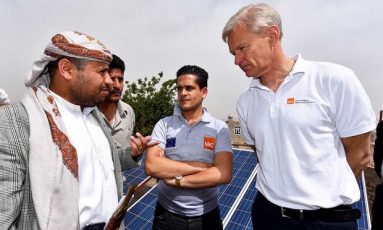 The secretary general of the Norwegian Refugee Council, Jan Egeland, speaks to people in Yemen. Photograph: NRC
“I am shocked to my bones by what I have seen and heard here in war- and hunger-stricken Yemen. The world is letting some 7 million men, women and children slowly but surely be engulfed by unprecedented famine. It is not a drought that is at fault. This preventable catastrophe is man-made from A to Z,” Jan Egeland.
The food crisis in Yemen has been made worse by the continuing conflict between the Houthi rebels who control Sana’a together with former president Ali Abdullah Saleh – who led the country from 1990 to 2012 – and forces loyal to the ousted president, Abdu Rabbu Mansour Hadi. Since March 2015, Saudi Arabia has led US-backed military intervention in Yemen aimed at reinstating Hadi, who lives in exile in Riyadh, and countering the advances of the Iran-backed Houthi forces. In May, WFP hopes to reach 6 million people who are severely food insecure, but the organisation will have to cut rations for 4 million of them by 60% in order to do so.
Source: The Guardian. Read full article here.
5 May, 2017