
Add us as your preferred source on Google to see more of our content in Search.
 Add to Preferred Sources
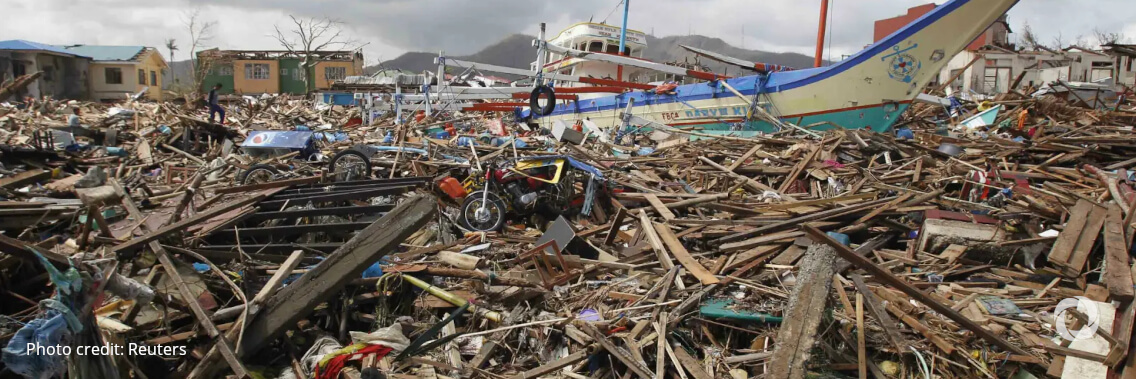
The Philippines is struggling to recover from last month’s massive Typhoon Rai that caused losses worth 11.1 billion Php ($215m) to agricultural crops and farmland and another 17.5 billion Php ($330m) damages to homes, roads, electricity, and water lines.
More than 420,000 hectares of land have been lost to storm floods, and as many as 925,000 homes damaged or destroyed. Key staple crops like rice, coconut, and sugarcane have been wiped out across some regions of the country. The Philippines’ fisheries industry has lost over three billion’s Php ($58m) worth of fishing boats, gear, and stock.
Oxfam Philippines Country Director Lot Felizco said: “our staff reported finding people begging for scraps of food in Bontoc, Padre Burgos, Tomas Opus, and Malitbog, towns that were worst hit in Southern Leyte”.
“As the rest of the world starts a new year with hope, nearly 7 million people – more than the entire population of Denmark – are struggling to come to terms with their homes damaged or destroyed and main incomes gone. Nearly 390,000 farmers and fishing folk have had their crops flattened, fishing boats smashed, or livestock killed or lost. They have been left with nothing,” said Oxfam Pilipinas Country Director Lot Felizco.
Petronilo Bohol, a fisher from Malitbog village, Southern Leyte, who had already been hit by two other storms before Rai said: “We live here because our only livelihood comes from the sea. We pulled out all the boats for safety, but the waves still reached them and reached the roads. Typhoon Rai was bigger and stronger than the two previous ones. It turned our mountains bald.“
Ramon Cabarrubias, a welder from Malitbog village, Southern Leyte, told Oxfam: “[During the storm] we crowded in our bathroom thinking that it was going to be our end. The next day, we came out to nothing. My mechanic tools are gone. Even my boat disappeared”.
Typhoon Rai was the last – and by far the strongest – of fifteen typhoons to have hit The Philippines in 2021.
Extreme weather events like Typhoon Rai are a harbinger of worse to come. Scientists have long warned that rising global temperatures, induced by a man-made climate crisis, are causing typhoons to become more intense more frequent.
Oxfam roundly criticized the last COP26 climate talks for showing an “appalling disregard“ of the financial plan needed to compensate countries, like The Philippines, for loss and damage. It has urged rich polluting countries to honor their promises not only to cut carbon emissions to avoid a catastrophic global temperature rise above 1.5C but to also stump up funding for mitigation and adaptation – and loss and damage – to poorer countries.
Climate-fueled extreme weather events, compounded by the economic fallout from COVID-19 and existing inequalities, have pushed millions of vulnerable people in the Philippines to the brink of hunger and poverty. In 2021, over 26 million people – nearly a quarter of the population – were already living under the poverty line, where families of five earn less than 12,082 Phs a month ($230 a month).
A recent survey in 2021, showed that 2.5 million Filipinos experienced involuntary hunger at least once in the three months (Jul-Sept 2021).
In the Philippines now – as local people struggle to clean up and recover their homes and livelihoods – urgent humanitarian funding is needed to provide life-saving food and water and to help people rebuild their homes, crops, and businesses. Oxfam is urgently calling for 4 million Euros to help support its part of the collective humanitarian response in the country.