
Add us as your preferred source on Google to see more of our content in Search.
 Add to Preferred Sources
Since the start of the voluntary repatriation of Chadians from Darfur on 18 December 2017, 259 households of 942 refugees have returned. The first convoy transported 98 families of 299 individuals, while the second and third respectively came with 79 households of 305 people and 82 families totaling 338 individuals. The returnees are children and women in majority.
They are the first groups of over 4,000 Chadian refugees out of some 8,000 living in Darfur who have opted to return home after over decade in the camps.
UNHCR is supporting both governments to ensure that refugees are well prepared for the return and reintegration process and that both their legal and physical protection needs are ensured. This includes proper health screening and safeguards from sexual and gender based violence and other protection risk while in transit and during reintegration.
For this first stage of the operation, three convoys have been organised transporting refugees and their belongings including their livestock and harvest from Darfur to the transit centre of Moudeina, in Chad’s eastern region of Sila.
Besides transportation, refugees are assisted with return packages which include a combination of cash and in-kind assistance, intended to help them re-establish themselves in Chad.
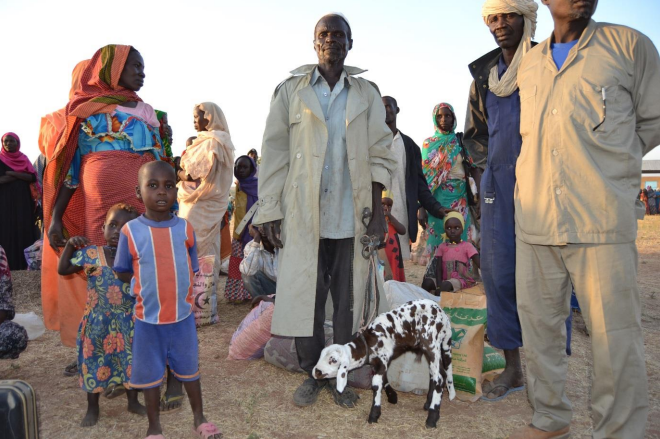
Moussa Yahya Haroun, 60, born in Moudeina. He returned home with his two wives, 16 children and their livestock in the first convoy. Photo: UNHCR
In Chad, as part of their return package, returnees received a cash grant (the equivalent of $150 per person, $180 for vulnerable), building materials per family and construction kits per group of 10 households going to the same return area.
In the transit center, beside the registration process by UNHCR and its government partner CNARR, they get hot meal provided by the ADES, a UNHCR partner, and have temporary accommodation in the transit center while they are getting their return package and moving out of the transit center. They use local transportation services including taxis, which they pay for with part of their cash grant. UNHCR will be working with the Government of Chad and other partners to monitor their situation in their return areas and to enhance service provision in the return areas. In Moudeina for example, UNHCR has funded the renovation of the local police station and the construction of a small hall for public meeting in the Sous-Prefet’s compound is being build. UNHCR is also looking to build a water point in the village if resources are available.
Each convoy is welcome by local government and traditional authorities who along with UNHCR and its partners also informed the returnees of the measures taken including the return package to facilitate their re-establishment in Chad. In Chad, UNHCR and its partner AIRD have provided transportation to returnees going to Tissi, located at about 250 km of Moudeina.
UNHCR and the Governments of Chad and Sudan will hold a cross-border meeting this month (January) to assess this first stage of the voluntary repatriation of the Chadian refugees from Darfur and accordingly plan the next convoys.
Original source and full report: UNHCR
Published on 2 January 2018