

Add us as your preferred source on Google to see more of our content in Search.
 Add to Preferred Sources
Last updated: August 2026
Wastewater (via the release of methane and nitrous oxide) is a global issue for the planet’s environment and its inhabitants. It accounts for about 1.57% of the world’s greenhouse gas emissions, nearly the same level as the aviation industry, according to the latest reports from the UN Environment Programme (UNEP). Human waste, household sewerage, and sometimes toxic and even medical waste are released directly into the planet’s ecosystems. Apparently, the majority of people realize this and are aware of the urgency to change this state of affairs, but no significant changes have happened.
Why? Perhaps one of the reasons is that polluted water is extremely difficult and expensive to clean up, or maybe installing expensive water treatment systems within industries could reduce profits?
Did you know that we could reuse about 320 billion cubic meters of wastewater annually? Today, most of this potential remains untapped. That’s over 10 times the amount of freshwater produced by the world’s desalination plants, according to UNEP.
Suggested reading: Worldwide pollution statistics
Water pollution statistics in 2026: the key numbers
- Almost half (45%) of untreated household wastewater comes from homes without a sewer connection or a septic tank (an underground, watertight container often made from concrete, plastic, or fiberglass), UN-Water reported in 2024.
- At the same time, there’s limited data on industrial wastewater treatment: experts collected it from just 22 countries, accounting for 8% of the global population. In these countries, only 38% of the industrial wastewater received treatment, and just 27% was safely treated, according to UN-Water.
- 56% of water bodies across the 120 reporting nations have good ambient water quality (as of 2023).
- Traditional wastewater treatment consumes around 3% of the world’s electricity. However, it actually carries around 5 times more energy than it takes to treat it, mostly as heat and organic matter, which is quite enough to provide electricity to around half a billion people a year, according to UNEP. For example, capture the methane instead of venting it—and you’ve got biogas.
- In 2020, around 4.4 billion of the world’s population throughout 135 low- and middle-income nations did not have access to safe drinking water. By 2023, according to UNICEF, the number of people who still lacked access to safely managed water services was 2.2 billion.
- Unsafe water that contains hazardous microorganisms can spread diarrhea and diseases such as cholera. Every year, polluted drinking water causes 505,000 diarrhea-related deaths.
- More than 251.4 million people needed schistosomiasis prevention treatment (as of 2021).
- In terms of water and sanitation, contaminated drinking water in combination with poor sanitation and hand hygiene leads to 1 million fatalities from diarrhea.
- As UN Water reports, if both water quality and the control of water bodies fail, the lives and health of 4.8 billion humans could worsen by the end of the decade.
- Around 1.7 billion people worldwide consumed water that was infected by human waste in 2022.
- About 80% of marine pollution comes from land-based sources, including waste from factories, plastic garbage, and agricultural wastewater.
- One of the greatest impacts of water pollution is that every year ocean waste kills almost a million seabirds and marine life.
What is water pollution?
Water pollution happens when hazardous chemicals and toxins contaminate water sources, seriously lowering water quality, which, in turn, harms ecosystems and human health.
Note that any physical, chemical, biological, or radioactive material in water is referred to as a “contaminant” under the Safe Drinking Water Act, according to the U.S. Environmental Protection Agency.
Various toxic substances and hazardous compounds from factories, cities and farms lead to the contamination of water bodies since they dissolve much more easily in water than in any other fluid on Earth.
Occasionally, Mother Nature poisons the water too, such as when mercury contaminates oceans, rivers and lakes after filtering out of the Earth’s crust. However, for the most part, human activity is to blame.
According to an analysis based on 625 studies collected from 63 nations, the world’s water quality has deteriorated due to the growth of urban places, and to address the issue, researchers suggest more forest cover.

Effects of water pollution on human health
There is a close connection between public health and water purity, with one of the main causes of various illnesses such as cholera, dysentery, and hepatitis being contaminated water.
Being exposed to pollutants such as microplastics and specific minerals and metals found in untreated or poorly treated water, such as lead and arsenic, causes neurological damage and can increase the chance of developing cancer, according to a study published on ScienceDirect. Furthermore, this exposure to poor-quality water can negatively impact mental health and has been associated with a higher risk of anxiety and depression.
Suggested reading: Water pollution in the Philippines
What are the six main sources of water pollution
Water quality is affected by two major categories of pollution sources:
Point sources (also called “direct”): discharges that can be identified, such as the ones from industrial facilities and sewage/wastewater treatment plants.
Non-point sources (also called “widespread”/diffuse): these come from broad areas and are more complicated to pinpoint, including agricultural runoff that contains pesticides and fertilizers.
These are the main water pollution sources and the category each one belongs to:
1️⃣ Industrial waste – (point source)
Industries seriously harm the environment by contaminating the land, the air, and the water with heavy metals and waterborne pathogens that multiply and release toxins, impacting our health and ecosystems.
Industrial facilities generate waste in the form of hazardous compounds that can:
- Lead to intoxication, immune system suppression, and fertility problems
- Influence the temperature of freshwater systems, damaging marine life
- Generate ‘dead zones’ in water (areas with insufficient oxygen to support marine life)
What makes matters worse is the lack of waste disposal infrastructure.
2️⃣ Oil pollution – (both point and non-point source)
This occurs when gasoline from parking areas and highways, as well as oil from pipelines and fracking operations (a drilling technique that helps to extract oil), enters water bodies through surface run-off.
Oil spills from tankers and drilling rigs can extend over hundreds of kilometers, covering sea surfaces, rocks, beaches, or plants with a thin layer of oil and are much more harmful than spillages on land. They have a serious impact on marine life and animals living near the shore since the thin layer of oil that may cover them can eventually kill through suffocation or poisoning.
3️⃣ Plastic pollution – (non-point source)
Annually, numerous species of marine life die after consuming plastic or becoming entangled in it.
In addition, each year lakes, rivers, and seas become polluted by 19 to 23 million tons of plastic waste that seep into aquatic environments, according to UNEP.
Research indicates that once plastic enters the ecosystem, it may take anywhere from 100 to 1,000 years for it to break down.
Moreover, global plastic waste may increase by nearly 190% by 2060 under a business-as-usual scenario, from 353 Mt in 2019 to 1,014 Mt in 2060, according to the OECD Global Plastics Outlook report.

Scientists have discovered that if plastic pollution continues and humanity does nothing to address the issue, by 2040, the amount of plastic wasted in waters each year could reach 29 million tons, as reported by National Geographic.
4️⃣ Wastewater – (point source)
Pollution occurs on a daily basis, with 14 million cubic meters (14 billion liters) of wastewater that contains human waste with bacteria and pathogens that breed disease being produced by households every day in least developed nations.
The lack of treatment infrastructure causes this to be discharged directly into the environment, harming the soil, air, and underground water.
- On a global scale, around 44% of household wastewater did not undergo proper treatment before being discharged, according to UN Water (September 2025).
- In 2022, the figure mentioned above was 42%, equivalent to around 113 billion cubic meters of household wastewater released without necessary treatment.
- Data from UN-Water’s Progress on Wastewater Treatment (SDG target 6.3) shows that 56% of all domestic wastewater went through safe treatment in 2024. As for industrial wastewater treatment around the world, there’s currently not enough data.
According to the data provided by the United Nations, out of all world regions Northern America is leading in treating domestic wastewater, followed by Oceania and Europe. The graph below shows the percentage of treated domestic wastewater by region (2024).
How much wastewater is treated (by region)
The table below shows the percentage of wastewater coming from households and the service industry that undergoes proper treatment at the source or via centralized wastewater treatment facilities prior to reaching the environment.
Northern America, Oceania and Europe are better in this regard, while Latin America and the Caribbean, Central and Southern Asia and Sub-Saharan Africa show lower figures.
Source: OurWorldinData
5️⃣ Pesticide and fertilizer run-off – (non-point source)
This is a term that describes unsafe water flowing from farmlands as a result of irrigation, rain, or melted snow. Agricultural run-off may contain pesticides or fertilizers that are applied without caution or irresponsibly by farmers. The results can be devastating, with polluted groundwater harming humans, flora, and fauna.

6️⃣ Radioactive pollution – (point source)
Radioactive waste can linger in the environment for thousands of years and cleaning this up is extremely challenging.
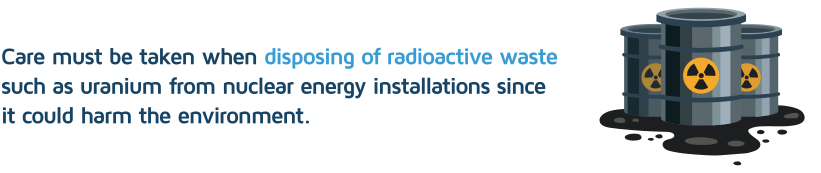
For example, in August 2023, Japan dumped advanced liquid processing system (ALPS) treated water into the ocean from the damaged Fukushima nuclear facility. The government claimed that because the wastewater had been treated, there were limited potential health concerns and damage to marine life; to ensure that water pollution has no negative consequences on the environment, careful monitoring is still necessary today.
Why access to drinking water is one of the 17 Sustainable Development Goals
According to the World Health Organization, 6 billion people (around 73% of the global population) used safely managed drinking-water services in 2022.
However, there are still around 2.2 billion people who do not have access to safely managed water services. Among these:
- 1.5 billion benefit from ‘basic services’ (i.e., they have access to a protected drinking water source within a 30-minute round trip, access to improved individual toilets in their household, and handwashing stations in the house with soap and water).
- 292 million have ‘limited’ water services (i.e., they have access to drinking water sources, but the round trip to this exceeds a 30-minute round trip).
- 296 million make use of unimproved sources (i.e., they consume water from an unprotected water source).
- 115 million obtain their drinking water directly from various surface water sources (i.e., rivers and lakes).
Those who live in poor, informal, or illegal settlements typically lack proper access to improved sources of drinking water and suffer from poor drinking water quality. However, the issue with unsafe drinking water is seen not only in developing nations – according to the Centers for Disease Control and Prevention’s (CDC) estimates, annually, drinking water germs cause illness for at least 1.1 million Americans.
Drinking water pollution is linked to the disposal of various chemicals, plastics, and pharmaceuticals into fresh, potable water sources which can cause digestive problems and more serious health issues such as cancer.
Suggested reading: Water scarcity statistics and future projections
How many tenders and jobs were posted in the WASH sector? (DevelopmentAid exclusive insights)
In 2025, DevelopmentAid, the largest database of development information in the world, registered a total of 9,966 tenders published in the water, sanitation and hygiene (WASH) Sector.
Organizations that posted those tenders are: the World Bank, the Asian Development Bank, the European Investment Bank, the European Commission Directorate-General for International Partnerships, UNDP, UNICEF, FAO, the Inter-American Development Bank, the European Bank for Reconstruction and Development, Swiss Agency for Development and Cooperation, and numerous nonprofit organizations.
In addition, there were 427 grants published in the sector by various organizations, including the European Commission, Horizon Europe, UNICEF, the Belgian Development Agency, Japan International Cooperation System, and many other organizations.
The DevelopmentAid database also hosted 2,264 jobs posted for individual consultants in the WASH sector.
How to prevent water pollution and protect the drinking water sources
Pollution control, raising awareness and educating the general public on issues related to water and the pollution of water sources is crucial. Various non-profit organizations across the world have suggested multiple measures that could help humanity to stop or at least minimize its impact on the water.
Here are some of the suggested solutions to reduce water pollution by the Solar Impulse Foundation, an environmental non-profit project established in collaboration with the Swiss Federal Institute of Technology in Lausanne.
🔹 Wastewater treatment
Since wastewater causes water pollution, it is important that there is a steady increase in the number of households whose wastewater is treated before it is released back into the natural circuit. This treatment of wastewater involves extracting contaminants using physical, chemical, or biological procedures. There are multiple small-scale solutions that can be implemented, but the major problems remain in the industrial sector and large cities.
🔹 Eco-friendly agriculture
It is important to employ energy-saving food production and effective irrigation that minimizes the need for water, as well as making use of climate-friendly crops.
🔹 Managing stormwater
Stormwater management is an attempt to limit rainwater or snowmelt runoff onto roadways, lawns, and other areas to prevent contaminants from polluting the water.
🔹 Preventing air pollution
Our oceans absorb 25% of the carbon dioxide that is mostly emitted by human activity. This is why ocean water pollution is directly impacted by air pollution and, as a result, the oceans become more acidic which also endangers coral reefs and marine life.
🔹 Reducing plastic waste
Our waters contain 80% of the plastic that comes from land sources; for example, river water pollution occurs from unauthorized landfills and illegal dumping. It is vital to reduce plastic consumption and improve plastic waste disposal and recycling.
🔹 Water conservation
It is essential to ensure that more clean water is available everywhere around the world which entails managing water wisely, treating it with care, and understanding that it is a scarce resource.
🔹 Proper disposal of hazardous waste
It’s important that you learn how to properly dispose of chemicals and hazardous materials such as paint, lawn chemicals, and vehicle fluids in your country or region
🔹 Reducing chemicals for gardening
Sustainable agriculture is key to reducing the water bodies’ pollution from pesticide and fertilizer run-offs. Farmers and smaller gardeners can become more environmentally friendly by growing native flora, seeding cover crops between rows, using no-till and mini-till methods and others.
🔹 Regular maintenance of the wastewater treatment facilities
It’s amazing how much can be achieved by regular maintenance of wastewater treatment equipment. By performing routine checks of septic tanks, households can minimize the risks of leaks and contamination of underground waters.
Final word
The numbers that describe water pollution keep changing as reporting gets better. Readers should treat what’s above as a snapshot, not a prediction of what’s coming. If you work in WASH or water-sector programming, the more useful next step is action rather than another statistic: browse current water and sanitation tenders, check active WASH grants, find implementing organizations in this space, or search for WASH jobs if you’re building a career in the sector.
Frequently Asked Questions (FAQ)
1. What are the statistics describing water pollution?
In 2024, 44% of household wastewater around the globe wasn’t treated properly before it was discharged (WHO, 2024). Over 20% of the global population (more than 1.7 billion people) used a drinking water source contaminated with feces in 2022 (WHO). Contaminated water is accountable for around 505,000 diarrheal deaths annually (WHO). From 19 to 23 million tonnes of plastic waste makes its way into aquatic ecosystems each year (UNEP).
2. What percentage of the world’s water is polluted?
It’s impossible to give concrete data, because global monitoring doesn’t cover every water body. But the closest figure available today is the one from 2024, and according to it, 44% of household wastewater is not safely treated, with just 56% of water bodies around the 120 countries that provide data showing good ambient water quality (UN-Water).
3. What are the top causes of water pollution?
The main sources are as follows: untreated sewage and wastewater, agricultural runoff (“rich” in fertilizers, pesticides, herbicides, animal waste), industrial discharge (waste, byproducts), oil spills, and plastic waste. There’s also urban stormwater that washes pollutants into rivers and oceans.
4. How much wastewater is treated globally?
55.78% of household (domestic) wastewater is safely treated (as of 2024). Industrial wastewater lags further behind, but the data for it was analyzed based on just 22 countries – 38% received some treatment, but only 27% was safely treated. Currently, there’s no reliable figure that would show us a bigger – wastewater treatment across every country.
5. How many people drink contaminated water?
The World Health Organization in 2022 estimated that the number of people who used water from a drinking water source containing feces was at least 1.7 billion.
In addition, about 4.4 billion people in 135 low- and middle-income nations could not benefit from access to clean drinking water.
Subscribe to our news digest. Stay up-to-date with the latest news and events from the international development aid sector.