
Add us as your preferred source on Google to see more of our content in Search.
 Add to Preferred Sources
The battery storage system earmarked for Hywind, the world’s first floating wind farm in Scotland, is being eyed for potential use in other future developments under a collaborative agreement announced by the project’s owners Statoil and Masdar.
Norwegian oil and gas firm Statoil and Abu Dhabi-based renewables developer Masdar, which respectively own 75 per cent and 25 per cent of Hywind, said they plan to analyse data from the ‘Batwind’ integrated battery storage system and “explore the potential for further applications and business opportunities”.
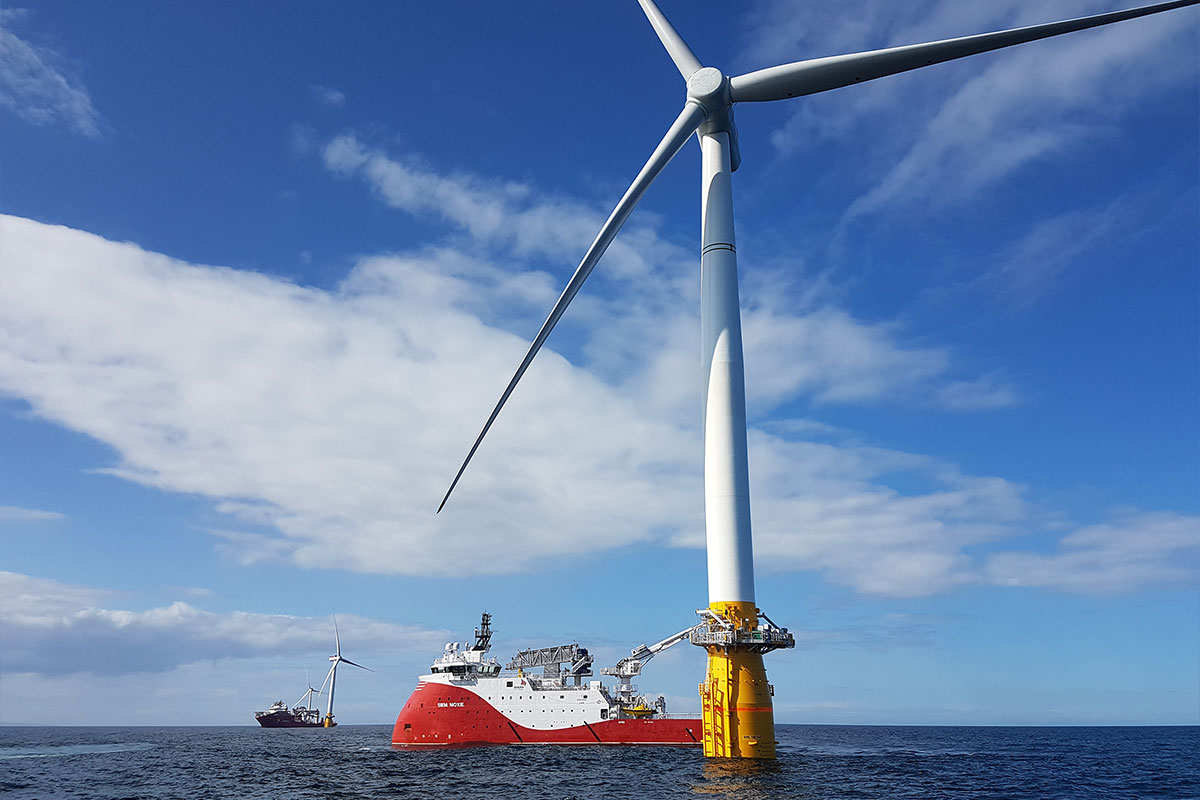
Opened last October by Scotland’s First Minister Nicola Sturgeon, the pilot 30MW Hywind project is the first to deploy turbines without fixed foundations in deeper waters where there are stronger winds, thereby enabling the 15 turbines to deliver higher yields of electricity.
Situated 25km off the coast of Aberdeenshire, the project is currently powering around 6,600 homes in the region, and the developers plan to bolster the project with the installation of a battery – dubbed Batwind – at the onshore substation to store energy generated by the turbines for use when winds are low.
Under the terms of the agreement, the two state-backed companies said they plan to purchase, test, and install Batwind to investigate how the battery storage system can be leveraged to improve the operational cost efficiency of other offshore wind farms.
Head of Hywind development in Statoil’s new energy solutions department, Sebastian Bringsværd, said storage was crucial to ensure predictable energy supply in periods without wind or sun as more renewables come on to the grid.
“Batwind has the potential to add value by mitigating periods without wind – and by that making wind a more reliable energy producer year around,” he said. “This could expand the use and market for wind and renewables in the future.”
Studying Batwind’s performance under a range of conditions will enable a “thorough exploration” of the potential integration of battery storage with wind and solar power systems, offering insight into the potential use of the technology in other locations, according to Bader Al Lamki, Masdar’s executive director for clean energy.
“This has the potential to deliver far-reaching benefits in the development of renewables as a baseload power source,” he added.
The news came as Masdar signed a separate agreement with the Argentinian province of Jujuy to explore the development of utility-scale grid solar power projects in the region, which the firm said is “home to some of the world’s highest solar irradiation levels”.
Jujuy authorities are aiming to deliver 3GW of solar power deployment in the province, which is also located in the so-called ‘lithium triangle’ in South America where large deposits of the metal are mined for use in the growing global battery market.
Announcing the agreement, Gerardo Rubén Morales, Governor of Jujuy, described the province as a “resource-rich territory”.
“All of our strength is aimed at generating the conditions to attract investment for the development of green energy clusters and technology research,” he said.
In addition, Masdar, the Australian government, and the Khalifa University of Science and Technology in Abu Dhabi today announced plans to collaborate on sea ice research and energy efficiency in Antarctica in a bid to boost scientific understanding of the effects of climate change on the polar continent.
Under the agreement, a Masdar team will next month travel to the earth’s southernmost continent to monitor energy efficiency and investigate the potential to use renewable energy at Australia’s three Antarctic research stations.
The team will also report on environmental impacts and best practices.
Moreover, the deal will boost cooperation on research missions, sabbaticals and scholar programmes between the three partners, said Masdar CEO Mohamed Jameel Al Ramahi.
“The UAE and Australia share strong ties and a deep commitment to research and clean technology,” he said. “This partnership is further evidence of the far-reaching benefits of clean technology, in the hottest regions of the world as well as its coldest.”
Original source: Business Green
Published on 17 January 2018