

Add us as your preferred source on Google to see more of our content in Search.
 Add to Preferred Sources
Development finance institutions (DFIs) display little to no transparency as to how their funds worth trillions of dollars are managed, particularly when it comes to investments in private sector operations This is the conclusion of the first-ever DFI Transparency Index compiled by the watchdog NGO Publish What You Fund.
The index looked into the operations of 30 large DFIs totaling $2 trillion in assets to assess their transparency level across five categories: core information, impact management, accountability to communities, financial information and financial intermediary sub-investments.
Main findings
The report highlighted that while the DFIs’ transparency in terms of investments in sovereign (public) operations was more or less ensured, they disclosed little to no information on the implementation and outcome of most of the private projects (non-sovereign operations) they funded.
“This report marks a moment for reckoning for DFIs and their shareholders,” said Gary Forster, the CEO of Publish What You Fund. “The mandates of DFIs require them to be transparent. However, the dearth of information raises some serious questions about the differences these DFIs are making.”
The DFI Transparency Index revealed that many DFIs do not even publish a general list of their investments, leaving stakeholders in the dark about the basic activities of development banks. They do not disclose the projects’ impact on the local community or the amount of private funds their investments managed to attract. They fail to disclose co-financers of their investments or report to the targeted community on the achievements of projects.
“$2.4 trillion needs to be mobilized each year for climate finance alone, so it’s crucial that the investments of development banks are having the desired impact, but the lack of transparency on these issues is concerning,” said Paul James, one of the authors of the report.
Scorecard
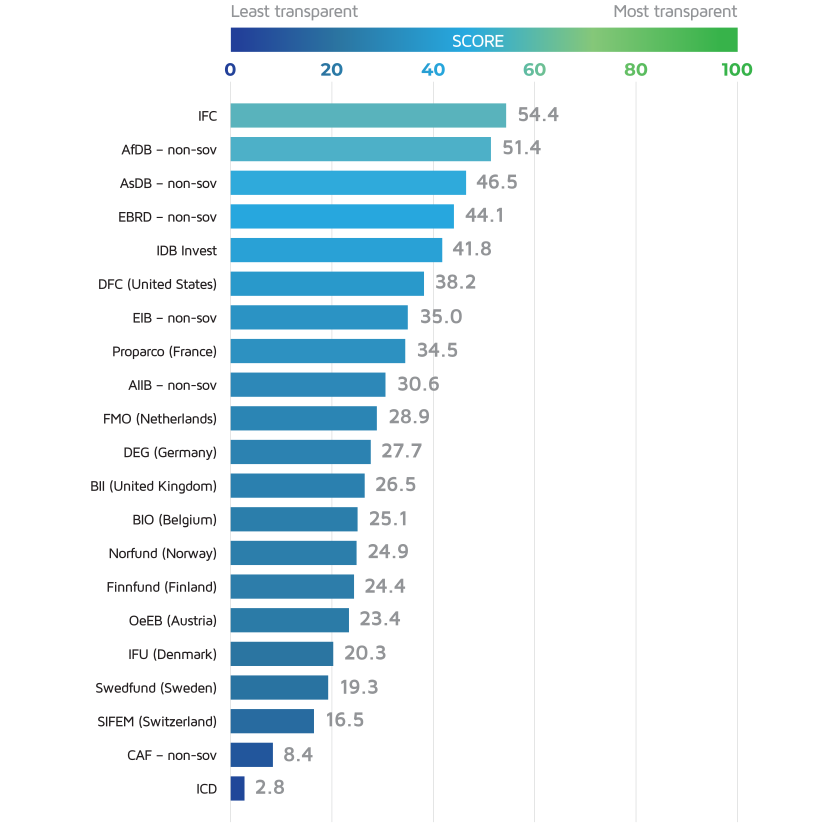
Publish What You Fund has collated its data into the operations of development banks and financial institutions to create the DFI Transparency Index which ranks the International Finance Corporation (IFC, part of the World Bank Group) as the most transparent non-sovereign (private sector) DFI, however, it received a score of just 54.4 out of 100 total possible points.
The next three top scorers in the index are the African Development Bank (non-sovereign fund), the Asian Development Bank (non-sovereign fund), and the European Bank of Reconstruction and Development (EBRD, non-sovereign fund), with scores in the low to mid-40s (out of 100 total possible points).
The DFI receiving the lowest score (2.8 out of 100) in the report was the Islamic Corporation for the Development of the Private Sector (ICD), the non-sovereign investment arm of the Islamic Development Bank (IsDB).
Fig.1. Non-sovereign DFIs
Source: DFI Transparency Index
The report’s authors noted that although the DFIs included in the index “have a long way to go in becoming transparent, they are certainly not the least transparent”. They specified that a number of large DFIs (mostly Asian and South American) with combined assets of about $3.7 trillion were not included in the report as the information disclosed made it impossible to ascertain whether they had non-sovereign or sovereign operations.
This latest report from Publish What You Fund comes on the heels of their 2022 Aid Transparency Index that revealed that even top-rated sovereign (government) development agencies and well-respected organizations such as UKAID (FCDO), JICA (Japan’s state development agency) and The Global Fund also suffer from a lack of transparency into their operations and investments.